Community Corner
LIDC: The Controversy Continues
When we left off last week, it was April of 1959 and local opposition was feeling optimistic...they were about to be very disappointed.
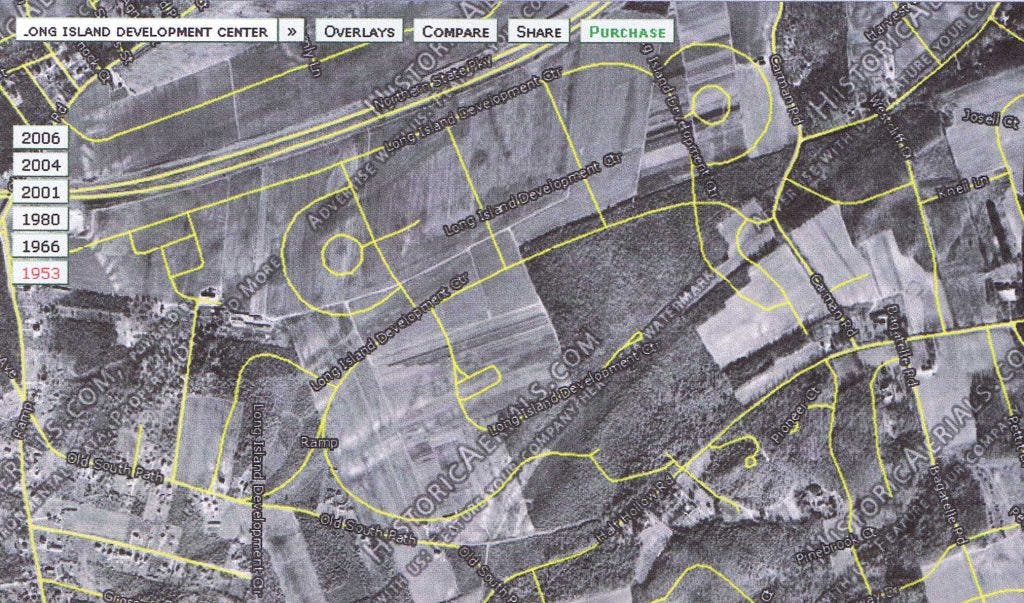

When we left off , it was April of 1959 and local opposition was feeling optimistic.
This feeling stemmed from the fact that the state promised to do a site visit of the Melville location. The hope of the local officials and civic group being that the state would then decide to reconsider and locate the School for Mentally Retarded Children elsewhere.
Then on July 23, 1959 the Long-Islander announced, “State officials on Monday confirmed the selection of the 500 acre ‘Echo Lane Site’ in Melville as the one in which it will build a $40,000,000 school for the mentally retarded. The decision…all but ends 16 months of bitter struggle by a group of 14 homeowners whose land is included in the site to have it moved.”
Find out what's happening in Half Hollow Hillsfor free with the latest updates from Patch.
The state said, “that the Melville site is the only site among the 13 studied which meet the requirements of his Department. He said the school must be accessible to visitors, near a population center where employees may be recruited and accessible to educational and medical centers.”
Despite this news, the opposition, composed of not just the homeowners mentioned but several civic association as well, demanded that the town use it influence to get the site moved.
Find out what's happening in Half Hollow Hillsfor free with the latest updates from Patch.
Then on Aug. 6, 1959 the Long-Islander announced that, “A Huntington Homeowners Protective Association has been formed in Huntington to fight the State’s decision to locate a school for the mentally retarded in Melville.”
The article goes to explain that, “the stated aim of the association is to force the State to locate the school outside the Township.” The association was formed from a core of 30 homeowners in the area, and they hoped to reach 15,000 residents by their mass meeting planned for August 23 of that same year.
In a press release they conveyed that they felt forced into this action by the state, and that they were only trying to protect their property values. And so the campaign to move the site of the school continued in full force, and a letter to the Long-Islander on file in the Town Historian’s office even accuses Gov. Nelson Rockefeller of nepotism.
So for four months the battle continued, and then on Jan. 28, 1960 the Long-Islander reported that, “Governor Rockefeller has given the State Department of Mental Hygenie a green on its plans…” This news wasn’t welcome to the residents of Huntington, and even “Supervisor Robert J. Flynn said the decision came as a complete surprise to him [as] he as been seeking to arrange a meeting between the Governor and the Town Board on the matter.”
Flynn demanded a report from the state that clearly explained what made the Melville site the only acceptable one, and likewise, why the other 13 sites were ruled out. Construction of the school was to begin as soon as possible in an attempt to alleviate overcrowding in the other schools for the mentally retarded, the governor’s office said.
Tensions continued to heighten, and by May 19, 1960 the Long-Islander reported that, “The powerful Hills Civic Association has thrown its weight behind those groups seeking to avert construction… The Association charged this week that the resident mental population in the West Suffolk area now represents 35 percent of he state mental population. Additional facilities have the potential for creating a ‘mentalslum’ here it was charged.”
The association argued other parts of the state should be asked to shoulder the burden, “for mass housings, minimum housings, multiple occupancy and exploding school population, lower tax base and law enforcement problems that can be expected as the aftermath of still another state institution here.”
The state continued to move forward with its plans and in the Nov. 30, 1961 Long-Islander it was revealed that the Assistant Commissioner in Charge of the Division of Mental Retardation for the State Department on Mental Hygiene, had confirmed the patients would not be limited to children solely, and would include all ages. He also said it would be at least three years before the school opened.
The same article concluded, “Meanwhile residents of the Hills area are preparing to go into the Supreme Court of Suffolk County on Dec. 4 to obtain a permanent injunction against the use of this particular site by the State. The case was postponed two weeks ago when the State entered a cross action to restrain the adverse litigation.”
On Feb. 22, 1962 the Long-Islander reported that the Supreme Court judge in Riverhead had denied the injunction. The state felt that because the acquisition of land was for the public welfare, then the decrease in property values as a result of the land’s acquisition was not valid.
In response to this decision the Citizens Planning Council, as the partnership of residents and civic association was now called, only declared that would seek an appeal to the decision.
“This does not mean we have lost, and we defiantly are not discontinuing out court action, commented the Council spokesperson.” They went on to describe their plans to take the case to the Appellate Division in Brooklyn, to serve papers on the Commissioner of Mental Hygiene, with the desire that construction would be halted as long the case was in court.
Interestingly, in the same article, the council makes a plea to all residents to support their Easter candy sale, with all proceeds going to cover court costs.
The state, on the other hand, planned to begin construction the following spring. Tune in next week to find out more!