Neighbor News
Broken Lamps, Old Electronics Get New Life At Huntington Repair Café
Volunteers repaired lamps, electronics and more as the traveling Long Island Repair Café nears its 10th year.


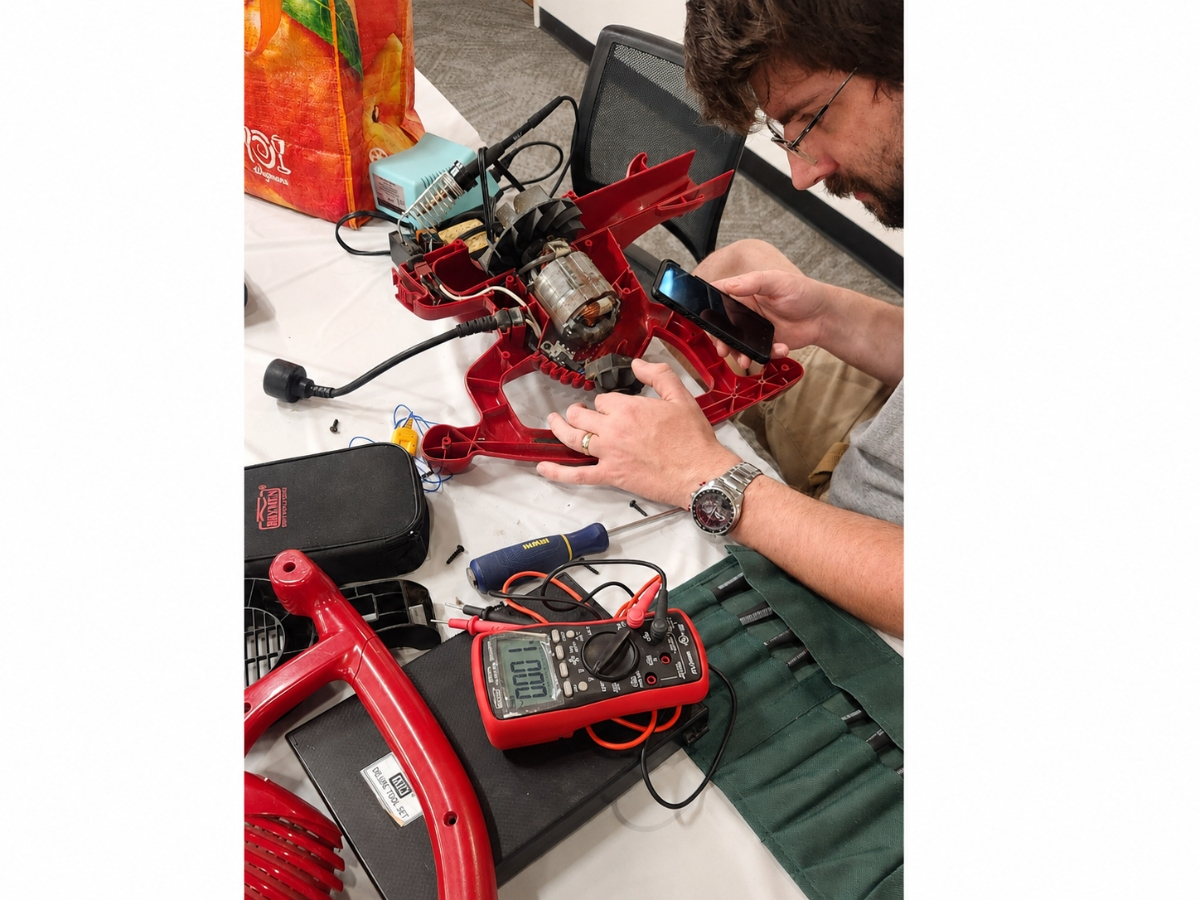
HUNTINGTON, NY — The traveling Long Island Repair Café brought its free repair program to Huntington Public Library on Aug. 8, allowing residents to have volunteers examine everything from lamps and electronics to clothing, jewelry, furniture and appliances rather than immediately replacing them.
Broken lamps, small electronics, jewelry, sewing projects and other household items arrived with their owners, many of whom hoped the objects had at least a little life left in them.
Around tables stocked with tools, replacement parts and electrical components, volunteers with backgrounds ranging from engineering to home economics worked through the problems one by one.
Find out what's happening in Huntingtonfor free with the latest updates from Patch.
Long Island Repair Café founder Lori Barber said people generally left with an answer.
“They’re very grateful that either something got fixed or they know why it can’t be,” Barber said. “But a lot of things get fixed.”
Find out what's happening in Huntingtonfor free with the latest updates from Patch.
The event came as the Long Island program approaches a milestone. Its first event was held in 2017, and organizers are now looking toward the program’s 10th anniversary in 2027.
What first attracted Barber to the Repair Café concept was the idea of fixing things rather than throwing them away.
“Just the whole idea of fixing things rather than throwing stuff away,” Barber said.
From the Netherlands to Long Island
Barber said the Repair Café movement originated in the Netherlands.
Nearly a decade ago, she attended a webinar run by the New York State Department of Environmental Conservation that included someone involved with a Repair Café in the Hudson Valley.
Barber went to the international Repair Café website and searched for something similar closer to home.
She said she found nothing on Long Island and nothing in New York City.
“So I said, ‘Okay, I’m going to do this,’” Barber recalled.
She began working with local contacts to find a place to hold an event and staged the first one in a parish hall.
That first gathering attracted media attention without Barber reaching out, she said. Once the event was covered, Patchogue Library contacted her about bringing the concept there. From there, the idea began to travel.
“Once we got into some libraries, it spread,” Barber said.
The model eventually became largely library-based, with the Repair Café moving from community to community rather than operating out of a permanent location. Barber said the growth has reached a point where she generally no longer has to solicit host sites.
“I don’t contact the libraries,” she said. “They contact me.”
The program has developed a particularly strong presence in western and central Suffolk County, while several libraries in Nassau County have organized similar efforts and occasionally receive help from Barber’s volunteers.
The Repair Café has made repeat appearances in communities across Huntington and elsewhere on Long Island. Barber said the group has visited South Huntington and Harborfields multiple times and has also worked with libraries and organizations farther west and east.
Sometimes an object means more than its price
For organizers, one of the Repair Café’s central goals is keeping repairable possessions out of landfills.
But the objects brought through the doors sometimes carry decades of memories.
Barber said some of the most memorable repairs have involved belongings with significant sentimental value. People have arrived with lamps that sat broken in closets for years because they could not bring themselves to discard them.
One man once brought in a large toy battleship he had owned as a child.
Volunteers managed to bring the old toy back to life, Barber recalled. It moved and performed functions the owner remembered from years earlier.
“He was so excited,” she said. “We get some odd things sometimes. I’d say the most common item is a lamp.”
Barber said people often appreciate learning that a needed part is no longer manufactured or that a component has simply worn beyond repair. Instead of discarding something without knowing whether it could have been saved, the owner leaves knowing someone took the time to examine it.
Asked what has been the most rewarding part of nearly a decade of Repair Café events, Barber’s answer was simple.
“Making people happy,” she said.
An all-volunteer operation
The people examining items are all volunteers.
On Saturday, roughly a dozen volunteers were on hand, with others from the group unavailable that day.
Barber pointed to volunteers who repair jewelry, sew, work with electrical devices and tackle mechanical problems. Judy, a retired home economics teacher, handles sewing and some jewelry work. Other volunteers have engineering backgrounds, while some are lifelong tinkerers who have spent years learning how things work.
One longtime volunteer is over 90, Barber said, and has missed only a handful of events.
The group needs that variety because not every volunteer can attend every Repair Café, she said. Younger volunteers may have children and work obligations, while others are retired.
Asked what she would most like to see as the Repair Café moves toward another decade, Barber immediately identified one need.
“Finding more volunteers,” she said. “We definitely need a variety of people so that not everybody has to come every time.”
Giovanni Carrera, 19, said he became involved after participating in one of Barber’s youth programs. Carrera, who attends Farmingdale State College, saw the Repair Café as an opportunity to learn more about electronics as he considers electrical engineering as a future field.
“It’s a fun experience just coming here,” Carrera said. “You can see a lot of really interesting electronics and a lot of old retro electronics that we never imagine seeing.”
The lamp table
Throughout the repair session, volunteers worked on several appliances, including one of the event’s most common patients: a lamp.
Volunteer John Rigrod explained that volunteers do not immediately tear a lamp apart. They first rule out simpler problems before examining sockets, wiring and other components.
Part of the reason lamps arrive so frequently, Rigrod said, is that homeowners may be understandably hesitant to experiment with electrical wiring themselves.
“You do it wrong, you don’t want to get a shock,” he said.
As the repair progressed, volunteers consulted one another about wiring, replacement sockets and the tools needed to finish the job.
Among the residents watching the process was Amie Chechkin, who brought in her mother’s lamp for her first Repair Café session.
Chechkin learned about the Huntington event through a local town publication listing August activities.
While volunteers worked, she learned that the Repair Café has no permanent storefront. Instead, its tools and volunteers travel from site to site.
‘We have to have people come’
Rigrod said the group can bring knowledgeable volunteers and tools into a room, but the effort depends on host libraries and other organizations promoting the events so residents actually bring in their broken possessions.
The larger purpose remains keeping repairable objects from becoming waste, but organizers also see a social benefit in the interaction between the volunteer and the owner.
A person may walk into a library carrying something that has not worked in years and walk out with it functioning again.
For Barber, that outcome has helped the Repair Café grow far beyond what she initially imagined.
“I didn’t really think of it as geographically that wide,” Barber said. “I was thinking little around my own community. But the libraries embraced it very quickly.”
Back at the lamp table, volunteers completed their work on Chechkin’s mother’s lamp.
She thanked the group and summed up her first Repair Café visit succinctly.
“Very successful,” Chechkin said.
Get more local news delivered straight to your inbox. Sign up for free Patch newsletters and alerts.