Crime & Safety
MS-13 Gang Member Coerced New Recruits, Threatened Violence: DA
"When the boys resisted, this defendant stated to them in unequivocal terms, 'This is how you end up dead in the park.'''


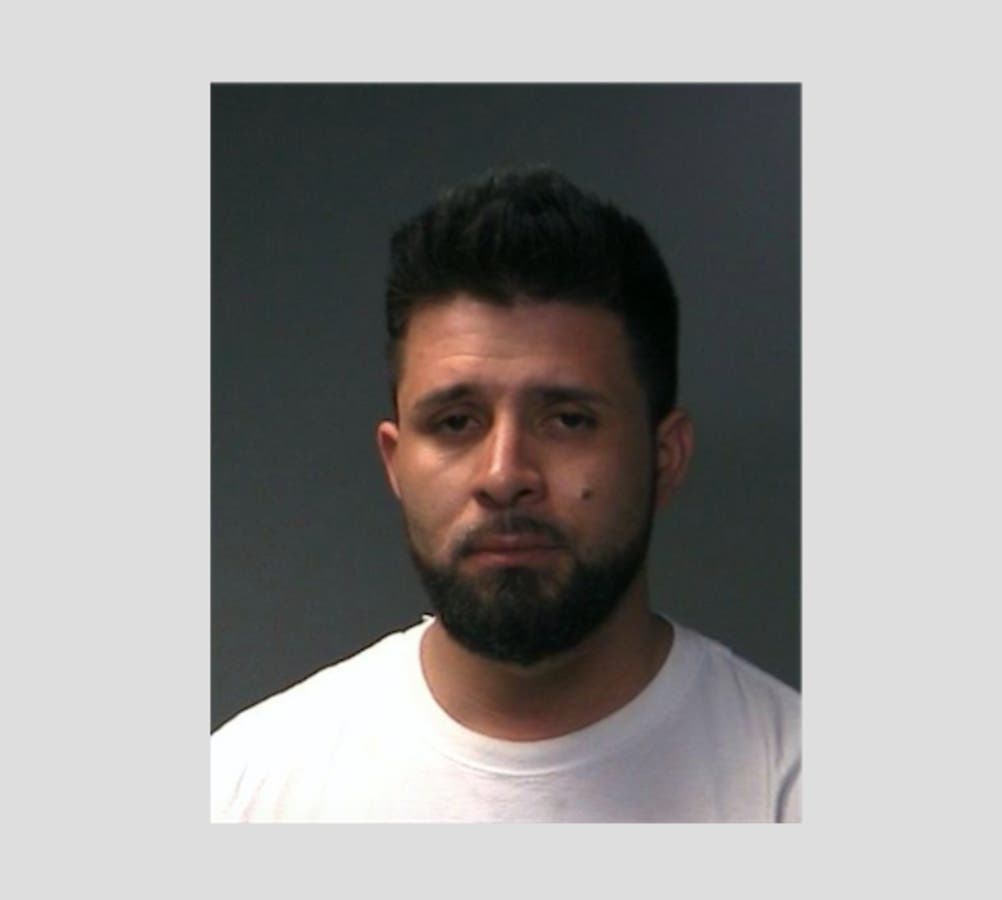
HUNTINGTON STATION, NY — The war on deadly gang infiltration in Suffolk County continued Monday as Suffolk County District Attorney Tim Sini announced the trial conviction of an MS-13 gang member who used the threat of brutal violence to attempt to recruit new members for the gang.
“The victims did not join; they did the right thing,” Sini said. “That’s why it’s critical that the Suffolk County District Attorney’s office is here to protect the victims of not only gang violence, but also of gang intimidation.”
Juan Lopez, 32, of Huntington Station, was convicted by a jury of first degree attempted coercion, a felony, Sini said.
Find out what's happening in Huntingtonfor free with the latest updates from Patch.
On April 16, 2017, at approximately 1 p.m., Lopez and several other MS-13 gang members approached two young men at Manor Field Park in Huntington Station in an attempt to recruit them to join MS-13, Sini said.
It was just five days after the murder of four young men near a park in Central Islip by alleged MS-13 gang members, Sini said.
Find out what's happening in Huntingtonfor free with the latest updates from Patch.
“When the boys resisted, this defendant stated to them in unequivocal terms, ‘This is how you end up dead in the park,’” Sini said. “My message to Mr. Lopez is: 'That’s how you end up in jail in Suffolk County.'”
Lopez was arrested by the Suffolk County Police Department on April 17, 2017.
The case was prosecuted by the Enhanced Prosecution Bureau’s gang unit, launched in January by Sini to focus exclusively on investigating and prosecuting crimes committed by gang members, such as members of MS-13.
“We are going to bring the fight against MS-13 to a whole new level, and that includes utilizing our penal law in innovative ways,” Sini said. “That includes putting an enormous amount of pressure on known MS-13 gang members.”
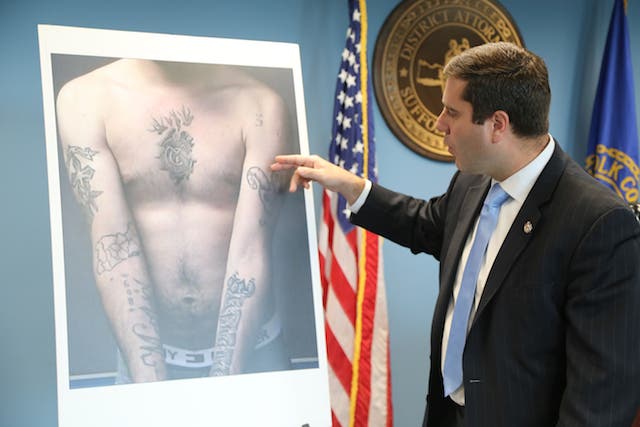
Lopez faces a maximum sentence of one and one-third to four years of incarceration.
He will be sentenced by State Supreme Court Justice Fernando Camacho at a later date.

Since his election in November, Sini has pledged to crack down on the deadly MS-13 gang.
"We will not tolerate MS-13 in our communities, and my office is implementing an extremely aggressive strategy to combat gang activity in Suffolk County," he said.
Under Sini's leadership, the Suffolk County District Attorney's Office has been reorganized to include the designated gang unit within the newly-restructured enhanced prosecution bureau; that unit will focus exclusively on investigating and prosecuting gang members in Suffolk County, the release from Sini's office said.
The gang unit will work target gang members, coordinate efforts and intelligence with all gang-assigned law enforcement units in the region, and work to host prevention and intervention programs in the community.
While serving as commissioner of the Suffolk County Police Department, Sini launched a multi-pronged strategy to eradicate MS-13 from Suffolk County, which included collaborative efforts to collect intelligence on gang members and share intelligence with partnering law enforcement agencies, enhanced and targeted police presence and patrols in affected areas, and significant investments in gang prevention and intervention strategies, he said.
Efforts have resulted in more than 300 arrests of MS-13 gang members since September, 2016, Sini said in January.
Spotlight on deadly MS-13 in Suffolk County
Days after the gruesome discovery of four bodies in Central Islip on Long Island — the four young men are believed to have been victims of the deadly MS-13 street gang — the national and international spotlight has been on Suffolk County as lawmakers, educators and a horrified public try to shine a light on MS-13 and seek answers on how to stem the tide of escalating violence.
The vicious murders have shocked a nation, with President Donald Trump speaking in Brentwood in July, 2017 about the insidious MS-13 gang that's been terrorizing local communities across Long Island in the county.
And in his speech, he promised to rid the gang-ravaged communities of Long Island of the "animals" on their streets.
MS-13 gang member, Trump said, are brutally violent. "They don't like shooting people because it's too quick, it's too fast," he said. Instead, they "knife them, cut them, let them die slowly because it's more painful. These guys are animals."
Long Island has been hit hard, with 17 "beautiful young lives" murdered since Jan. 16 on Long Island alone by July, 2017, he said.
"They butchered those little girls. They kidnap. They extort. They rape and they rob. They prey on children. They shouldn't be here," Trump said.
MS-13 beats with victims with clubs, slashes them with knives and machetes, he said.
"They have transformed peaceful parks and beautiful, quiet neighborhoods into blood-stained killing fields. They're animals," Trump said.
Putting the brakes on gang activity before recruitment
In an effort to amp up efforts to tackle escalating gang violence and fight back against potential gang recruitment in schools, Gov. Andrew Cuomo announced the deployment of a new gang violence prevention unit, targeting 10 high-risk schools in Suffolk County in September, 2017.
The gang violence prevention unit consists of 10 New York State troopers, deployed to the "high-risk" schools that serve as "ground zero" for gang recruitment and activity, Cuomo said.
The 10 schools are reportedly in six targeted districts: Brentwood, Central Islip, Huntington, Longwood, South Country Central and Wyandanch.
The goal, the governor said, is to put the brakes on deadly gang activity before young people even get recruited; the troopers will also seek to identify early warning signs of any potential gang activity in schools.
At least one school district wasn't happy about the plan.
"At no point did any state official or otherwise reach out and ask what we need or don't need," Huntington School District Superintendent James Polansky wrote in a letter to members of the school district.
The gang violence prevention unit was organized to coordinate with the Suffolk County Police Department to launch an "Educate the Educators" program, which will help teachers and faculty recognize the early warning signs of gang involvement and recruitment, a release from Cuomo's office said.
In addition, State Police will roll out a gang awareness curriculum directly to students to teach them about the dangers of gangs and foster a relationship between students and police, Cuomo said.
Cuomo made the announcement on the one year-anniversary of the horrific murders of high-school students Nisa Mickens and Kayla Cuevas by MS-13.
The new initiative follows earlier initiatives by Cuomo to expand access to state intelligence and law enforcement assets in the fight against MS-13.
In April, 2017, the governor launched expanded patrols in Brentwood and Central Islip, providing an additional 25 state troopers and added six investigators to the FBI-led Long Island Gang Task Force.
"Our number one job in government is to keep all New Yorkers, and especially our children, safe. By partnering with our schools, we will be better prepared to stop gang activity before it starts and end this heinous cycle of violence," Cuomo said. "This is just one step in our ongoing efforts to eradicate the threat of MS-13 and ensure that every student remains on the path to a bright future."
MS-13's insidious spread
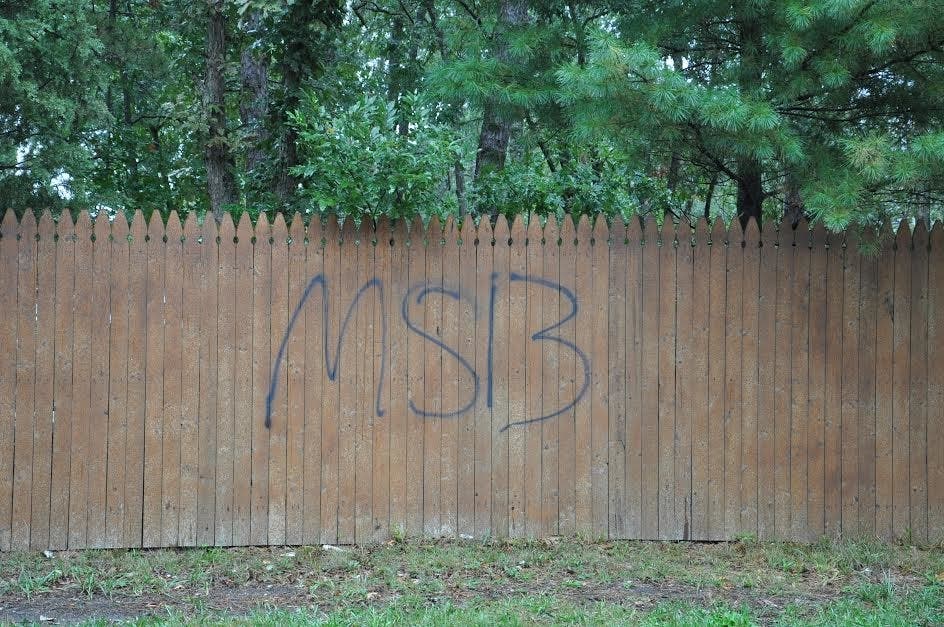
MS-13, which was formed in Los Angeles in the 1980s by immigrants fleeing El Salvador's civil war, is known for its brutal violence, including machete attacks and home invasions.
But for all the public outcry, for those directly impacted by the quadruple homicide in Central Islip, the heartbreak is deeply personal.
One former MS-13 member's story
Trying to illuminate the dark reality of an MS-13 member's life, *Elmer — his real name was withheld to protect his identity — a former MS-13 member who was able to escape the gang's tentacles and is now a member of Council for Unity, shared his story with Patch.
Council for Unity is a non-profit organization based in Brooklyn that works with schools and jails to help gang members find a new path and self-empowerment through education and lessons in "leadership, self-expression, mediation, conflict resolution and advocacy," according to the group's website.
Telling his story, Elmer said: "I joined the MS-13 gang right after my mom died. I was 8-years-old. The gang was, for me, a new life, a new family."
After an initiation when he was jumped, Elmer said, "They showed me everything I needed to know and then I started a new life by busting gangs, robbing, beating our enemies, doing any type of drugs every day, every night, shooting people, drinking every day."
When he was 13, Elmer said he was shot three times and almost lost his leg. "I've been shot, stabbed almost to the point of dying and still didn't come to my senses. I spent my young life mostly in jail because of the violent and criminal things that I did. I lost two of my best friends when I was 15," he said.
And then came Council for Unity, he said.
"God gave me a second chance," Elmer said. "The Council for Unity helped me to stay away from gangs, showed me the other way of life, the other way to live without being a gang member, showed me love, the love I was looking for, the support and real brothers and sisters that I didn't have, a family to trust, a family to talk to. Council for Unity saved my life."
Elmer said he made the decision to leave the gang because he was tired of "seeing young people on the street getting killed every day. I was tired of funerals. Tired of watching kids join gangs, doing drugs in their early age. I decide to change when I saw two friends get hit with a straight bullet . . I've made too many mothers cry. I refuse to let another tear be shed because of me."
Today, Elmer is working, has a family and a new life.
"Getting out of a gang is hard," he admitted. "You might be beaten or killed. You think being in a gang is cool? You're wrong. All it's going to do is bring is problems to your life. If knowing gang life was so surrounded by death, I don't know how anyone could want to get into a gang. The way out is not by the guns and violence — it is by using our minds."
How did they get here? Guardian Angels founder Curtis Sliwa outlines MS-13's migration to Long Island
The recent murders have put the insidious gang violence on Long Island on the international canvas, with the world watching and wondering how such gruesome violence has come to infiltrate sleepy, suburban communities.
Curtis Sliwa, founder of the Guardian Angels, a non-profit volunteer safety patrol organization whose members are known for their trademark red berets, spoke to Patch about the path MS-13 has taken to Long Island.
"There was a very violent civil war in El Salvador from 1980 to 1992. In 12 years 75,000 people were killed. It created a refugee crisis and many El Salvadorians fled North to Los Angeles. They settled in Mexican neighborhoods and immediately were preyed upon by the largest Los Angeles street gang, the 18th Street gang, which got started in Los Angeles in 1965," he said.
"In order to protect themselves from the 18th Street gang, the El Salvadorians formed MS-13 and started to defend their turf. And even though they were outnumbered they proved to be durable and extremely vicious," he said.
The "Mexican Mafia," which controlled the Latinos in the California prison system, had MS-13 join their ranks, Sliwa said.
"This larger group was referred to as the Surenos. That's why, to this day, MS-13 is sometimes referred to as SUR-13. But their enemy continued to be 18th Street gang — and that is similar to what exists presently in Nassau and Suffolk Counties. It is MS-13 vs. 18th Street. MS-13, with this newfound strength had more protection in the barrios and prisons of Southern California," he said.
Next, Sliwa said, as El Salvadorians migrated east, looking for work, they landed in large numbers, first in Fairfax County, Va,. which is right outside of Washington, D.C.
"They then followed the trail up into Nassau and Suffolk counties, where there was a lot of day laborer work," he said. "In the early 90s they embedded themselves into Fairfax County and in the late 90s they began to spread into Long Island. Along the way, MS-13 started to recruit Guatemalans and Hondurans who were also being picked on by the Mexican 18th Street gang."
"MS-13 uses the machete as a weapon of terror. They will slash their victims, slice off fingers and limbs and on occasion, behead their intended targets."
The machete is a hallmark of bloody MS-13 crime, Sliwa said. "The weapon of choice for MS-13 is the machete, which can be homemade in metal shops or garages," he said. "Unlike other gangs, which prefer guns, Ms-13 uses the machete as a weapon of terror. They will slash their victims, slice off fingers and limbs and on occasion, behead their intended targets. It is done to silence any potential snitches. Since their main form of getting money is to shake down and extort their own community, the machete spreads fear to those who are being extorted."
The machete, he added, is also a weapon that is used to do field work and gardening and can easily be transported around to do work. "But its secondary purpose is to spread fear," Sliwa said.
Life in the MS-13 gang
Sliwa said those who join or affiliate themselves with MS-13 have been initiated into, or joined, a "para military group with a strong code of internal discipline. To slight, diss or repudiate your membership in MS-13 means that you are to be disciplined. There are weekly meetings and dues that are to be paid. To ignore these responsibilities of being a member of MS-13 will earn you a brutal beatdown. MS-13 is paranoid about those who are perceived to be snitches," he said.
Gang members have "nothing to lose"
Robert DeSena, president and founder of Council for Unity, said many who want to join MS-13 are beaten as a form of initiation. "They have different modes of assault. They're ruthless. They're violent and come from an extremely violent county."
For many MS-13 gang members recruited young, whose agendas include unspeakable acts of brutality, DeSena said. Gang members come from El Salvador, an "intense" link, he said. "If they get deported, they will be killed. They have nothing to lose," he said. "Trying to infiltrate them? It's easier to infiltrate the mob."
Unaccompanied minors and gang activity on Long Island
According to Suffolk County Sheriff's Office Chief of Staff Michael Sharkey, with amped up enforcement efforts, gang members are now trying to become less identifiable.
"A lot of gangs are trying to blend in," Sharkey said. "They used to have noticeable tattoos, but that's now seen as counterproductive to their carrying on their gang business."
In a 2017 interview with Patch, Sgt. Steve Lundquist, an investigator for the Suffolk County Sheriff's Office gang intelligence unit, said specifics of the Central Islip murder investigation could not be discussed due to the ongoing case.
But he said the murders "have put a spotlight" on gang activity on Long Island. "And rightfully so. Once it's young kids, getting killed, young girls getting killed, it really gets people's attention."
Discussing MS-13's presence in Brentwood and Central Islip, Lundquist said the demographics of the area have changed, with communities "inundated" with individuals of Central American descent. "Not to say they're bad people, but when a new group does come in, sometimes they are the minority in that area, and gangs form for protection. After awhile, when the area changes, their population increases and they become the dominant group in that area."
MS-13, he agreed, became a presence on Long Island in the late 90s, "but not with the numbers we have now."
Today, Lundquist said, families have grown and brought new family members to the area. "A lot of people from El Salvador have heard about Brentwood, so they flock there," he said.
Unaccompanied minors in the area have been linked to gang activity, Lundquist said.
"Because they are unaccompanied, they are looking for a place to live, looking for food, looking for people that will take care of them," he said. "The gang is very attractive, to help them out, give them a place to live, feed them. That's one of the ways to recruit them, to become members of a gang — they have no place else to turn sometimes."
Many unaccompanied minors, he said, come from areas of El Salvador where MS-13 "runs a lot of the country." Some are already MS-13 members when they arrive in the United States, or have grown up with MS-13 family members. "They don't know anything different," he said.
Recruitment happening wherever kids congregate
Recruitment, Lundquist said, is happening in schools, streets, anyplace where people openly congregate, with most kids initiated between 12 and 15-years-old. "If they're going to recruit them, they get them when they're young and impressionable and don't know better," he said.
Some kids who resist recruitment could be killed, Lundquist said, because MS-13 gangs are afraid those potential recruits will be scooped up by the rival 18th Street gang.
MS-13 violence, he agreed, is marked by deadly machete use and for violent robberies and home invasions, with less of an emphasis on drug dealing, which is seen more with Latin Kings, Bloods and Crips.
Rep. Peter King, R-Seaford, agreed that a federal program that allows unaccompanied minors to cross the border is a critical issue; he said he's had extensive conversations with Sini — and of the MS-13 arrests made, more than 50 to 70 percent were unaccompanied minors, King said. There are more than 4,000 unaccompanied minors in Suffolk County, King told Patch in 2017.
Unaccompanied minors who come to the United States Department of Health and Human Services, are placed with families "that have been threatened by MS-13 or paid by MS-13," King said. It's believed, King said, "that MS-13 is gaming or using the system" to get young people placed with Suffolk County families and subsequently, bolster MS-13 ranks.
HHS, he said, "is not a law enforcement organization," and therefore, there is "a question of how extensive their investigation is or how equipped they are to do an investigation."
King said there is definite pressure for kids to join gangs, with the threat of violence for those who won't join.
"Police have told me that kids who don't join get beat up pretty badly, there's definite pressure — a definite risk of being killed," he said.
A brighter future
Looking forward, Lundquist said, the way to stem gang violence is through outreach.
"Kids need to have better options, better family support, better community support," he said. "Keep them busy playing sports and doing things, not in the streets."
MS-13 coverage on Patch:
- MS-13: An Inside Look At The Brutal Gang And Its Insidious Spread On Long Island
- Crackdown Nets 39 MS-13 Arrests In 30 Days
- AG Jeff Sessions Warns Deadly MS-13: 'We Are Targeting You'
- 3 MS-13 Gang Members Reportedly Charged In Brutal Quadruple Homicide In Central Islip
- Feds ID Alleged MS-13 Gang Members Charged In Dozen Long Island Murders
- Guardian Angels Founder Curtis Sliwa Offers Plan To Rein In MS-13
- War Against MS-13 Rages On, Police Chief Discusses Concerns
- Watch Live: Suffolk Police Commissioner Tim Sini Testifying Before Congress On Deadly MS-13 Gang
- 'We Are At War:' Dozens Of MS-13 Gang Members Arrested, Indicted
Video courtesy Fully Involved Media Group
Photos courtesy Suffolk County District Attorney Tim Sini's office.
Get more local news delivered straight to your inbox. Sign up for free Patch newsletters and alerts.