Politics & Government
County Gives Last Demonstration on New Voting Machines Before Primary Day
New Yorkers will be voting on new voting machines on Tuesday. The County Board of Elections is giving demonstrations all over Westchester of the new electronic voting technology.
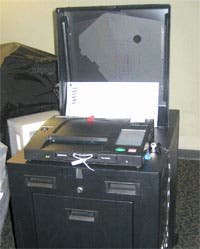


Officials from the Westchester County Board of Elections gave a demonstration of the state's new electronic voting machines at the County Center in White Plains last Thursday.
About 50 people showed up for the presentation, which came just days before Tuesday's primary elections—the first big test of the new machines in New York.
The state is the last in the country to implement new voting technology mandated by the 2002 Help America Vote Act (HAVA), a federal law passed in the aftermath of the 2000 presidential election scandal. The law's stated intent is to allow greater access to the polls for disabled and bilingual voters, but the effect has been a complete overhaul of the country's election systems.
While some critics have raised red flags about the security of the machines and others are predicting mass confusion at the polls, county officials stressed the simplicity of the technology and said they were confident that the transition to the new machines would be smooth.
"We want to dispel the rumors that this is a complicated system," said Paula Redd-Zeman who, as the Board's director of technical services, is in charge of rolling out the new machines.
"We have been traveling the county, from the Hudson River to the Sound Shore, and the consensus is, 'that's all there is?'"
The machines, called optical scanners, are essentially filing cabinets with a computer on top. Voters feed hand-marked ballots into the machines, which take about 15 seconds to scan the ballots. The ballot is either accepted or returned to the voter with one of three possible error messages.
An 'overvote' occurs when more than one candidate is chosen in a single race. In that case, voters can take the ballot back to a poll worker and get a blank ballot. A 'blank ballot' message is displayed when no choices are made. And a 'misread ballot' message indicates that the ballot is torn or folded.
Redd-Zeman stressed that one of the advantages of the new system over the old lever machines is the opportunity for voters to fix any mistakes they may make. A voter can receive up to three blank ballots during her visit to the polls, with any discarded ballots secured in a locked canvas bag.
"Before, [with the lever machines], once you opened that curtain you were done. I've seen people open the curtain to ask a question, but the vote has already been cast," she said. "Now you've got three bites at the apple."
Officials have also touted the fact that the hand-marked ballots provide a paper trail and will allow manual recounts if there are issues with the computer system.
Find out what's happening in Larchmont-Mamaroneckfor free with the latest updates from Patch.
Polling stations will look a bit different this year, too. Each district will have a table, called a 'privacy booth', with a three-foot wall on top that divides the table into four partitions where voters will mark the ballots. The special pens will be tethered to the station.
While many of those who attended the demonstration on Thursday expressed concern over the new system's security, most seemed pleased after using the machines.
"I like it. It may have a few bugs right now, but it's fast," said Joyce Moore of Mt. Vernon. "I could see there being a lot of traffic [at the polls this year] because it's a new system."
Marc from Greenburgh, who did not give his last name, agreed that the machines are easy to use but expressed some concern about the ability to manually recount the ballots.
"If someone hacks [into the machine] and changes the numbers, how are [poll workers] going to know for sure," he said. "I'm a little uneasy about this all being done on a computer, which is vulnerable."
Few officials have said they are concerned about the system's security, but several are predicting confusion at the polls. Assemblyman Richard Brodsky, D-Greenburgh, held a press conference in Manhattan last week to raise a number of concerns about the machines. He warned of a "looming disaster" on primary day, when he will be one of five Democratic candidates on the ballot for attorney general.
"However well-intentioned, the transition to computerized voting, recent budget cuts, technical issues and other errors of policy and judgment are likely to cause significant voter disenfranchisement," Brodsky said.
His main concerns are the smaller size of the print on new ballots and the lack of interpreters to aid non-English speakers in navigating the new technology.
Redd-Zeman said she has heard few complaints about the size of the print, even as seniors have been attending the demonstrations in large numbers. Of the language issue, she said that people who don't speak English "already know that language is an issue and they know to show up [to the polls] with an interpreter." The ballots are printed in English and Spanish.
But even some poll workers are skeptical about the transition being smooth. William Joseph Reynolds of Ossining, who has 31 years of experience as an election inspector, predicted "chaos" after attending a recent training session.
"After observing this meeting, which had some elements related to the new machines, I can anticipate that there will be sheer bedlam; many of the inspectors are panicking," said Reynolds, who was not at the demonstration on Thursday.
He added that a number of older poll workers seemed "intimidated by the new machines."
Redd-Zeman said the county is in the process of hiring more poll workers than usual, and is expecting to have 6,500 workers on hand during the general election in November. The county has purchased 1,000 machines at a cost of $12,000 a piece.
Find out what's happening in Larchmont-Mamaroneckfor free with the latest updates from Patch.
Area residents will have four more chances to try out the new machines before the November general election. Officials will be at the County Center Oct. 3 from 1 to 3 p.m.; at the Kessel Student Center at Pace University on Oct. 4 from 6:30 to 8:30 p.m.; and at the Rye Town Court House on Sept. 29 and Oct. 6 from 7 to 9 p.m. Voters unable to attend the demonstrations can visit the county's website to download a Power Point of the presentations.