Neighbor News
A Labor of Love . . . Finally Able to Help Refugees
St. John's Church Hosts Furniture Drive for Connecticut Refugees
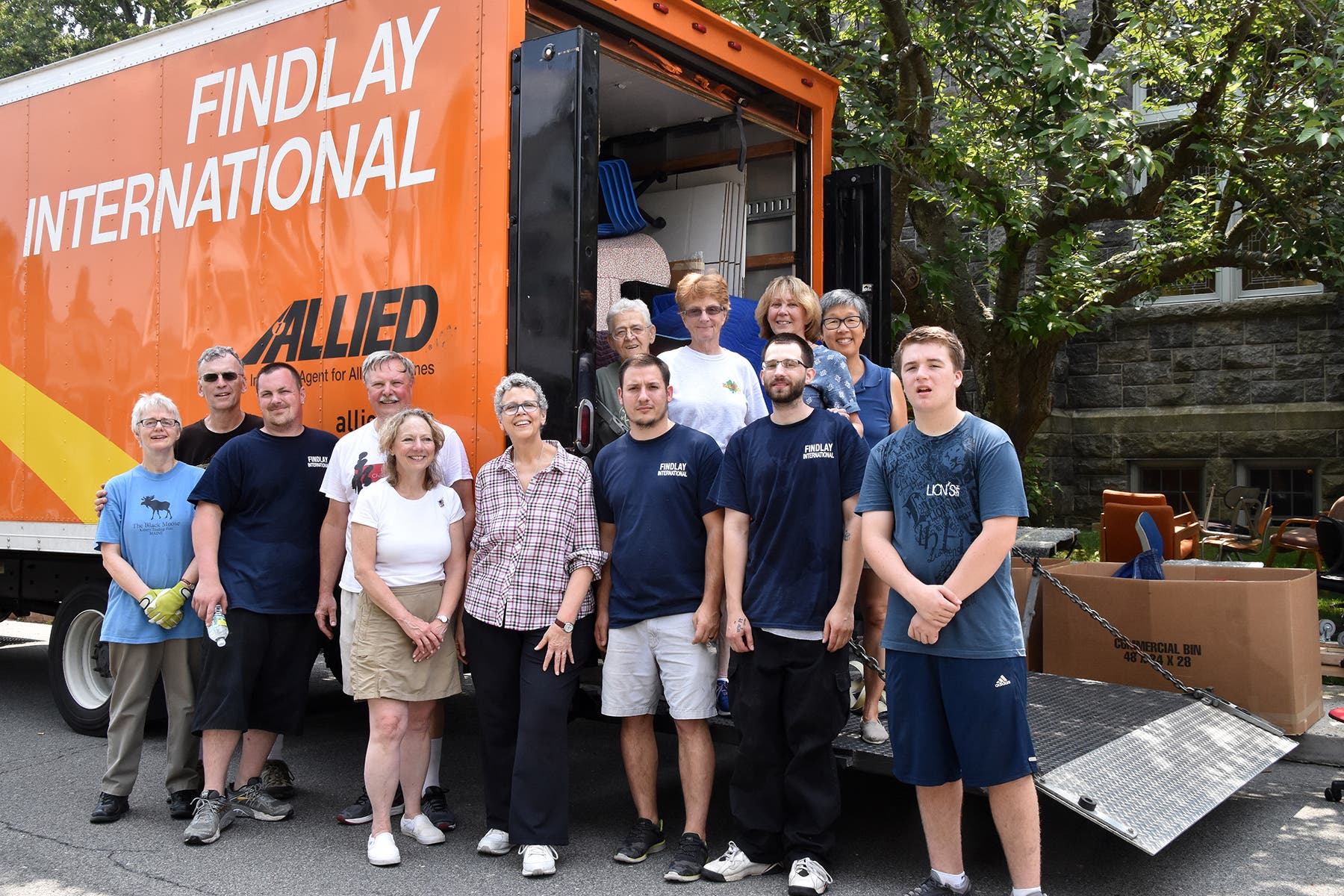


A few weeks ago, St. John’s Episcopal Church in Larchmont, as a member of the Westchester Refugee Task Force (WRTF), sponsored a furniture drive, hoping to gather some basic furnishings for refugee families arriving in Connecticut this summer. The response by the community was enthusiastic, to say the least. Sixty-seven local families arrived in SUVs and trucks -- some of them borrowed or rented -- filled with an array of gently-used furniture. Three dozen volunteers, including eight teens who are part of the Larchmont-Mamaroneck Chapter of the Lion’s Heart, a national teen service organization, assisted in unloading, cleaning, and breaking down the furnishings. At the end of the five-day drive, more than 350 pieces of furniture filled the lower level of the church, including sofas, tables, chairs, bed frames, dressers and lamps -- enough to furnish apartments for ten refugee families.
Fortunately, Larchmont resident Greg Mouracade, the president and owner of Findlay International, a professional moving and storage company, came to the rescue, providing a 26-foot moving van and an experienced crew to help transport approximately 3,000 cubic feet of furniture to New Haven. Nearly a dozen volunteers helped unload the furniture at a warehouse in Connecticut, including a handful of Yale football players. All told, more than fifty volunteers assisted in collecting and transporting the furniture.
Now what? Integrated Refugee and Immigration Services (IRIS), located in New Haven, CT takes over. IRIS is one of the approximately 350 refugee resettlement agencies across the US, and they will furnish apartments, and provide a myriad of other supports and services, to resettling refugee families arriving from Syria, Afghanistan, Iraq, Sudan, the Congo, and Eritrea. Founded in 1982, IRIS has welcomed over 5,000 refugees since its inception, and anticipates resettling 420 refugees this year, up from about 250 in 2015.
Find out what's happening in Larchmont-Mamaroneckfor free with the latest updates from Patch.
To support resettlement efforts, religious and civic groups across Westchester County banded together to form the Westchester Refugee Task Force (WRTF). This group began in November 2015 with a handful of Episcopal churches around Westchester, including St. John’s, in response to a call to aid refugees by the Episcopal Diocese of New York’s Bishop Andrew Dietsche. The group has grown to include 23 churches, synagogues, Islamic centers, and civic groups in addition to individuals.
The WRTF recently helped a refugee family that was co-sponsored by Stamford Interfaith Refugee Settlement (SIRS) through IRIS. Members of the WRTF took responsibility for furnishing part of an apartment for a Syrian family of six, including four children, who arrived after spending two years in a refugee camp in Jordan.
Find out what's happening in Larchmont-Mamaroneckfor free with the latest updates from Patch.
Although there are currently no refugee resettlement agencies operating in Westchester, the Hebrew Immigrant Aid Society (HIAS), the oldest refugee resettlement agency in the United States, is trying to gain approval from the State Department to begin settling refugees in Westchester County. In the meantime, WRTF is busy exploring opportunities to work with HIAS and eagerly anticipating the possibility of member organizations co-sponsoring some of the first refugee families to resettle in Westchester County.
As the agencies sort out how they can best help refugees locally, WRTF members became impatient to do more to be part of the refugee solution now. St. John's parishioners Jmel Wilson and Wendy McFee suggested to the WRTF that St. John’s host a furniture drive for refugees arriving through IRIS this summer. They had no idea what the furniture drive would yield, or exactly how the furniture they collected would be transported to New Haven, but they wanted to help. The overwhelming community support -- measured in both furniture and volunteer hours -- shows that many others shared their passion.
Although she can only imagine what the furniture drive will mean to the arriving refugee families, Jmel has a very good idea of what the effort meant to the donors. “The overwhelming response of donors was gratitude,” she explained, “to finally have some concrete way of responding to the horrifying news stories and pictures. To know that what they were doing was going to directly benefit people who had suffered so much.”
Some people, she said, donated furniture that had belonged to deceased parents. “They had been hanging on to it for years, waiting for the right time and they were so excited that this opportunity had presented itself.” Wendy shared that it was particularly touching on Father’s Day, the second day of the drive, to see so many fathers bring their children to the drive and explain its purpose to them.
The effort itself generated interest and more offers to help. “Several donors came into the room and looked at the volume of the collection and were visibly moved by the generosity of our community, Jmel recalled. “They would ask, ‘what else do you need?’ ‘What else can we do for these people?’ There was a great sense of relief that we are finally able to help.”
REFUGEE RESETTLEMENT – HOW IT WORKS: Refugee candidates undergo a very rigorous security screening process led by the United Nations High Commission for Refugees (UNHCR), the international body responsible for “protecting the rights and well-being of refugees around the world.” While it takes an average of 18-24 months to process refugee applications, for Syrian refugees, the process can take significantly longer due to security issues and the difficulty in verifying their information. Once approved for refugee status, only a handful are referred by the UNHCR for admittance to the United States; in 2016, 85,000 refugees will be admitted to the US by the US Department of Homeland Security. According to the figures provided by the United Nations, there are 15 million refugees worldwide living outside their home countries, and another 27 million “internally displaced” refugees residing in their homelands. The refugees selected to be resettled in the United States are brought in by one of nine voluntary nongovernmental refugee organizations, which then pairs them with one of 350 affiliate refugee resettlement agencies across the country. The local affiliate agencies are responsible for resettling the refugees and assisting them with temporary services including housing, education, healthcare referrals, job-search preparation and assistance, legal services, and cultural orientation including English lessons, for a period of up to 3-6 months.