Community Corner
'Living Shoreline' On Display As New Rules Get Hochul's Signature
The legislation offers a roadmap for working with, rather than against, Mother Nature when it comes to protecting the NY coastline.


MAMARONECK, NY — NYS Senator Shelley Mayer and Assemblyman Steve Otis took an opportunity to show off firsthand how new legislation they co-sponsored might change the way municipalities and property owners think about managing New York's shoreline.
The lawmakers hosted a press conference on Tuesday to celebrate the "Living Shorelines" legislation being signed into law by Gov. Kathy Hochul. The new law will require the Department of Environmental Conservation (NYSDEC) to encourage the use of nature-based solutions as the preferred approach for stabilizing tidal shorelines in the oversight and regulatory decisions of the agency.
Mayer said that the new law will encourage a coastal flood protection infrastructure that gets stronger over time, as plant life providing natural flood barriers thrives and grows, rather than slowly wearing down like more traditional seawalls and barriers. The legislator explained that a "living shoreline" not only does a superior job of flood mitigation — it has the added benefits of being a perfect habitat for marine life and offers a natural filtration system for pollution from ground runoff.
Find out what's happening in Larchmont-Mamaroneckfor free with the latest updates from Patch.
"After Hurricane Ida, many constituents reached out to me for assistance with flood damage. I was happy my office could help individuals but the systemic impact of climate change requires much more. As the community rebuilds once again following the devastating storm this past week, we need to be proactive about increasing resilience and protecting against future flooding. This legislation will empower DEC to encourage the use of nature-based solutions, strengthening our shorelines and communities."
The New York lawmakers pointed to communities across the Empire State that are facing intensifying climate change-related hazards, including dangerous floods. Otis noted that in just the past few days, flooding displaced residents in nearby neighborhoods. The assemblyman said that the new law is an important step in addressing what is becoming an ever-growing concern.
Find out what's happening in Larchmont-Mamaroneckfor free with the latest updates from Patch.
"Living shoreline principles are vital to improving coastal resilience, reducing flood impacts, preventing shoreline erosion, and protecting natural habitats," Otis told those gathered. "Thanks go to Governor Kathy Hochul, the NYS Department of Environmental Conservation, Assembly Environmental Conservation Committee Chair Deborah Glick, and the many environmental groups who support these important policies. Senator Mayer and I worked closely to move this bill in both houses. This is important legislation for coastal communities that will help advance nature-based policies at a time when sound practices are needed."
The lawmakers couldn't have chosen a better venue to highlight the importance of their legislative victory.

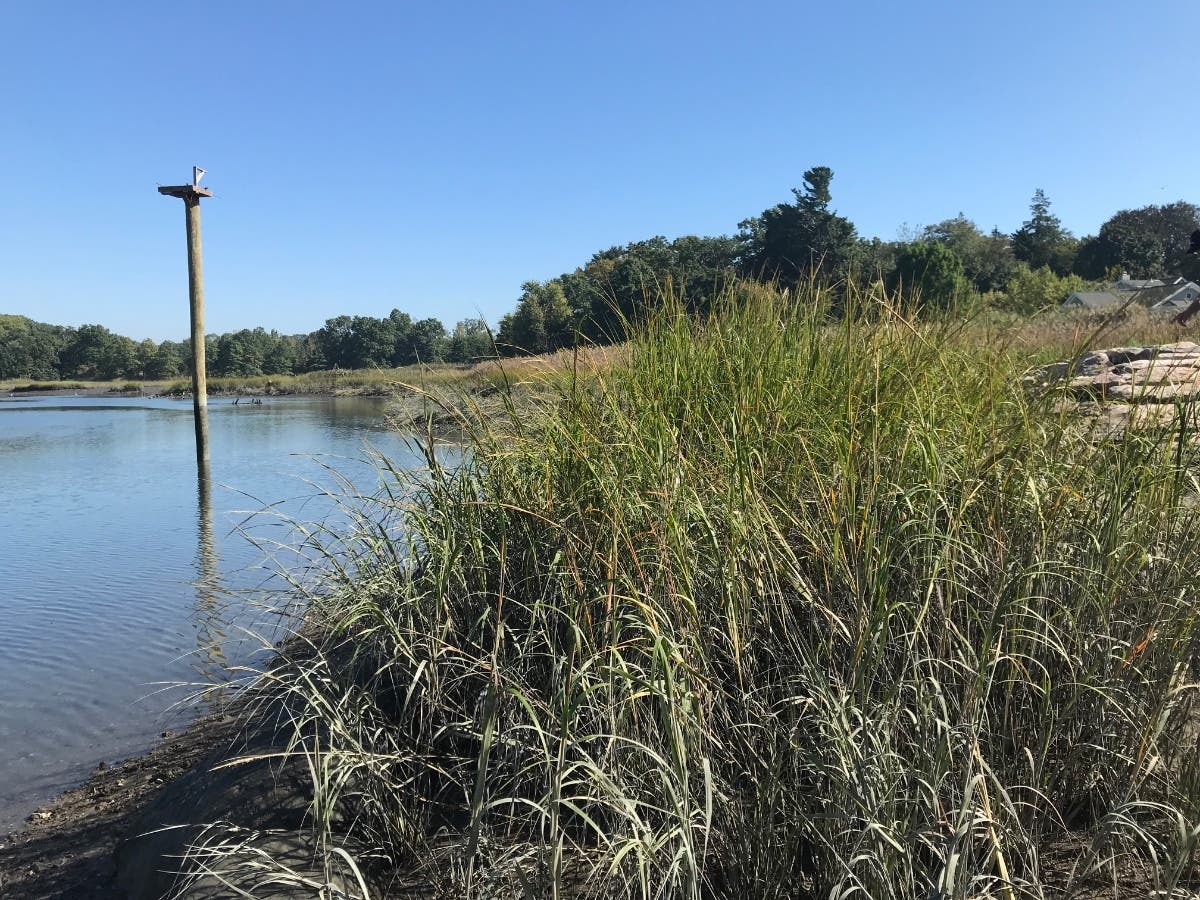
Bryan Martin, the homeowner hosting the announcement, knew when he bought the property surrounded by the Long Island Sound on three sides that the crumbling seawalls that help keep the seawater at bay would need to be replaced. But he had a vision that was less about protecting the property from seawater and more about coexisting with the Sound.
Before he committed to the process of restoring his small stretch of shoreline, a project that would take years to be fully realized, he called his neighbor, former Town of Mamaroneck Supervisor Nancy Seligson, for a second opinion on whether or not his vision was realistic.
"I called Nancy to walk around the property with me," Martin explained. "I told her what I had in mind and I asked if I was crazy to think it was possible. She told me, it wasn't just not crazy, it was exactly right. In a way, she was there at the very beginning and I never looked back."
Seligson recalled that day, and marveled that it was before the devastation of Ida, and even before the pandemic.
Seligson, who co-chairs the Citizens Advisory Committee of the National Estuary Program for Long Island Sound, said that the new law will help living shorelines like this become an example for other projects across the region and around the state.
"Increasing living shorelines is an important step toward making our communities more resilient to sea level rise and storm events, and will help to alleviate impacts of flooding," Seligson said. "That's why this legislation is necessary and timely and one of the priorities of the Long Island Sound Management Plan. Senator Shelley Mayer and Assemblyman Steve Otis know first-hand from their constituents how devastating recent storms have been. Directing NYS DEC to prioritize nature-based solutions for shorelines will help make all of New York State more resilient."

As one might imagine, the process of creating a living shoreline on the property just yards from the Hommocks Conservation Area came with plenty of red tape. Martin said the project required approvals from local, state and even federal regulators. He explained that the county wouldn't okay work until the town had signed off, and the state approvals were contingent on the county's okay and if the federal regulators wanted any changes, the process starts all over again.
"All told, I needed approval from 17 agencies," Martin said.
But the proud homeowner said that there was something of a silver lining to all that bureaucracy. Martin said he learned a lot in the process and along the way, became involved in efforts to help make a change in the way people think about protecting the shoreline.
Martin has plenty of allies in that cause. According to the lawmakers, the bill was inspired by the work of Save the Sound, Riverkeeper, and The Nature Conservancy, three major advocacy organizations confronting the impacts of climate change on water bodies and inland areas.
"New York City saw its rainiest day on record last Friday, with 8.65 inches falling at John F. Kennedy Airport. States of emergency were declared for the city, Long Island, and Westchester County," Save the Sound's David Ansel said. "Extreme weather wrought by climate change is becoming more frequent and more severe. The Living Shorelines Act will prioritize nature-based solutions to strengthen our coastlines—solutions that are more resilient and will better protect people and property in the face of rising tides and temperatures."
If the new law offers a better chance of a future that looks more like a small stretch of coastline on a narrow peninsula in Westchester County, the results will be hard to argue with.

Get more local news delivered straight to your inbox. Sign up for free Patch newsletters and alerts.