Politics & Government
Judge Failed to Embrace Historic Mamaroneck Tree; Work on Pine Street Continues
Residents' lawsuit tossed, long-awaited project with uncertain future moves forward.
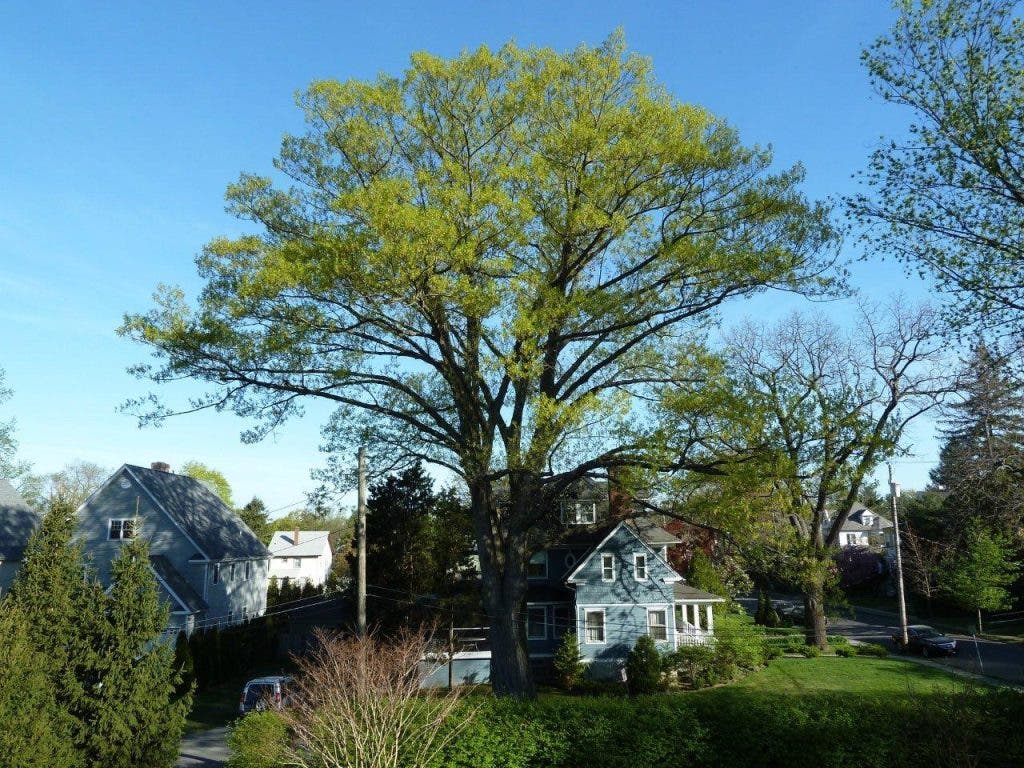
Stacked drainage pipes and orange cones alongside Beach Avenue in the Village of Mamaroneck signal the start of work designed to alleviate flooding around Pine Street, a 300 foot long road that has been the focus of almost 20 years of lawsuits and controversy.
A group of village residents had sued to stop the work, claiming that the village didn’t follow the state’s environmental laws and that the project endangered the Tompkins Farm Oak, a massive and historic tree that sits adjacent to Pine Street.
Find out what's happening in Larchmont-Mamaroneckfor free with the latest updates from Patch.
Last Friday, however, a judge in White Plains denied the residents’ motion to issue an injunction against the project, which is on track to be completed within six to eight weeks, weather permitting, said Village Manager Richard Slingerland.
The parties have a September court date, but by then the job will be over, said Nora Lucas, who initiated the lawsuit with Stuart Tiekert and Charles Morelli, who also live near Pine Street.
Find out what's happening in Larchmont-Mamaroneckfor free with the latest updates from Patch.
“I’m disappointed,” said Lucas. “I don’t think the judge embraced the tree.”
In such disputes, matters often boil down to experts with differing opinions and, therefore, it is difficult to predict an outcome. The parties to the lawsuit contend that the work, as currently designed, will damage the tree.
“The tree is not endangered,” said Slingerland. “We will take every precaution and measure to protect the tree.”
The only thing residents can do is wait and see if the tree survives the work and the drainage situation improves.
The history of Pine Street has been frustrating for all involved, said Lucas. In 1993, Tiekert and Morelli helped initiate a successful lawsuit that stopped the development of a house. A local law states that building permits can only be issued if the roadway on which it is situated, “shall have been suitably improved to the satisfaction of the planning board.”
Approval for Pine Street never came, yet in 2002, the village granted Cosimo Panetta building permits to construct two houses on Pine Street, leaving a potential lot undeveloped. A consulting engineer for the village signed off on the drainage plan, according to court papers, and the planning board issued the building permit contingent on the stipulation that Pine Street “would be suitably improved as proposed.”
It became a matter of dispute which party was responsible for upgrading the road. Panetta improved the road “to some extent” by installing underground tanks to deal with the drainage issue, said Slingerland, but they never worked properly. Nearby residents have long complained of soggy basements due to the Pine Street houses.
As a result of the road remaining unimproved, the village planning board issued Panetta a temporary certificate of occupancy at his residence, 514 Pine St., which he cannot sell until he receives a permanent certificate. Panetta unsuccessfully sued the village after he demanded in writing that the building inspector issue his permanent certificate, according to court papers.
Complicating matters, developer Gerald Cappetta has expressed interest in building on the remaining Pine Street lot, but he cannot get a building permit until the street is improved.
Lucas contends that Panetta and Cappetta should pay to fix the road. Cappetta has agreed to pay $22,500 toward the Pine Street portion of the drainage job (projected to total around $53,000). Slingerland said that Cappetta is also responsible for paving Pine Street when the project is completed. The rest of the budget for the $273,550 project includes $100,597.50 from the village and $150,452.50 from a federal Environmental Protection Agency (EPA) stormwater grant.
Responding to criticism that public funds, whether local or federal, are being used to benefit private parties, Slingerland said that fixing the entire flooding problem in the village would cost millions of dollars and involve a raft of federal, state and local agencies.
From the village standpoint, the federal grant money is helping to fix an endemic problem along Beach Avenue and Pine Street that neighbors have been complaining about for years.
“They’re trying to solve the problem, but they haven’t gone about it the right way,” said Lucas. “I want the village to ensure that the tree will survive whatever happens on Pine Street.”