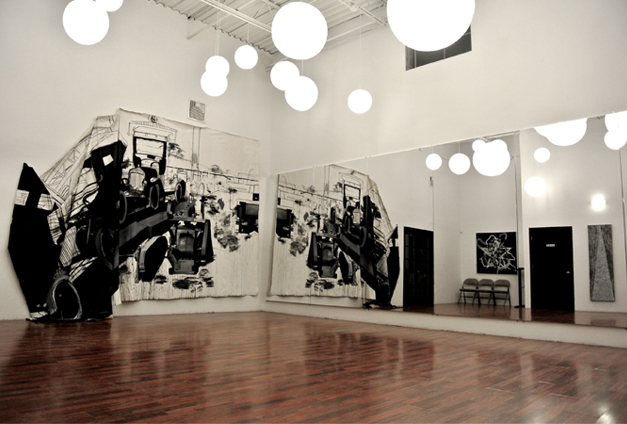

Alfred Peña walks in Rhythmology, smiles and jokingly says, “Good morning.” It’s six in the afternoon and ten students are ready to start turning on their toes. Eight women and two men—promising numbers.
“We multiply turns and subtract some shoulder movements to divide the musical phrase. Resistance must be created towards our partner using our own weight. Movement is bound by the law of gravity, but it is not finite. If we find the center of our body, anything is possible. Everything is relative.” This is how Alfred teaches, by combining dance with his scientific knowledge. It’s not unusual to come into one of his classes and find him stretching an elastic band tied to a pencil to explain the resistance needed between dance partners to perform a certain step.
Rhythmology’s goal is to make it possible for anyone to become a professional dancer using Latin rhythms, take salsa, bachata and merengue to the next level as dance forms. To make this dream come true, Rhythmology is involving younger generations and spreading the idea that Latin rhythms are not only fun and sensual, but can also be studied in the process of becoming a professional dancer. One of their strategies is to include other more structured dances that are already taught traditionally in dance schools. It’s been almost a year since Rhythmology added flamenco to its curriculum, for example. Flamenco is an art form that is more than 200 years old and is declared Intangible Cultural Heritage of Humanity by UNESCO.
“Ten years ago, the creation of a global culture of Latin dances seemed a far-fetched idea. Now, there are competitions like the World Latin Cup and the World Salsa Open. The level of artistic accomplishment of the participants at these competitions is proof that Latin dance has evolved and that there is room for more growth.”
In the short term, one of Rhythmology’s goals is to have at least ten different locations in New York state. “Our studios in Patchogue and Westbury are a good beginning. We have salsa, bachata, West coast swing, flamenco and very soon we will have kizomba.” In order to create a network of Latin American traditions and culture, Rhythmology launched its first art installation with a painting and sculpture exhibit using the three studios in its main location in Westbury. A group of plastic artist was given the opportunity to exhibit their work , Francisco Moreno & Toussaint Wallace were the main exhibits in 2012 and now you can enjoy Lydia Enriquez & Rachel Klinghoffer’s work.
“Networking and education are the foundation of Rhythmology. We want to be a global company that offers a living, changing style of dance and a universal culture of Latin American rhythms.”
Rhythmology has an extraordinary team of teachers and dancers, and its connections in restaurants, hotels and discos complete the circuit of its marketing strategy, which offers the opportunity for social connections in classes and makes the nightlife of discos and dance halls a stepping stone into its lessons. Alfred Pena’s formula to make a studio and educational initiative grow works. New students arrive on a daily basis because they heard about Rhythmology on Saturday’s party or they had the chance to see Alfred and his dancers in a weekend show. The success, positive energy and happiness exuded by this Dominican are contagious. Rhythmology reflects Alfred’s approach to his public. It’s a modern, fun studio and is, most importantly, full of art and rhythm.