Community Corner
George Takei Talks Japanese-American Imprisonment At FDR Museum
The event was held on the 75th anniversary of the signing of the executive order that led to incarceration of his family.


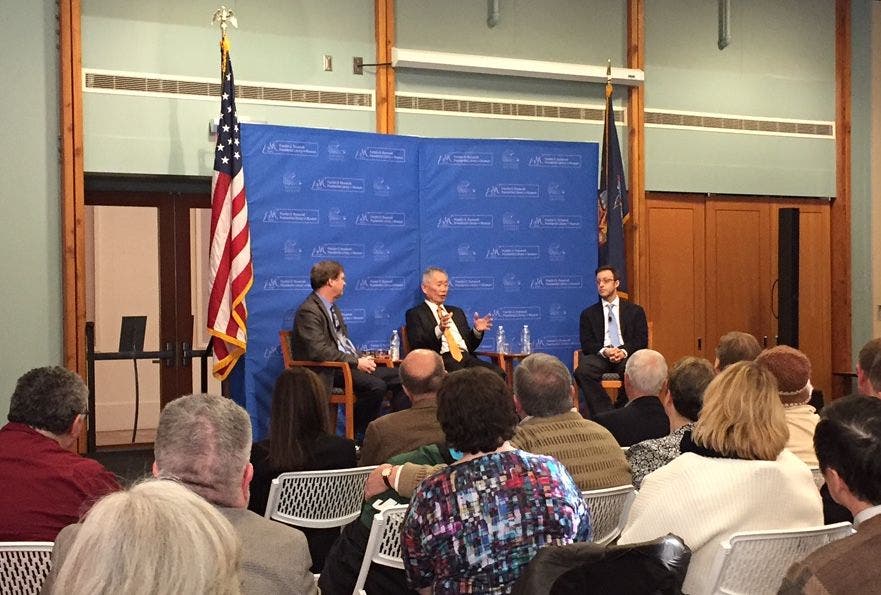
HYDE PARK, NY — George Takei said that, contrary to what they are usually called, he and his family were not in a Japanese internment camp during World War II.
The 79-year-old actor and activist, best known for the “Star Trek” franchise where he played Hirkaru Sulu, said the Japanese were the ones who ran Japanese internment camps.
Then where were he and his family imprisoned during the war?
Find out what's happening in Mid Hudson Valleyfor free with the latest updates from Patch.
“It was an American internment camp,” Takei said.
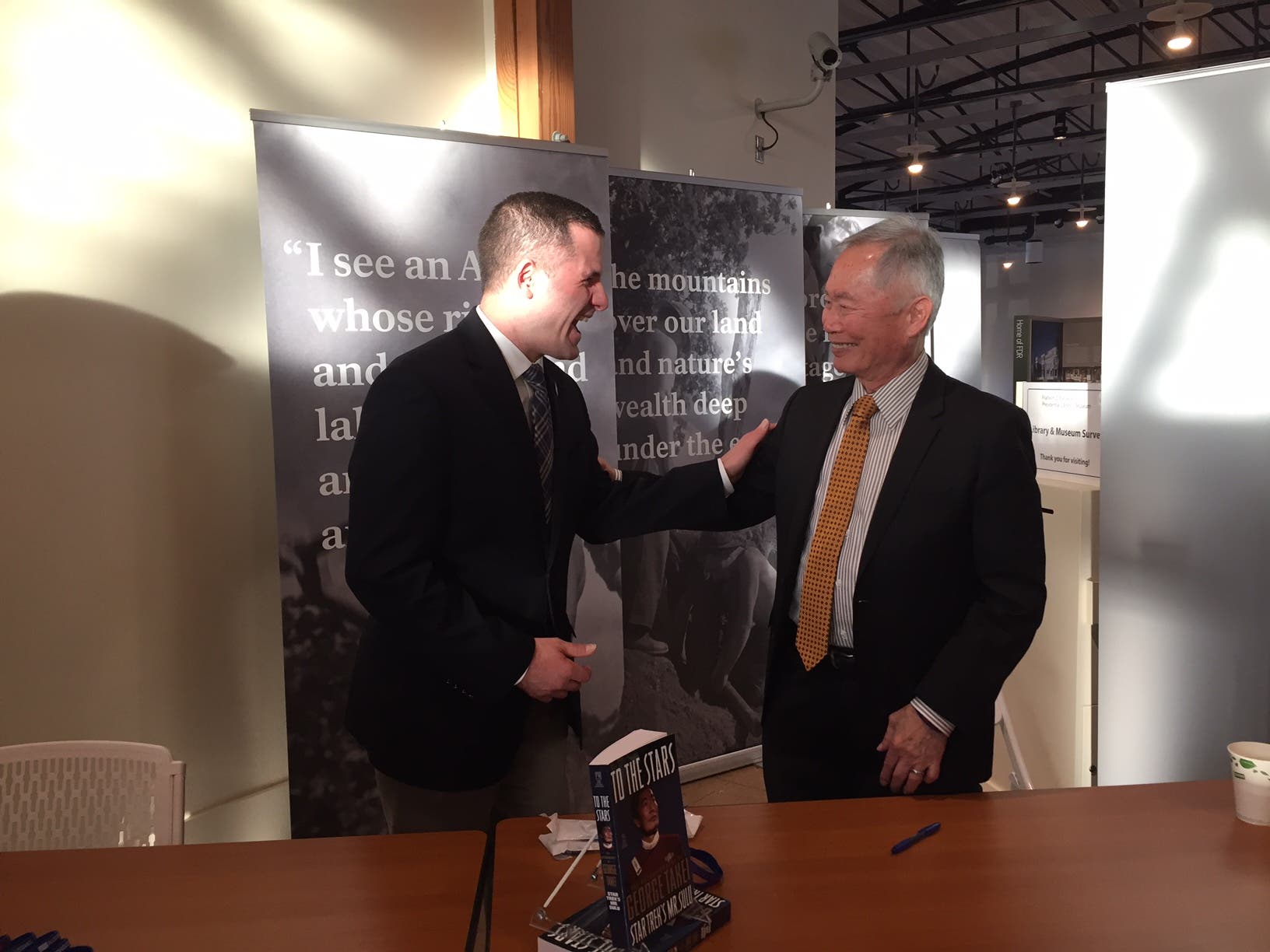
Takei was participating in a discussion at the Franklin D. Roosevelt Presidential Library and Museum in Hyde Park Sunday on the 75th anniversary of the signing of Executive Order 9066, which led to the incarceration of 120,000 people of Japanese descent, including about 80,000 American citizens.
Find out what's happening in Mid Hudson Valleyfor free with the latest updates from Patch.
The library and museum also unveiled a new photographic exhibition: “Images of Internment: The Incarceration of Japanese Americans During World War II.”

Paul Sparrow, the director of the library and museum, moderated the discussion.
Roosevelt explained that the push for the executive order was driven by the military in the wake of the bombing by Japan of Pearl Harbor.
There was no push back from the Justice Department at the time.
In fact, Earl Warren, who eventually became chief justice of the Supreme Court, was California’s attorney general at the time and was one of the prime movers behind the round up and imprisonment of Japanese Americans, Roosevelt said, because there was a lot of racism in the state during that period.
He said the American people were also to blame for not standing up for their fellow citizens.
“We looked like the enemy,” Takei said.
He was born in Los Angeles to Japanese-American citizens. His father was born in Sacramento; his mother, in Japan.
In 1942, his family was removed from their home and first taken to Santa Anita Park, where they lived in horse stalls, because the camps were still being built.
Takei was only a child so he said it was exciting to be living with horses.
“But for my parents, it was a degrading, humiliating experience,” he said.
They were next sent to Tule Lake in northern California. It was the largest of the incarceration centers.
“Tule Lake is a lovely name for a truly horrible place,” Takei said.
The government came up with a loyalty test, one question of which was the determining factor as to whether Japanese Americans were sent to the harshest of the camps.
Takei said the question was: Will you swear unqualified allegiance to the United States of America and faithfully defend the United States from any or all attack by foreign or domestic forces, and foreswear any form of allegiance or obedience to the Japanese emperor, to any other foreign government, power or organization?”
Takei explained that there was no way to answer that question without being contradictory.
Answering “yes” to the first part, meant answering the same to the second part, and the result was an assumed loyalty to a foreign government that one had to swear to give up.
Takei’s father and mother answered “no,” and thus were labeled disloyal.
“This did not happen to Italian-Americans or German-Americans,” he said.
Eventually those imprisoned were released and given a one-way ticket to anywhere in the country they wanted to go. Reparations in the form of $20,000 to each survivor were approved much later during the Reagan administration.
Takei and his family went back to Los Angeles.
“I felt like an immigrant coming back to my hometown,” he said. “It was a place we had never been to.”
Takei singled out Wayne Collins, a lawyer with the northern California ACLU for being one of the very few who represented people like Takei’s mother, who had renounced her citizenship and helped her get it back.
He said he wonders what would have happened if he had been sent to Japan to live with his mother, if she had been deported after the war.
“If it had not been for [Collins], I would be a different person,” Takei said.
He said the same things that happened to his family and thousands of others could occur again, if the country continues on its path to bar immigration.
Takei noted that President Donald Trump’s executive order temporarily barring immigrants from coming to the United States, which was overturned by the courts, was “a terrible echo of what happened to us.”
If the country is concerned about what is going on, Takei said, “we have to stand up and say this is not us — this is not America.”
Takei said he thought during the drive up to Hyde Park from New York about all the history he was passing, and that he was coming — for the first time — to the place were Franklin Delano Roosevelt lived.
“I’m going to the home of the man who imprisoned me,” Takei said.
“Only in America.”
Photo caption: From left, Paul Sparrow, George Takei and Kermit Roosevelt. Photo/video credit: Michael Woyton/Patch Staff.
Get more local news delivered straight to your inbox. Sign up for free Patch newsletters and alerts.