Community Corner
4 Important Insights for New Yorkers Paying Child Support
Find out how New York sets, calculates and enforces child support, and where parents can turn for legal help.

This is a paid post contributed by a Patch Community Partner. The views expressed in this post are the author's own, and the information presented has not been verified by Patch.
Each month, a New York parent checks a pay stub, opens a banking app and wonders why the child support payment doesn’t seem to match the math. A raise, a daycare bill or a medical expense can change the total in ways that are hard to predict.
You can consult a child support attorney New York families trust to help clarify what the law requires.
How a Child Support Order Gets Established in New York
A support case usually starts when a parent files a support petition in Family Court to request an order. When a child receives public assistance, the Department of Social Services may file the petition itself.
State court guidance on how child support is established in New York outlines three paths:
- Divorce case: The Supreme Court can order support during a divorce.
- Support petition: A parent can ask Family Court for an order without a divorce.
- Written agreement: A court may refuse to enforce a written agreement that fails to meet legal requirements.
The custodial parent is the primary caregiver, with whom the child lives most of the time. The noncustodial parent lives elsewhere, typically keeps visitation and parental rights, and usually pays support. Both parents must financially support a child until age 21 unless the child becomes emancipated through marriage, self-support or military service.
How New York Calculates Child Support Payments
New York calculates support under the Child Support Standards Act (CSSA), which combines both parents' net incomes, applies a set percentage by number of children and divides the obligation proportionally. The combined parental income cap is $193,000, so the percentage applies up to that amount.
The percentage rises with the number of children:
- One child: The percentage is 17%.
- Two children: Support rises to 25%.
- Three children: The figure climbs to 29%.
- Four children: The rate reaches 31%.
- Five or more children: The rate is at least 35%.
Lower-income parents have a safeguard in the Self-Support Reserve of $21,546 for 2026, while the federal poverty guideline is $15,960. A child support attorney in New York may help confirm which figures apply to a case.
What Other Costs Are Added to Basic Child Support Orders
The Guideline Amount may not cover every child-related cost. New York can layer mandatory add-on expenses on top of it, so a monthly payment may run higher than the basic percentage alone suggests. Common add-ons include:
- Childcare: Courts can add childcare costs tied to work.
- Medical costs: Courts can also add unreimbursed healthcare expenses.
What Happens When Child Support Payments Fall Behind
Falling behind may cause unpaid balances to build into arrears. New York State Child Support Services and the Family Court may then pursue enforcement actions for unpaid child support, including:
- License suspension: The state may suspend a driver's license once an account is more than four months past due.
- Tax refund interception: Authorities may intercept state refunds when more than $50 is owed and the refund is more than two months past due. Federal refunds may be intercepted at more than $500, or at a lower threshold for cases involving public assistance or foster care.
- Credit reporting: Credit bureaus may receive a report after more than 2 months or after $1,000 is past due.
- Frozen accounts: The state may freeze bank accounts at more than two months past due and more than $300 owed.
Arrears may grow quickly. A lawyer who handles child support cases may help parents review their options.
New York Child Support Law Firms Worth Considering
Parents weighing next steps may look for a local firm that handles child support cases. Three firms serve different parts of the state.
1. Tully Rinckey PLLC
With more than 20 years of experience, Tully Rinckey PLLC is familiar with how New York courts apply the CSSA. Its attorneys offer counsel and representation, drawing on multidisciplinary strategies to advocate for parental rights and a child's safety.
Key features:
- Multiple New York offices: Locations include Albany, Saratoga Springs and Manhattan, with additional offices nationwide.
- 24/7 intake: Prospective clients can reach the firm at any hour and book online.
2. Shari Gordon Law
With experience in divorce and family law since 1986, Shari Gordon Law serves clients across Westchester and Putnam counties. Its client-centered approach reflects an understanding that every case is unique.
Key features:
- Two offices: Clients can meet with the firm in Yorktown Heights, NY, or Mahopac, NY.
- Divorce approaches: The firm offers contested divorce, mediation and collaborative divorce.
3. Maria Mateo Law
Founded in 2010, Maria Mateo Law handles child support, custody and paternity cases from its Queens, NY, office. The firm has represented New York City employees, teachers, police officers, firefighters and military members.
Key features:
- Family and immigration law: The firm handles both immigration and matrimonial matters, including child support.
- Queens office: The firm serves residents of New York City and New York State.
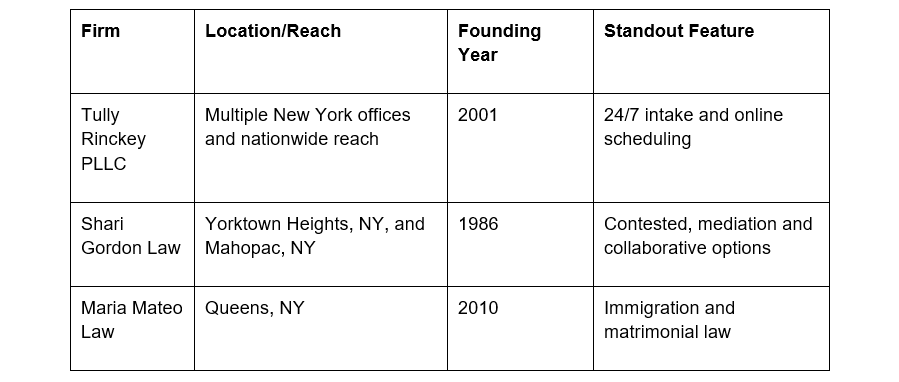
Comparing New York Child Support Law Firms at a Glance
Side-by-side details make comparison easier. Reach, history and standout features vary.
Frequently Asked Questions
Parents paying support often raise questions about duration, enforcement and legal help. Each has a straightforward answer.
Q: How long does child support last in New York?
A: In general, the obligation runs until the child reaches 21. Marriage, self-sufficiency or military enlistment may bring it to an end sooner.
Q: What happens if the other parent refuses to pay?
A: Unpaid support can accumulate as arrears and prompt action by New York State Child Support Services or the Family Court. Enforcement may reach a parent's license, tax refunds, credit record and bank accounts.
Q: Do parents need a lawyer to handle a child support case?
A: Formulas, add-ons and enforcement rules may be easier to navigate with legal guidance. A lawyer who handles child support cases can explain how each applies to a situation.
Taking the Next Step in a New York Child Support Case
Child support in New York follows a formula, yet real complexity surrounds it, such as add-ons and enforcement. If your situation feels complicated, consider speaking with a child support attorney New York families can turn to for guidance about their options.
This post is an advertorial piece contributed by a Patch Community Partner, a local brand partner. To learn more, click here.