Crime & Safety
How NYC Women Handle Catcalling: Barking, Dog Poo And Pics
A New York woman took to Reddit this week after she'd been catcalled to ask for "a go-to retort."


NEW YORK CITY — Catcalling. Street harassment. No matter what it’s called, most New York City women know what it is. Many have been targeted. They know what it feels like and do their best to take it in stride.
This week, "The Ladies of NYC" took to Reddit to compare notes on how to stand up to a form of harassment that two out of three women in the U.S. have experienced.
Reddit user AdditionalLibrary9 posed the question — which includes an explicit description of what her cat-caller said — and more than 100 New York City women responded.
Find out what's happening in New York Cityfor free with the latest updates from Patch.
“Today I had a man talk about putting his face in between my butt cheeks. In the moment, all I wanted was a great one-liner beyond ‘f--- off,’” the user explained. “Do you have a go-to retort? A one-time response that you’re super proud of? I’ll even take anything to make me laugh.”
The replies were savage, frustrated and fed up. Bark at them. Tell them you have explosive diarrhea. Tell the catcaller how dumb they look.
Find out what's happening in New York Cityfor free with the latest updates from Patch.
Overall, though, a stronger emotion seeped from their quips: fear.
“I hope you have a backup plan if they whip out a knife or worse,” one user wrote.
“Retorts are always a bad idea,” another said.
“Just keep walking,” wrote a third.
“I’d like to suggest something funny," another user wrote. "But it’s safer just to ignore them.”
Catcalling, also known as street harassment, is usually open verbal abuse that mostly targets women and girls. The woman’s body is usually the catcaller’s target.
While street harassment is an under-researched topic, existing data shows it's a significant problem throughout the country.
The group Stop Street Harassment reports 65 percent of women in the U.S. had experienced street harassment.
Among those women, 23 percent had been sexually touched, 20 percent had been followed and 9 percent had been forced to do something sexual, the nonprofit reported.
Street harassment isn’t exclusive to women: The survey also determined that 25 percent of men had been harassed. LGBTQ+ men were more likely to report being harassed than heterosexual men and their most common form of harassment was homophobic or transphobic slurs.
"Street harassment is a human rights violation and a form of gender violence," their 2014 report states.
"It causes many harassed persons, especially women, to feel less safe in public places and limit their time there. It can also cause people emotional and psychological harm."
The New York Police Department does not track specific catcalling or street harassment incidents, but it does record misdemeanor sex crimes like forcible touching, assault, and sexual misconduct.
In 2021, nearly 5,600 incidents were reported in all precincts.
This may be why several New Yorkers who responded to Wednesday's query for appropriate catcalling responses suggested women reach for a phone instead of a snarky response.
"If they work for any organization, particularly NYCHA employees love to catcall me, I take a picture and send it to that org," one woman replied on Reddit. "I include that I expect this matter to be taken seriously and investigated."
"Ive [sic] gotten so many creeps fired for catcalling me," replied another. "Im [sic] quick to call that job."
The Ladies of NYC aren't the only New Yorkers calling out the catcallers.
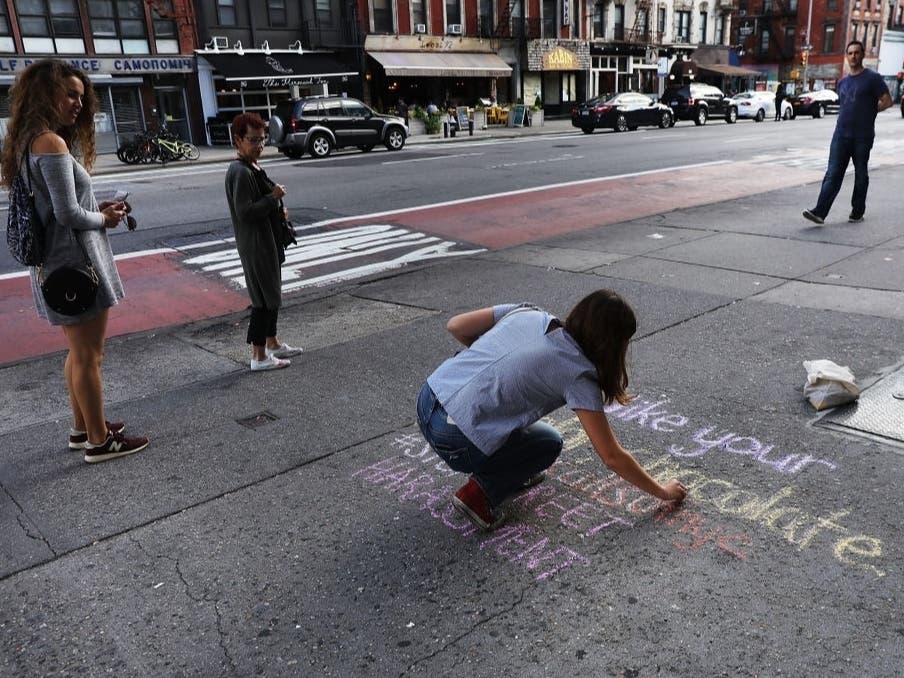
Sophie Sandberg, founder of Catcalls of NYC and Chalk Back, a global youth-led movement against gender-based harassment, was 15 when men on the street would call her “sexy,” she told The Daily Beast.
“I just felt so confused,” the NYU graduate told the publication. “It just felt like my body wasn’t my own. They were taking control of me in a way that I had never experienced before.”
Sandberg started Catcalls of NYC in March 2016. People would send her their street harassment stories. Sandberg would head to the spot it happened and use chalk to scrawl the often-explicit catcalls word-for-word on the sidewalk. Once finished, she would complete the artwork with #stopstreetharassment before posting a photo of it on Instagram.
“There’s this bizarre contrast between chalk, which is played with by children, and the bright colors against these really vulgar words,” she told The Daily Beast. “You see these colors and you think you’re going to see something light and fun, but then you see something that shocks and horrifies you.”
Catcalls of NYC is meant to “spur dialogue, provide a platform for story sharing, and promote cultural change,” its website states.
Since its inception, more than 150 young people around the world have started "Catcalls of" sites in their cities.
“Women have stopped me on the street to thank me for the project,” Sandberg told CNN. “I think it really helps people after they’ve been harassed to have somewhere to go and simply share what happened to them."
That sense of community was on display in the NYC Reddit group, where women shared funny stories but repeatedly cautioned one another to put safety first.
Perhaps the most graceful response to catcaller — from a woman who urged women never to do what she was about to describe — involved a dog walk, an open window, and truly epic aim.
"I once tossed a bag of fresh dog s--- into a guy's car who catcalled me right as I picked it up," the woman wrote.
"The light changed just as the bag entered his car and he realized as he drove ahead and I’ll never forget his yelling."
Get more local news delivered straight to your inbox. Sign up for free Patch newsletters and alerts.