Community Corner
Little Old New York: Fight At Golden Hill
A skirmish occurred in lower Manhattan two months before the Boston Massacre.

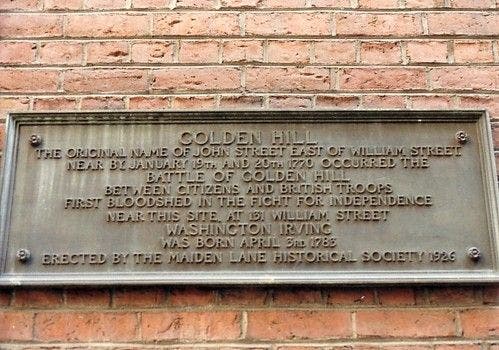
On January 19, 1770, half a decade before patriots acted upon independence, the Golden Hill area of New York City was the location for the popular Fly Market and also the scene of a skirmish between British soldiers and colonists.
About 100 yards to the east of a plaque currently affixed to the exterior wall of an office building, at the present corner of John and Gold streets, was a small hillock covered with bright yellow flowers that the Dutch called De Gouwenberg, or Golden Hill. British barracks were located nearby and citizens, in the years leading up to the Revolutionary War, were often at odds with the garrison.
Tempers had been running high since the imposition of the hated tax on tea. After years of debating the law that allowed British soldiers to quarter in the homes of citizens, friction over the establishment of a liberty pole became the powder keg that finally caused a riot.
Find out what's happening in New York Cityfor free with the latest updates from Patch.
The Sons of Liberty had erected liberty poles and each one had been removed by British soldiers. When the fourth liberty pole was erected on the Common (now City Hall Park), British soldiers tried, unsuccessfully, to destroy it with gunpowder on January 13. Several days later, the soldiers cut the liberty pole, sawed and split it into pieces, and then piled it before the door of Montagne’s Tavern that stood on Broadway north of Murray Street. The tavern was the meeting place for the Sons of Liberty.
Brawl Before Boston Massacre
Find out what's happening in New York Cityfor free with the latest updates from Patch.
The morning after the latest liberty pole was destroyed, 3,000 angry citizens gathered in "the fields" near Broadway and resolved to treat all armed soldiers who were in the streets after roll call as their enemies. In retaliation, the soldiers printed a handbill calling the colonists “robbers,” “traitors” and “rioters,” daring them to fulfill their threat. Two patriots, Isaac Sears and Walter Quakenbos, attempted to stop the posting of bills, and this action on January 19 caused a soldier to draw his bayonet. Sears knocked him unconscious with a ram’s horn.
The British reacted with taunts and ridicule, and after a series of provocative acts on both sides, a running brawl occurred between the mob and 20 soldiers. Patriots with clubs drove back the soldiers in what became the first bloodshed between the colonists and the British army. The Boston Massacre still was two months away.
Both groups retired to Golden Hill, where a detachment of regulars used their bayonets. At least one person was killed and several others, including soldiers, were injured in the skirmish. The soldiers were ordered back to their barracks by the mayor and their officers, but fighting did not subside until the next day.
New York would continue to see friction between its patriotic citizens and the Loyalists and British soldiers who occupied the town for most years of the Revolutionary War.