Community Corner
Little Old New York: Trinity Church
The current city landmark is the third church with this name.

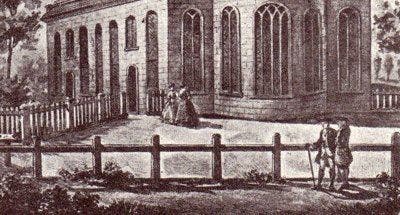
The site selected for New York’s first Trinity Church was “the ground lying on the southwest side of the burial place of the Ciity" (sic), according to old records written in Dutch. The area lay along the west side of Der Heere Wegh (The Broad Way), and the land included what was called the “Company” farm during Dutch days and the “King’s Farm and Garden” during British rule.
The original site was leased to Trinity Vestry during 1697. Upon accession of Queen Ann, the land was conveyed outright to the Vestry during 1705 by Lord Viscount Cornbury (Edward Hyde), her majesty’s
governor who was appointed during 1701.
Hyde later became the Earl of Clarendon and his daughter married James, the Duke of York, during 1660. Despite his title and prominence, Hyde was not liked by many people for a number of reasons:
- He was obsessed by his remarkable facial resemblance to Queen Ann and often appeared in feminine attire.
- Lewis Morris, the chief justice of New York and British governor of New Jersey, complained to the British Secretary of State about Cornbury’s mismanagement, his bribe taking and “his dressing publickly in woman’s cloathes” (sic).
- Upon return to England during 1723, Hyde had a portrait made of himself in a low-necked evening dress.
Prominent Names Attached To Trinity Church
The first church was started during 1696 and it was completed during March 1698. Its front with tower and steeple faced the Hudson River. Captain William Kidd lent equipment to hoist the stones. According to vestry records, Kidd “has lent a Runner and Tackle for the hoisting up stones as long as he stays here and Resolv’d that Capt. Clarke doe take Care to get the Same.”
The fire of 1776 that swept the city during the British Army’s occupation burned the roof and interior of the structure. The blackened walls finally were razed 12 years later to allow the second church on the site to be built from 1788 through 1790. Prominent Federalists became members of Trinity's congregation, including Alexander Hamilton, John Jay and Rufus King.
Weakened by heavy snow during the winter of 1838-1839, the second church structure was razed. Construction of the current church began during 1841.
George Templeton Strong, a lawyer and diarist whose writings provide a personal account of life during the 19th century, watched the construction of the present church from his Greenwich Street house. He recorded the following image:
March 19, Monday – Moonlight and a clear sky tonight—that’s one comfort. I went over (figuratively speaking) the rising glories of Trinity Church on Saturday. It’s going to be a glorious affair provided they don’t deform it with galleries. If they’d leave them out and the pews likewise, put the altar at the East End and have cathedral service there per die, I’d be quite satisfied.
The remains of many distinguished people from early New York have been placed in the Trinity Church graveyard. They include Robert Fulton and Alexander Hamilton.