Politics & Government
Mamdani Rejects Tax Hikes In First NYC Spending Plan
Mayor Zohran Mamdani unveiled a balanced budget after securing Albany support and ordering city agencies to slash spending.


NEW YORK, NY — Mayor Zohran Mamdani said the City erased a budget deficit that exceeded $12 billion and balanced a $124.7 billion executive budget through spending reductions, new taxes on wealthy New Yorkers and state aid.
He said the administration reduced the gap to $5.4 billion in its early months before closing it entirely.
“We have balanced the budget, and we have done so without placing the burden on the backs of working New Yorkers,” Mamdani said during a 1:30 p.m. presentation.
Find out what's happening in New York Cityfor free with the latest updates from Patch.
The plan combines agency savings, intergovernmental funding and new revenue from high earners, while avoiding property tax increases or broad service cuts.
“We taxed the rich, asking those with the most to contribute a little bit more to support those with the least,” he said.
Find out what's happening in New York Cityfor free with the latest updates from Patch.
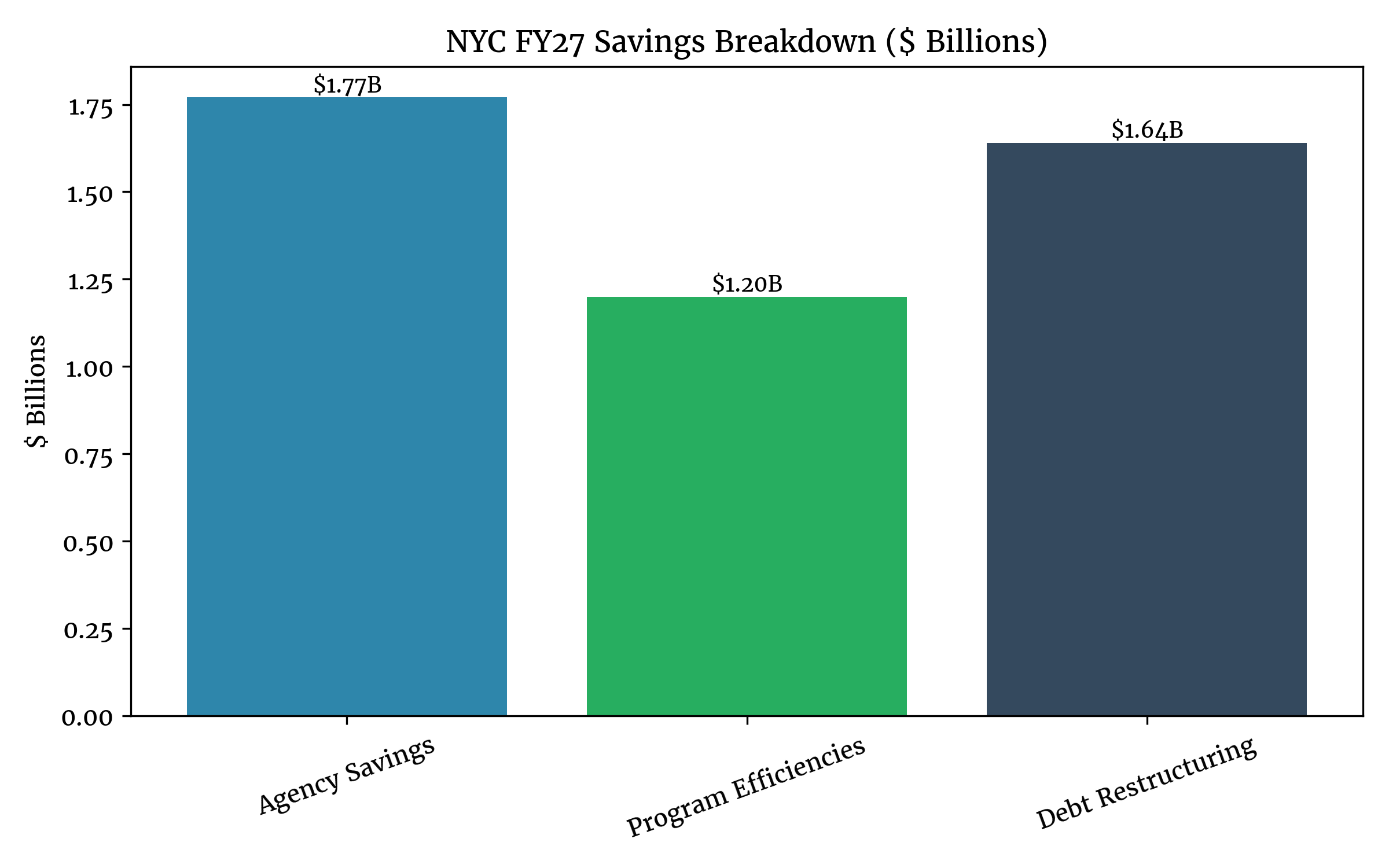
Mamdani said agencies identified $1.47 billion in savings over two years after being directed to appoint chief savings officers and reduce inefficiencies including consulting contracts, leases, software spending and overtime.
He said the City also addressed long-standing cost pressures in special education litigation, where due process cases are projected to reach $1.5 billion this year.
“For too long, our city has accepted this dynamic as the status quo,” he said. “Paying out settlements instead of fixing the underlying problem.”
The administration said changes to special education services and case handling are expected to save $149 million annually.
The budget expands child care, education and public safety funding, including $122 million to hire 1,000 teachers and a $7.6 billion capital allocation for school construction.
Mamdani said the City will seek a delay in full implementation of the state class size mandate, a move projected to save $500 million in the next fiscal year.
“Smaller class sizes are better for our children and better for our educators,” he said. “We don’t believe in empty promises. We want to do this right.”
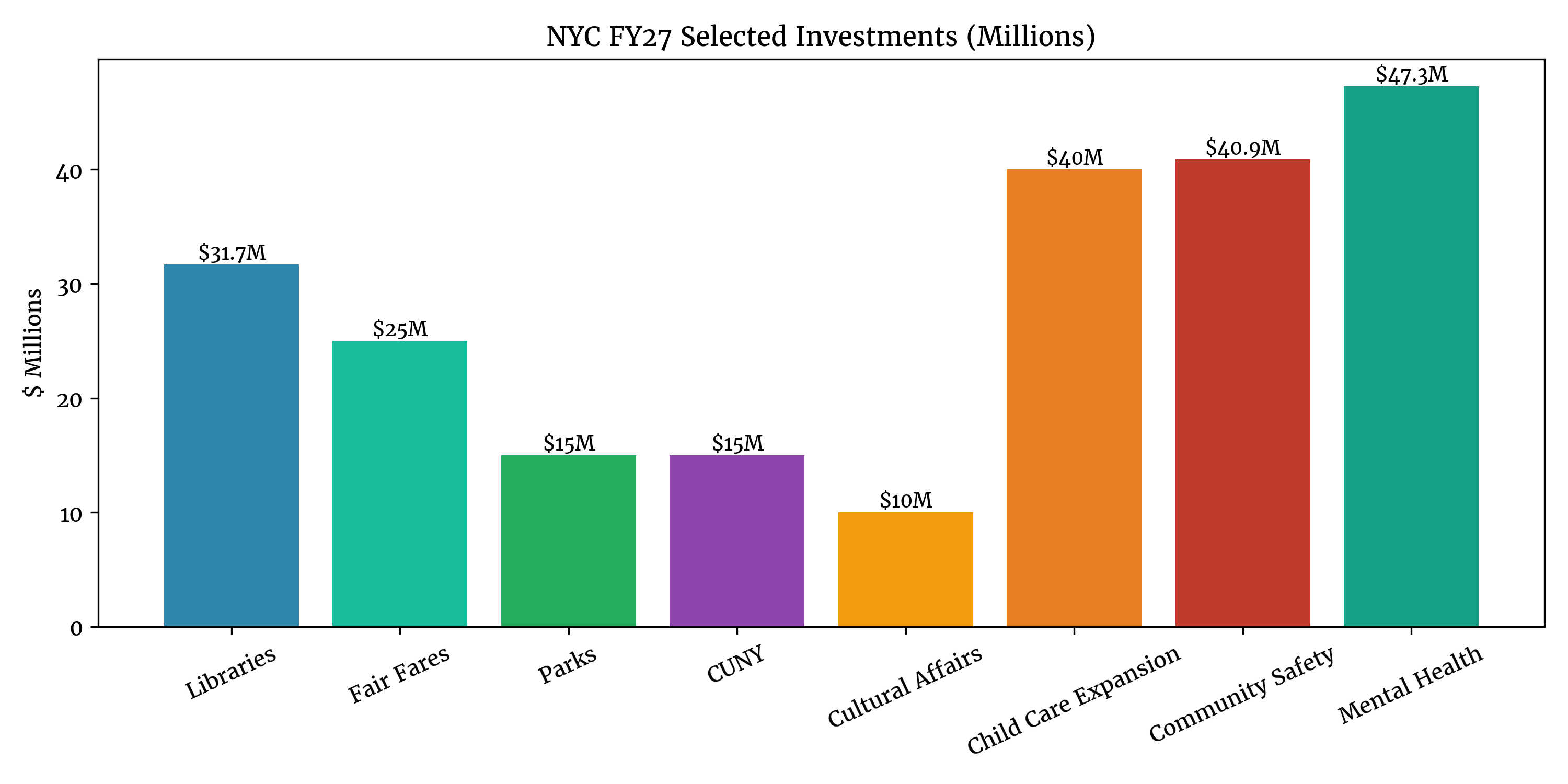
He also announced a $2.3 million child care pilot program for municipal workers and $40 million in higher reimbursement rates for child care providers.
The administration will expand literacy and math programs with $17.3 million in funding and increase public safety investments, including more than $40 million annually for the Office of Community Safety and $26 million for hate crime prevention.
Mamdani said the budget includes new revenue measures, including a tax on nonresident owners of second homes valued above $5 million, projected to raise $500 million annually.
The City will also work with City Council Speaker Adrienne Adams to reduce an unincorporated business tax credit, expected to generate $68 million each year.
He said Albany provided $352 million in direct aid and authorized $3.2 billion in savings measures, including pension and mandate flexibility.
Mamdani also proposed restructuring pension liabilities, projecting $1.64 billion in savings in fiscal year 2027.
“Let me be very clear,” he said. “This restructuring has no impact on retirees and their benefits or current employees and their future benefits.”
He said the fiscal year 2027 budget totals $124.7 billion, with 8 percent of new spending supporting new programs and 92 percent covering existing obligations.
Mamdani said the plan positions the City to expand affordability initiatives.
“We have laid the foundation for a future where we can continue to deliver the affordability agenda New Yorkers deserve,” he said. “That future seemed very far away a few months ago. Today, my friends, it is within reach.”
He thanked Gov. Kathy Hochul, Senate Majority Leader Andrea Stewart-Cousins and Assembly Speaker Carl Heastie for supporting the plan and securing state funding, calling it part of a new cooperative relationship between City Hall and Albany.
By The Numbers: Mayor Mamdani’s FY27 Executive Budget
Budget Size And Structure
$124.7 billion — Fiscal year 2027 executive budget
$2.3 billion — Reduction from preliminary budget
$117.1 billion — Five-year capital plan
Deficit And Fiscal Turnaround
$12 billion+ — Initial budget gap inherited
$5.4 billion — Reduced gap after early actions
$0 — Final balanced budget outcome
Spending Allocation
$17.3 billion — New spending across fiscal years 2026–2027
8 percent — New programs and investments
92 percent — Existing obligations and agency costs
Child Care Investments
$2.3 million — Municipal child care pilot program
$40 million — Increased provider reimbursement rates
Education
$17.3 million — NYC Reads and Solves expansion
Public Safety And Prevention
$40+ million annually — Office of Community Safety
$26 million — Hate crime prevention expansion
800 percent+ — Increase in hate crime prevention funding target
$9 million annually — FDNY civilian staffing expansion (starting FY27)
Streets And Sanitation
3,000 vehicles — With pedestrian alert systems
2031 — Full citywide trash containerization target
$14.8 million — Initial sanitation rollout funding (FY27)
$162.2 million — Peak annual investment (FY30)
Health And Social Services
$47 million annually — Mental health services expansion
$11.3 million annually — Disease surveillance funding
Housing And Capital Plan
$4 billion — New HPD capital funding (5 years)
$500 million — Additional FY2031 housing funding
$500 million — NYCHA renovation investment (FY28)
$256 million — Vacant unit restoration (FY27–FY28)
$5.6 billion — Total NYCHA capital investment
$117.1 billion — Total five-year capital plan
Get more local news delivered straight to your inbox. Sign up for free Patch newsletters and alerts.