Neighbor News
Melting Boundaries
Cosimo Cavallaro Reimagines Jesus in the Provocative Art Experience 'Passion of the Crust'
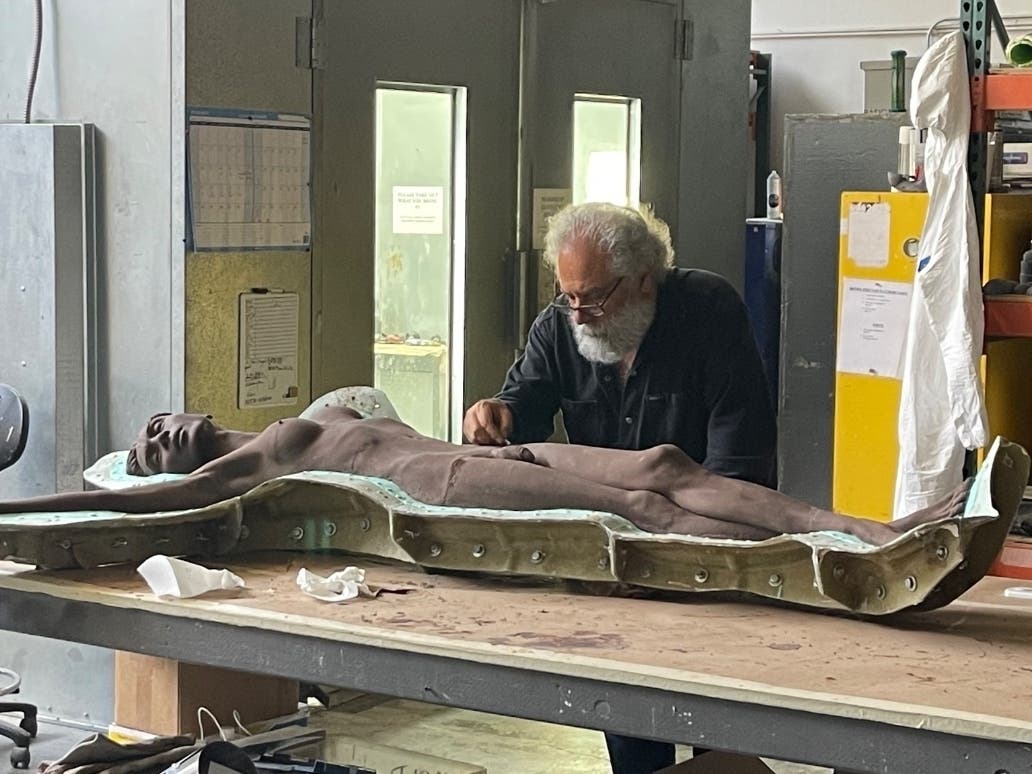
Nearly two decades after his infamous chocolate Jesus sculpture ignited international controversy, artist Cosimo Cavallaro has returned to one of the most debated images of his career. But while his 2007 work My Sweet Lord challenged audiences through shock and confrontation, his latest project, Passion of the Crust, seeks something far more elusive: transformation.
Now streaming worldwide as a pay-per-view art experience, Passion of the Crust unfolds as a hypnotic three-hour cinematic meditation. At its center is a life-sized chocolate sculpture of a transgender Jesus slowly melting atop a heated aluminum plate. Filmed by seven cameras and accompanied by the relentless crescendo of Maurice Ravel's Boléro, the work invites viewers into a contemplative journey through faith, identity, mortality, and rebirth.
The project revisits themes Cavallaro first explored with My Sweet Lord, the chocolate Jesus sculpture that sparked fierce public debate and generated death threats against the artist.
Find out what's happening in New York Cityfor free with the latest updates from Patch.
"I was worried for my wife and family," Cavallaro recalls. "What hurt me the most was when I received a phone call from a woman on her death bed asking me to destroy the chocolate Jesus."
For years, the experience convinced him he would never revisit the subject. That changed when an art history professor contacted him while researching a book on contemporary art. The conversation reopened old questions and compelled Cavallaro to reconsider the image that had defined one of the most turbulent chapters of his artistic career.
Find out what's happening in New York Cityfor free with the latest updates from Patch.
This time, however, his focus was not sacrifice. It was inclusion.
At a moment when conversations surrounding gender identity, belonging, and representation dominate cultural discourse, Cavallaro began searching for a figure who could embody a broader vision of humanity. His search ultimately led him to transgender model Rain Batingana, whose body and likeness became the foundation for the sculpture.
"When I told Rain I had chosen her to be my Jesus, she smiled and offered herself with love," Cavallaro says. "There was no resistance, no conflict."

The choice is significant. Throughout history, artistic depictions of Jesus have often reflected the values and assumptions of the societies that created them. By casting a transgender woman as Christ, Cavallaro challenges audiences to reconsider who is included within sacred narratives and who has historically been excluded from them.
Yet Passion of the Crust is not simply an exploration of gender identity. Rather, it uses gender as a doorway into larger questions about the nature of identity itself.
Created from a silicone mold of Batingana's nude body and a laser scan of her face, the sculpture becomes the centerpiece of a performance that slowly dismantles itself before the viewer's eyes. What begins as a recognizable human figure gradually collapses into an abstract landscape of flowing chocolate. Distinctions blur. Labels dissolve. Form gives way to something less defined yet strangely expansive.
For Cavallaro, the experience became unexpectedly emotional.
"What I experienced watching the chocolate body melt and collapse was a birth," he says. "I saw the piece becoming a new work of art without my doing."
As the sculpture transformed, so too did the artist's understanding of the work.
"I didn't experience the division. Rather the contrary, I experienced a unification," he explains. "I understood then that the body, the crust dies but not the spirit."
That philosophy lies at the heart of Passion of the Crust. While public debates increasingly focus on the labels that separate individuals, Cavallaro suggests that beneath those labels exists something universal.
%20copy.jpeg)
"When I freed myself of my labels, who I was and what they wanted me to be, I felt one with the universe," he says. "I was no longer this or that. I was all."
For some viewers, a three-hour film documenting the gradual melting of a chocolate sculpture may seem disconnected from a world consumed by political polarization, economic uncertainty, and global conflict. Cavallaro sees it differently.
"Humanity is under constant attack and one needs to stop fighting to heal or it will beat you to death," he says. "More now than ever it is important to stop and look inward to find who we are."
In that sense, Passion of the Crust functions as both artwork and invitation. It asks viewers to slow down in a culture driven by outrage, certainty, and instant reaction. Rather than offering answers, it creates space for reflection on faith, inclusion, and the possibility that spiritual connection may transcend the categories that often divide us.
Whether audiences experience Passion of the Crust as a spiritual meditation, a political statement, or a provocative work of performance art, Cavallaro hopes they will look beyond the headline-grabbing image of a melting transgender Jesus and engage with the deeper questions beneath the surface.
"There were so many things I missed in life," he reflects. "But when I did receive the message, it was worth the wait. There’s a saying I chant to myself now: ‘when the student is ready, the teacher shows up.’”
Visit chocolatejesusmelts.com