Weather
Storms That Once Battered NYC Every 500 Years Will Soon Hit Every 5, Study Says
Scientists from several universities made the dire prediction.

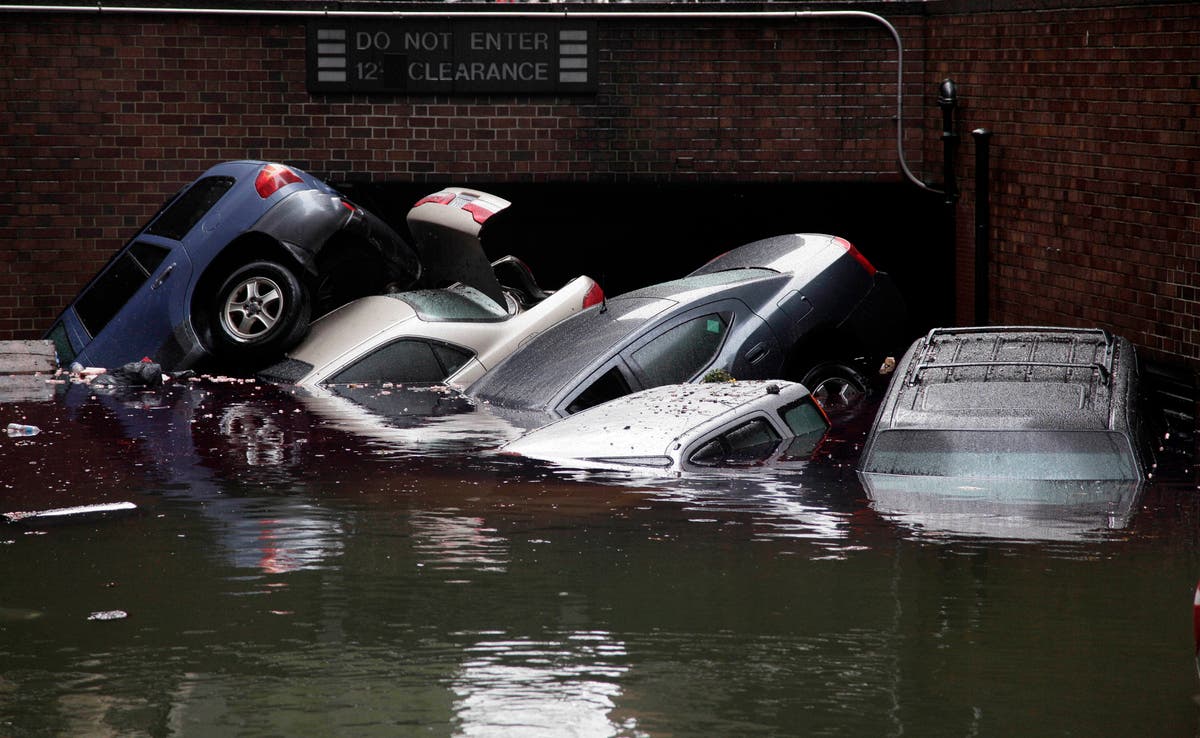
NEW YORK, NY — Devastating floods so rare they used to hit New York City once every 500 years will be battering the region every five within the next three decades, a new study warns.
Released just days before the fifth anniversary of Superstorm Sandy, the study from researchers at several universities and published Monday in the Proceedings of the National Academy of Sciences, primarily blames the predicted change on sea-level rise caused by global warming.
"This is kind of a warning," said Andra Garner, a Rutgers University scientist and study co-author. "How are we going to protect our coastal infrastructure?"
Find out what's happening in New York Cityfor free with the latest updates from Patch.
(For more neighborhood stories, subscribe to Patch for daily newsletters and breaking news alerts.)
The researchers based their analysis on multiple models that factored in predictions for sea level rise and possible changes in the path of future hurricanes.
Find out what's happening in New York Cityfor free with the latest updates from Patch.
Many of the models had a dose of good news for the city – climate changes may mean that storms are more violent, but they are also likely to swing further off-shore, meaning storm surge heights aren't likely to increase substantially through 2300.
However, rising sea levels could mean that floods of 7.4 feet or more that struck the New York city area roughly once every 500 years before 1800, and which occur roughly every 25 years now, could happen once every five years between 2030 and 2045.
Researchers made no recommendations on what public officials or others should do to prepare.
"The idea is this kind of study we hope will provide information that people making those kinds of decisions can use," Garner said. "We know that when Sandy hit in 2012, of course, subways, tunnels flooded, power was knocked out, parts of the city were just really devastated so studies like this provide some warning."
Other researchers included scientists from Penn State University, the Massachusetts Institute of Technology, Princeton University, Nanyang Technological University in Singapore, the University of Massachusetts Amherst and the Woods Hole Oceanographic Institution.
The researchers said there is scientific consensus that global sea level will rise in the coming centuries, although it is not certain how high. They cautioned that sea-level rise at New York City could exceed 8 feet by the end of the century if, in a high-emissions future, the West Antarctic ice sheet rapidly melts.
The study expects about 5 inches to 11 inches of sea-level rise likely in New York City between 2000 and 2300.
"I think the study is valid, but year 2300 is a long way off," said Billy Sweet, an oceanographer for the National Oceanic and Atmospheric Administration who was not involved in it. "What is more certain is the amount of sea level rise likely to occur in the next 50 to 100 years or so and that storm surges from nor'easters and hurricanes will continue to pose a risk for New York City."
Hurricane Sandy merged with two other weather systems into an unusual storm that devastated the oceanfront coastline and caused catastrophic flooding in New York and cities in New Jersey on Oct. 29, 2012. It was blamed for at least 182 deaths and $65 billion in damage in the U.S.
State and city officials in New York say they are planning numerous projects to guard against future flooding, including fortifying utilities and transit facilities, and note other projects are still in the design stage.
Lead Image: In this Oct. 30, 2012 file photo, cars are submerged at the entrance to a parking garage in New York's Financial District in the aftermath of Superstorm Sandy. Credit: AP Images/Richard Drew