Local Voices
Street Vendors Party To Celebrate Historic City Reforms
About 250 people gathered in Greenwich Village to celebrate a City Council vote to create 21,500 new vending permits decades in the making.

Feb. 12, 2026
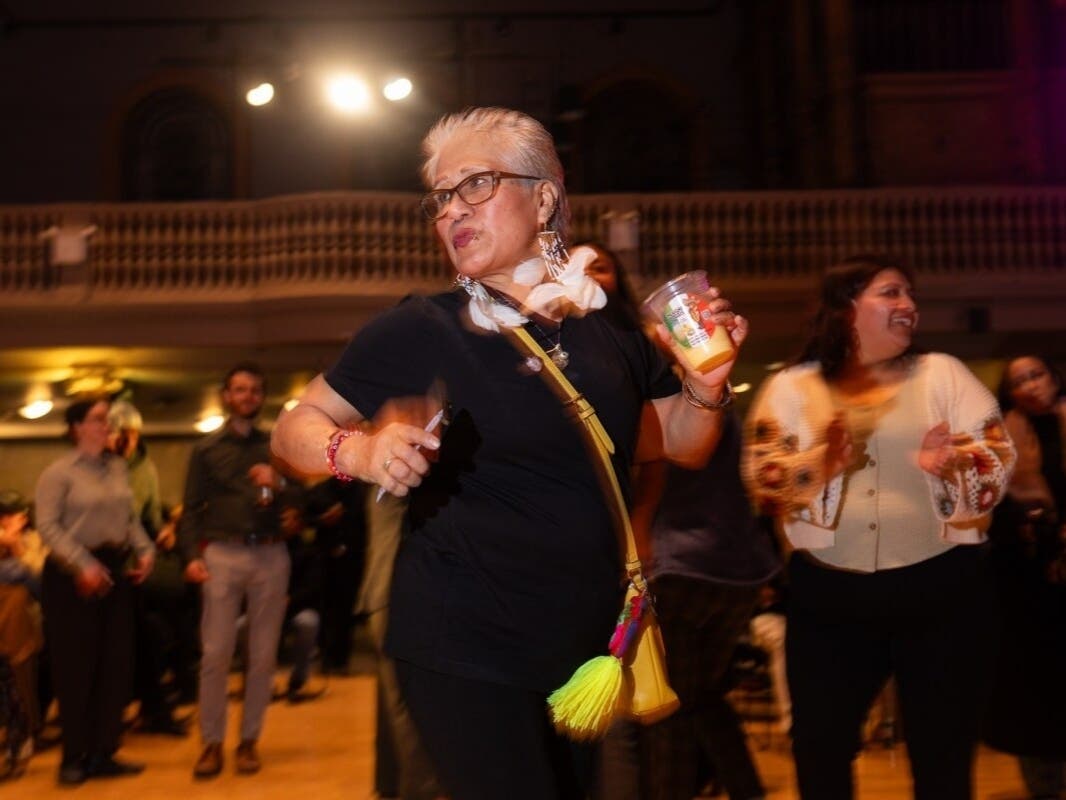
A mariachi band readied for a performance inside Judson Memorial Church in Greenwich Village Monday evening while street vendors danced to salsa, reggaeton and pop music spun by a DJ.
Find out what's happening in New York Cityfor free with the latest updates from Patch.
Lines formed before tables serving kati rolls,dumplings and spring rolls as vendors fed one another and laughter and conversation filled the room.
“So many people asked if they could bring food that I had to say no to a couple people,” said Eric Nava-Pérez, an organizer with the Street Vendor Project, the non-profit that hosted the party for 250 vendor members and supporters to celebrate a historic victory that would finally allow vendors to ply their trade legally and legitimately.
Find out what's happening in New York Cityfor free with the latest updates from Patch.

Street vendors dance at a party in Greenwich Village’s Judson Memorial Church celebrating their legislative wins, Feb. 9, 2026. Credit: Ben Fractenberg/THE CITY
A little more than a week earlier, the City Council had overridden former Mayor Eric Adams’ end-of-term veto to pass a package of bills that includes 11,000 new food vending permits and 10,500 new merchandise vending permits that will roll out over the next few years.
With those new permits, the city will finally offer roughly enough licenses to cover the estimated 23,000 vendors who currently work the five boroughs — a goal which vendors and their advocates have fought for years to accomplish.
Thousands of merchandise vendors who had been unable to obtain permits for decades will see the cap of 853 licenses, set in 1979, lifted for the first time. Food vendors, too, will see the largest permit expansion since a cap of 5,100 was instituted in the 1980s. (A 2021 law meant to make additional permits available has yielded only a handful due to implementation delays.)

Street vendors and their supporters line up for food during a potluck celebration at the Judson Memorial Church in Greenwich Village, Feb. 9, 2026. Credit: Ben Fractenberg/THE CITY
Rehana Parcin, 39, recalled the moment she and her husband learned of the bill’s passage as she carefully placed chicken and veggie kati rolls onto small bamboo boats for people who’d queued up before her stand Monday evening.
“We were in the cart when we heard the news, and we were so happy that we gave some of our customers free food that day,” Parcin told THE CITY in Bangla via an interpreter with the Street Vendor Project.

Vendor Rehana Parcin hands out her kati rolls during a party at the Judson Memorial Church in Greenwich Village, Feb. 9, 2026. Credit: Ben Fractenberg/THE CITY
For nearly 13 years, Parcin said, she and her husband have been stuck on a waitlist of more than 10,000 people for a food vending permit. They’ve been operating with one they’ve been renting from the underground market for $12,000 a year — a common practice for vendors who struggle to access permits. By comparison, official permits typically cost only about $200 to obtain or renew.
Parcin, who has been a vendor since immigrating to New York in 2010, said she’s hopeful about finally getting a permit of her own, and plans to spend the money she’d otherwise be using on a rented permit to expand her offerings to include specialties from her native Bangladesh.
“After all these years, we’ll finally be independent, we’ll finally be free, and our cart will finally be self-reliant,” Parcin said.
A vendor holds a kati roll during a potluck party at Judson Memorial Church in Greenwich Village, Feb. 9, 2026. Credit: Ben Fractenberg/THE CITY
‘Life’s Gift’
About an hour into the gathering, Semi Lopez, 42, emerged from the crowd with a five-gallon jug of piña colada hoisted over his shoulder. A swarm of people followed, with some volunteering help and others chasing after the cold, delectable drink.
“I’ve always liked supporting the community — I’ve always thought that,” Lopez said in Spanish. “We started just like any other street vendor — from the bottom, without a permit, without anything — so it’s good for us to support each other because I’ve seen the police take everything from vendors.”

Street vendors carry jugs of Piña Colada into a potluck party at the Judson Memorial Church in Greenwich Village, Feb. 9, 2026. Credit: Ben Fractenberg/THE CITY
Lopez has been a vendor in Sunset Park for 11 years, and got his start selling Mexican jello out of a laundry cart after a robbery left him physically unable to continue his work in construction. He now sells Mexican hot dogs and hamburgers from two food carts, he said, after expanding his business several years ago with two permits he’s been renting from the underground market for roughly $36,000 a year.
The native from the Puebla state of Mexico said he only became a member of the Street Vendor Project a few months ago, after police officers ramped up their crackdown on vendors in the area. But already, he said, he’s touched by the camaraderie and impact of the movement.
As part of the vending reform package, the City Council in September also overrode another Adams veto to remove criminal penalties for licensed street vendors.
“It’s a really big win, and I’m really happy about the new opportunities,” Lopez said. The permit expansion bill passed in a veto override late last month; however, it also stiffens rules around license suspension and revocation for vendors who repeatedly violate laws governing where and when they can sell.
Still, with the money he hopes to save from permit rentals, Lopez said, he’ll come closer to his dream of opening a brick-and-mortar place with an even greater variety of Mexican food.
Across the room, Aminata Volta was filling out a form to renew her Street Vendor Project membership. The first line of the membership pledge reads: “I am becoming a member of SVP because I want to help BUILD A MOVEMENT of street vendors fighting for stronger rights and better working conditions.”
Volta immigrated from Burkina Faso in 1987, and sells handmade jewelry and accessories in Harlem. She said she had received a letter just a week earlier informing her of good news she’s been waiting nearly a decade for: “Your number has been reached on the waiting list to apply for a General Vendor permit.”
“I almost fainted,” said Volta, 67, who’s been vending since 1989. “I called everybody to tell them about it.”
Among the people Volta called was Fatoumata Camara, a 73-year-old Bronx jewelry vendor from Côte d’Ivoire, who’d entered the waitlist about a decade ago upon Volta’s encouragement. Camara said she is still waiting for her number to be called, but is hopeful that the new permits will speed up the process.
Volta, meanwhile, encouraged her fellow vendors to remain patient as the process plays out — describing the passage of the reform package as “life’s gift.”
“I can’t wait for the other vendors to get their permits,” Volta said. “The joy — I want them to feel the same joy.”
Rosario Troncoso, for one, said she screamed in her apartment when she learned about the Council’s veto override on permit expansions. As president of the Street Vendor Association at Corona Plaza, Troncoso has witnessed an exodus of vendors from the once-vibrant public square in Queens since a high-profile crackdown in the summer of 2023 — with some vendors leaving the trade entirely to pursue other means of income.
But the vendors’ latest legislative victory, she said, could encourage people to return to a market that’s been thinning out over the last two years.
“I’ve heard from several people expressing interest in returning. Now that there will be new permits, they’re sort of asking questions,” Troncoso said in Spanish. “It gives me hope that even people who are not on the waitlist might one day get a license in the future. And for me, the fight does not end here. It will continue until everyone can get a license.”
Unfinished Business
As the celebration began to wind down at around 7:30 p.m., MD Nasir Uddin, 38, began to find his way to the exit. Uddin was among the Islamic goods vendors in Jackson Heights who had been ousted from the neighborhood’s “Bangladesh Street” two years ago, just days before Ramadan.
Since then, Uddin said, he has had his setup raided and merchandise confiscated several more times. Still, he has no choice but to operate without a permit after losing his job at a grocery store in 2020, at the height of the pandemic. By that time, the waitlist for a merchandise permit had already been closed for four years.
Uddin described the historic expansion of merchandise permits as a “long-standing dream come true.”
“But how are we going to make sure that the many vendors who’ve been working so hard and been getting so many tickets over the years — who’ve been facing all sorts of challenges — will be prioritized for the new permits?” he asked in Bangla.
But in Judson on Monday night, he celebrated while reminiscing
about the day when a Street Vendor Project organizer called to share the news about the new licenses.
“My family was very, very happy and they were like, ‘Maybe by the end of Ramadan, by Eid, we’re going to be celebrating your new permit,’” Uddin recalled. “But I had to tell them, ‘No, no, no, it’s going to take a bit more time to apply, to get it, and we don’t know what the exact procedure might look like.’”
“Then my family was like, ‘Wait, so you might not get it?’” He said, chuckling. “And they were upset again.”
This press release was produced by The City. The views expressed here are the author’s own.