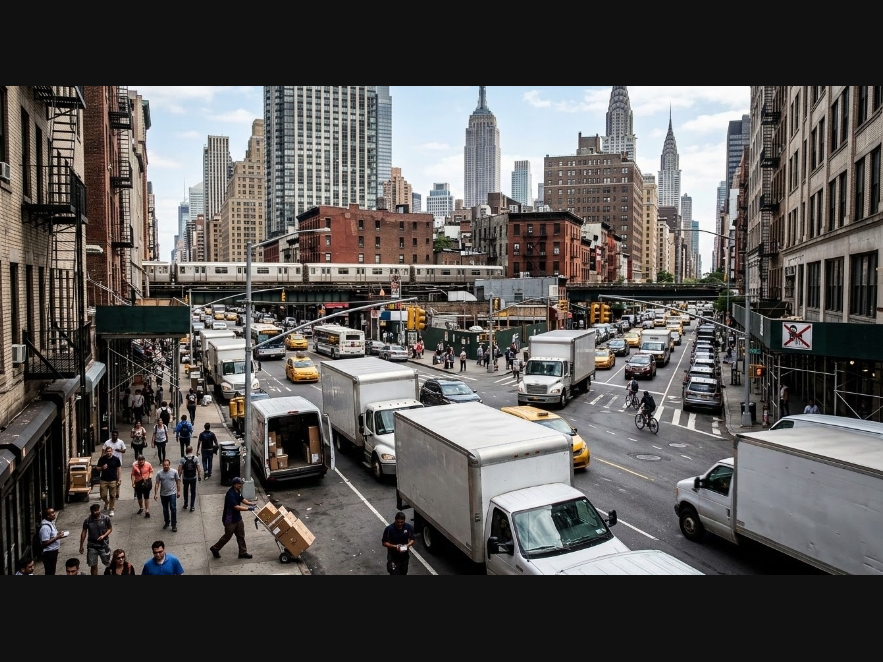
New York City witnessed from a high window is less a city than a daily act of collective improvisation. Thousands of heavy vehicles inch through streets already crowded with cyclists, dog walkers, fruit vendors, construction crews, tourists consulting upside-down maps, and lifelong New Yorkers who have somehow mastered the art of crossing six lanes of traffic without breaking stride.
Every delayed delivery is connected to a restaurant waiting on produce, a neighborhood bookstore expecting new releases, a hospital receiving supplies, or a family preparing for dinner. The traffic is frustrating, certainly, but it is also evidence of a community in constant motion, millions of people relying on one another in ways both obvious and invisible.
Transit Vs Storage
The ordinary observer imagines that the streets are meant for transit, yet anyone with a ledger and a schedule knows that the streets are primarily used for storage. Every square inch of asphalt is contested with a ferocity that would have embarrassed the crusaders. To venture into this arena without a precise understanding of every moving part is to court immediate disaster.
The city does not forgive the unprepared, nor does it accommodate the dreamer who believes that a delivery will arrive merely because it was promised. Success in this crowded theater requires an objective attitude, a realization that a vehicle is not an instrument of freedom, but rather a temporary prisoner of the grid.
Find out what's happening in New York Cityfor free with the latest updates from Patch.
A business may possess grand intentions, the most exquisite materials, and the most dedicated laborers, yet everything collapses if the necessary machinery remains trapped three boroughs away behind a wall of yellow taxicabs. Thus, every entrance and exit is timed to the fraction of a second.
The Tragedy of the Missing Hammer
There is something bewildering about a search for a misplaced shovel in a city that prides itself on skyscrapers. A grand construction project is frequently brought to a humiliating halt not by a shortage of capital or a strike among the bricklayers, but because nobody can identify which flatbed truck contains the specialized wrenches.
Find out what's happening in New York Cityfor free with the latest updates from Patch.
Having a tool tracking system is the only method by which an organization can prevent its magnificent endeavors from dissolving into a farce of frantic searching. It is an absurd spectacle to observe grown men, paid handsome hourly wages, wandering through a half-finished structure like lost children, asking one another if anyone has seen the pneumatic drill.
The loss of a single piece of equipment is never merely a financial grievance; it is a stain upon the dignity of the operation. A system that accounts for every item ensures that the machinery remains the servant of the worker, rather than the object of their endless, exhausting search.
The modern laborer is frequently overwhelmed by the sheer volume of implements required to alter the face of the metropolis. To expect a supervisor to remember the whereabouts of five hundred distinct devices while avoiding the wrath of parking enforcement is to demand a miracle from a mortal. Hence, a business must look upon its inventory with the possessive eye of a collector.
The Harmony of the Shared Ledger
The great difficulty of managing construction fleets in a dense metropolis is the natural tendency of human beings to keep secrets from one another. The office populates itself with thinkers who draw exquisite diagrams, while the street is populated by doers who must find a way to park a vehicle that is forty feet long on a corner that is thirty feet wide. Disaster occurs when these two parties cease to communicate. Using CDE software allows the ideal world of the planner to meet the stubborn reality of the driver.
Without shared clarity, the entire enterprise descends into a shouting match conducted via telephone over the roar of jackhammers. The planner insists that the delivery should have occurred at noon, while the driver points out that the designated street has been closed by the police since dawn. A shared digital space removes the opportunity for these entertaining but expensive arguments.
The city is a shifting kaleidoscope of obstructions, where a water main break or a political parade can instantly ruin the most brilliant logistical strategy. Information must flow with the same speed as the panic it is meant to prevent.
The Heavy Pageant of the Avenues
The sight of massive construction fleets rolling across the Williamsburg Bridge at dawn is a spectacle of terrifying beauty. These great machines are the true architects of the city’s future, yet their journey is fraught with obstacles that would baffle an ancient general. The weight regulations alone are enough to induce a migraine in the strongest mind, to say nothing of the low-hanging overpasses that threaten to decapitate any vehicle whose driver dares to be overly ambitious.
An error in directing one of these larger vehicles is an expensive indulgence that no serious organization can afford. A cement mixer caught on a residential street where it does not belong is a public scandal and a private financial catastrophe. The coordination of movements requires a level of oversight that leaves nothing to chance.
To maintain control over these rolling mountains of steel, one cannot rely on the hope that a driver will find their own way through the labyrinth of the outer boroughs. The path must be determined with absolute precision long before the engine is started, ensuring that every turn is legal, every bridge is high enough, and every destination is ready for the arrival.
The Preservation of Momentum
The ultimate luxury in urban commerce is not speed but continuity. When a project stalls because a truck is delayed or a tool has wandered into bureaucratic exile, the cost is measured in more than dollars. Momentum evaporates, optimism fades, and an entire chain of people finds itself waiting for a single missing piece.
The most successful organizations understand that efficiency is not merely an operational goal but a communal one. Every delivery that arrives on time supports a construction crew, a neighborhood business, a city block under renovation, or a team eager to get to work. Every well-tracked asset and every thoughtfully planned route strengthens a network of people who may never meet but depend on one another all the same.
New York has always been a collection of communities disguised as a single city. The warehouse relies on the driver, the driver on the dispatcher, the dispatcher on the site manager, and the site manager on the crew waiting at the curb. The traffic may never disappear, and the honking will remain a local dialect, but progress belongs to those who recognize that moving a city has never been the work of one vehicle or one company. It has always been a team sport.