Community Corner
Coronavirus Rates Still High In Orange, Rockland Red Zones
To exit a red zone, a micro-cluster's positivity rate has to drop to under 3 percent after 10 days (4 percent in less populated areas).


HUDSON VALLEY, NY — Coronavirus cases continue to crop up in the micro-clusters in Orange and Rockland counties designated by state health officials as red zones, but at greatly reduced rates.
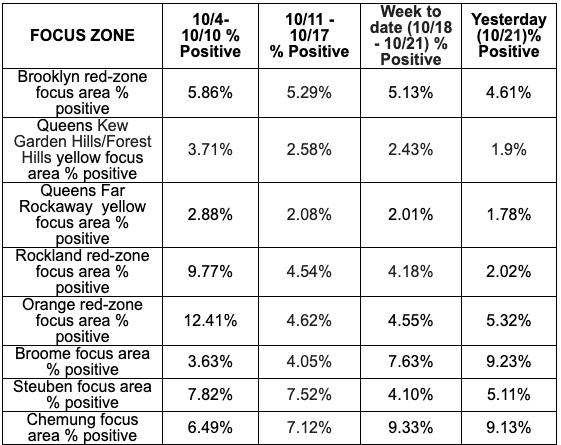
In Orange County, 45 people tested positive for the virus Wednesday, a positivity rate of 5.32 percent. In Rockland, 71 people tested positive, a positivity rate of 2.02 percent, and another three people have died of COVID-19.
Adjustments to the micro-clusters where restrictions on schools, businesses and gatherings are in place will be made through data analysis, Gov. Andrew Cuomo said.
Find out what's happening in New Cityfor free with the latest updates from Patch.
As of Wednesday, neither Rockland nor Orange met the metrics to end restrictions.
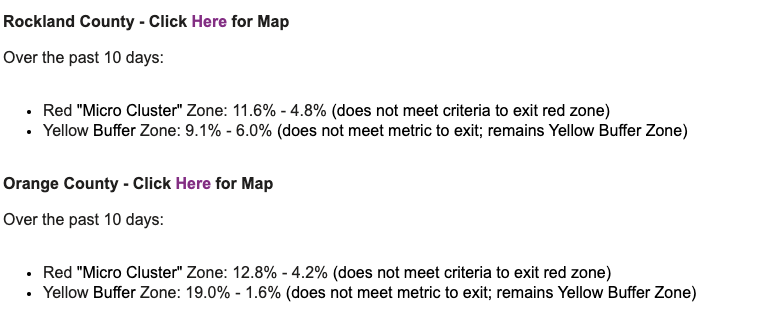
There are now eight micro-clusters in New York State being watched by health officials.
Find out what's happening in New Cityfor free with the latest updates from Patch.
Once any area meets certain metrics that demonstrate substantial coronavirus spread, it may be designated a focus zone: a Red "Micro-Cluster Zone" (with accompanying Orange and/or Yellow buffer zones) or an Orange Warning Zone (with potential for accompanying Yellow Buffer Zone) or solely a Yellow Precautionary Zone. In densely populated urban areas, two buffer zones - an Orange Buffer Zone and a Yellow Buffer Zone may be required.
- Red Zone — Micro-Cluster: A "Red Zone" focus area is put in place to contain spread from a specific, defined geographic area.
- Orange Zone — Warning/Buffer: An Orange Zone area either is put in place primarily in densely populated urban areas as a tight buffer zone around a Red Zone micro-cluster ("Orange Buffer Zone") area OR is implemented independently as a focus area based on the below metrics ("Orange Warning Zone"). The purpose of an Orange Buffer Zone is to 1) restrict activity to prevent further spread from Red Zone area; 2) provide a defined geographic area where metrics can be monitored daily to ensure COVID is not spreading beyond the Red Zone.
- Yellow Zone — Precautionary/Buffer: A "Yellow Zone" area either is put in place as a broader buffer area to ensure COVID outbreak is not spreading into the broader community ("Yellow Buffer Zone") OR is implemented independently based on the below metrics ("Yellow Precautionary Zone"). The purpose of a Yellow Buffer Zone is to 1) restrict some activity to help prevent further spread from Red and/or Orange Warning Zone area; 2) provide a larger defined geographic area where metrics can be monitored daily to ensure COVID is not spreading beyond the Red Zone or Orange Warning Zone.
After 14 days from being placed in a focus zone, the State DOH, in coordination with the local health department, and in consultation with global health experts, will determine whether data sufficiently demonstrate that the area has successfully reduced viral spread to a level able to be contained given testing, contact tracing and other health system metrics.
Health officials will decide whether the Focus Zone will be extended, modified (redrawn geographic boundaries based on case prevalence and positivity data), or ended.
For Orange and Yellow Zones that are put in place solely as "buffer zones" to monitor case spread beyond a designated focus zone, these will be evaluated based on positivity data, cases per capita, and daily hospital admissions over the entire 14 day period to ensure there are no signs of broader spread from the focus area that prompted the zone creation. If after 14 days there has been no notable increase in positivity, new cases, or new hospital admissions from the buffer zone, the buffer zone will - based on other epidemiological factors - become eligible to qualify for a new zone designation, or ending a zone designation, if appropriate.
Get more local news delivered straight to your inbox. Sign up for free Patch newsletters and alerts.