Neighbor News
- Augustus Griffin - - A Powerful and Majestic Link -
-This is about Augustus Griffin, and yes, there's a point to this, since this author owned VILLAGE HOUSE in Orient, New York.
BY DANNY McCARTHY
Jasper and Hannah Griffing had 14 children. Hannah “departed this life in Southold the 20th day of April 1699” at the age of 46 and two days. Jasper Griffing lived to be 70 years of age. He died April 17, 1718. There were brown sandstone markers placed at their graves. They were the ancestors of Orient journalist Augustus Griffin and the Riverhead Griffins. The parents of Augustus Griffin were James and Deziah (Terry) Griffin.
Augustus Griffin was a well-respected man about town. He walked down the street with his cane in hand and a step of importance which give him an air of command. He was also a man sensitive to the needs of his countrymen and women. He published his book titled Griffin’s Journal when he was at the age of 91 in 1857. Griffin’s Journal is a history of Southold Town and mainly concerns discussion on Orient that he compiled from diaries and journals he maintained throughout his life.
Find out what's happening in North Forkfor free with the latest updates from Patch.
In a July 28, 1983 Traveler article, it is noted that in the back of Griffin’s Journal, there are collections of short essays on such topics “of a social nature as drunkenness, kindness and motherhood.” Women were written about as being “free of male-dominated pressures.” He had a great recollection of individuals “who in themselves offered a worthwhile glimpse into what the English-speaking people of the North Fork were made of at the time.”
Griffin’s Journal is true history-in-the-making. Augustus Griffin has left us a legacy in book form taken from a 58-year handwritten record of Early American life. It is a true mother lode of local history and genealogy. Griffin kept endless records of births, deaths, and marriages of local folk. Greenport is even spotlighted. There are details of the beginnings of that village showing that the Greenport of the early 1800s was not too dissimilar to the Greenport of today. Greenport is still a true “bonanza for investors.”
Find out what's happening in North Forkfor free with the latest updates from Patch.
The Oysterponds Historical Society reproduced the journal and added a hard-cover index supplement. Many of the names listed are of family names that are still prominent in Southold Town. The journal and index are also the works of The Mad Printers of Mattituck.
Augustus Griffin wrote in his Griffin’s Journal that an Indian native during the time of Jasper Griffin presented Jasper with a wood porringer. Porringers were bowls that were usually made of pewter. This gift was acknowledged and appreciated by the Indian native.
There are other remarkable stories in Griffin’s Journal. One details the assistance of Deziah’s housekeeper, Mrs. Jerusha Corwin, “who was assisting mother at the time.” It seems that on the first of August, 1773, there was a miserable storm. British troops arrived at the house of James Griffin during the storm and were at the door. Augustus Griffin wrote: “They demanded, with shameful oaths, the body of my father, dead or alive.” When the angered bunch was at the bottom of the stairs inside the house James Griffin was at the head of the stairs. He waited for a British soldier who was on horseback to move to another side of the house. Mrs. Corwin showed the troops everywhere Griffin was not. “Perfectly cool and collected, with a smile, she showed them every room and closet below, previous to going up stairs.” The horseman outside did move so Griffin, in his nightshirt, leaped out a window some 20 feet to safety. “As they were mounting the stairs, Mrs. Corwin rubbed the candle out, making them believe it was they who did it. Before they could light it again his escape was affected. This circumstance no doubt saved him.”
There have been inaccuracy charges against Augustus Griffin’s writing but like one-time Oysterponds Society director Barbara Fertig said, “His work was probably very accurate but not written in a way that was understandable to other people. He would say, ‘Thomas Terry, son of Thomas Terry,’ and we don’t know which Thomas Terry he was talking about.”
Reverend Epher Whitaker shares in his book, History of Southold, of how Augustus Griffin says in his Journal that around 1638 a group of 13 men and their families left their home of England and later arrived at New Haven, and then in the fall of 1640 they all were on board a vessel to Southold. The thirteen included: “Rev. John Youngs, Barnabas Horton, William Wells Esq., Peter Hallock, John Tuthill, Richard Terry, Thomas Mapes, Matthias Corwin, Robert Akerly, Jacob Corey, John Conkline, Isaac Arnold, John Budd.” It is brought out in Reverend Whitaker’s book where he feels Augustus Griffin was somehow incorrect in his Journal. Supposedly the 13 men did not head to Southold all together at the same time nor did they reside in New Haven previously all together either. Reverend Whitaker writes: “There is only a tradition that one of them was ever in Southold at any time.” Reverend Whitaker gives other clarifications and perhaps corrections as well.
No matter what the end result is, Augustus Griffin is a champion. He may have received criticism for his writing but he has left us a true heirloom that all of us can profit from.
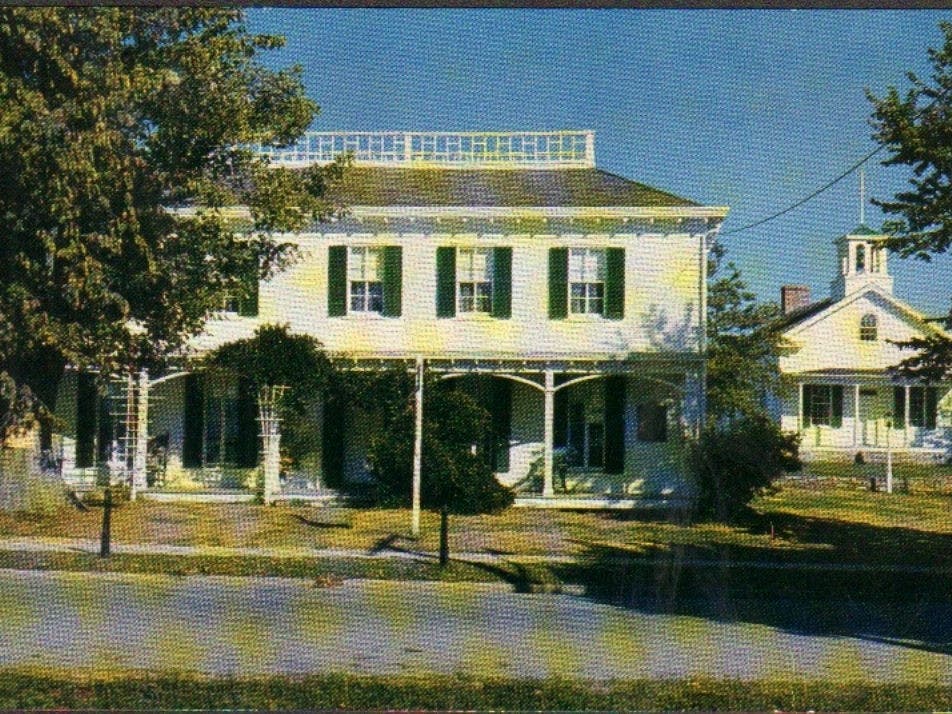
July 7, 1945 was the date the old Village House in Orient opened as the home of the Oysterponds Historical Society (OHS) on Village Lane. Village House was the first building acquired by the society and the only one that stands on its original site. Mrs. Jeremiah Vail operated a boarding house there in the 1800s. An 1873 map identifies it as the “Village Hotel.” It was originally the home of Augustus Griffin who built the earliest part of the structure and enlarged it and operated a tavern there. He was a school teacher and Innkeeper who provided room and board to sea captains plus merchants and other visitors.
According to the Southold for the Preservation of Long Island Antiquities (SPLIA) Orient volumes, there are signs of a former greenhouse conservatory once being on the property and a barn where the Village House is located. Prominent merchants and builders that were part of the Douglass family retired to Orient from Brooklyn and included a James Douglass who is said to have built the Village House. Square handmade nails were throughout. Hand-hewn beams were in the cellar. There was a crawl space. In the 1950s, exterior stairs were added and more extensive remodeling was done in the 1960s. “The front section was built in two sections and is the oldest part. The floor level is a step up to the added section.” When remodeling was done one section of the wall adjoining the old part was left uncovered and actually showed Sage brick wall as well as old timbers. The roof looks flat and has a slight curved effect since the beams are “carved out of solid timbers in a manner called a Carlin in Marine {-type} building.”
The year the Oysterponds Historical Society was dedicated marks VE and VJ days and dutifully represents a tribute to the men and women of World War II. An array of permanent collections was placed on display that includes an Indian collection of arrowheads, tools, and pottery spotlighting the pre-Poquatuck and Poquatuck periods. Orient’s whaling master Edwin P. Brown has his well-represented collections on view, including sea shells, corals, and carved handiwork that was done by natives of foreign lands, which actually does connect Orient with the world. There is a Civil War room where many of the records of Orient men and their personal effects who enlisted during that period are kept. More looking back can be done at the OHS Village Hall where there is a model of the old Orient Windmill. Older Orient village is also represented with photographs. There are even ledgers of a “General Store.”
Membership totaled some five or six hundred when the organization first opened in 1945. Oysterponds Historical Society Historian Herbert M. Hale listed the staff of this truly outstanding organization in the March 1946 issue of the Long Island Forum: The president was George R. Latham, vice president was Alfred Luce, Mrs. Walter Prince was secretary, Mrs. Myron Rackett was assistant secretary, the treasurer was Mrs. H. F. J. Knobloch, and the trustees were Mrs. Douglas Knox, Mrs. S. Wentworth Horton, Elliot Brooks, Vinton Richards, and Harry S. Newman.
A complete collection of buttons and mounted costumes of various periods were on exhibit during the summer of 1945. Oil paintings, watercolors and pastels by local amateur and professional artists were hung as rotating exhibits throughout the season.
The officers of the society maintain a Guest Book that has seen thousands of entries of names and represents residents from all over Long Island and Greater New York as well. Membership and visitors reveal some spirit.
Most of the meetings of the Oysterponds Historical Society are scheduled to be held in the Old Point Schoolhouse which is presently on the grounds of the society. The Old Point Schoolhouse was originally built in 1888 and stood at the tip of Orient Point. Due to declining enrollment, the building closed in 1930. The building lost its cupola in the 1938 hurricane. The present site location of the building took place in 1949 where the Janet T. Swanson Gallery and the Beach Plum Christmas shop are housed. Lectures, arts and crafts and historical exhibits, and flower shows and such are held on the main floor. The “pine room” is on the lower level where community activities for young and old are scheduled that include conferences, club meetings, and entertainments. There is a fireplace and kitchenette there.
House tours are routinely scheduled by the Oysterponds Historical Society. The Petty Homestead, which is one of the oldest houses in Orient village, was featured in a 2003 OHS house tour.
In 1995 the Historical Society had an exhibit that shared different interpretations. Artists like William Steeple Davis (1884-1961) were represented. The works of Brian Hagiwara, Emma Latham Beebe, and James Kent were on-hand as well as L. Vinton Richard and Lloyd Ziff.
In August 1861, the original poetry that follows was written by Miss C. A. Jacobs and was dedicated to the Sage of Orient and Southold Town’s first chronicler, Augustus Griffin, who was in his 95th year at that time:
“TO AN OLD FRIEND
When the shades of life’s last evening,
Gather round the closing day,
And the shadowy forms of heaven
Count earth’s fleeting heart’s away, —
When the golden sands are ebbing,
Slow and sadly to the shore,
And the dying harp hath spoken,
All its murmuring music o’er, —
When the wearied footsteps falter,
On the confines of thy tomb,
And thy fairest hopes have faded,
In the twilight’s deepening gloom, —
Then may hope’s immortal blooming
Cluster round thy closing day,
And the angel harps of heaven guide
Thee o’er the spirit way.”