Politics & Government
Crackdown On Food Trucks At Wineries Sparks Fury
A livid contingent of winery representatives came to a special Southold Town board meeting demanding answers.


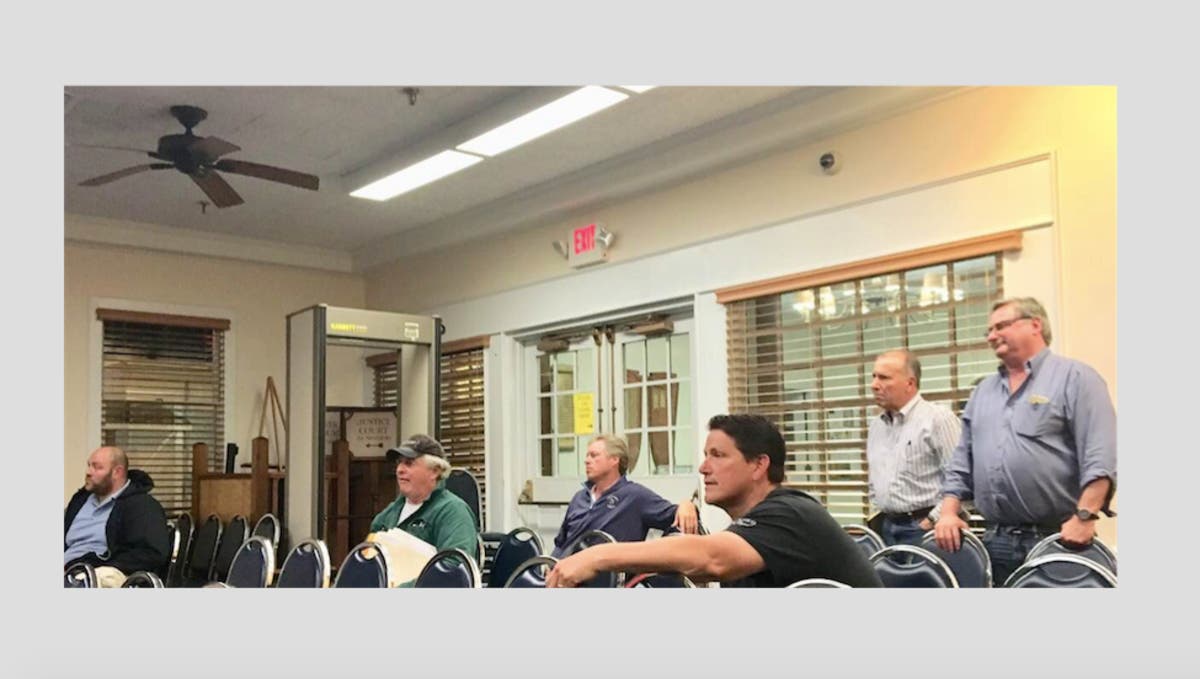
SOUTHOLD, NY — Tempers flared at Town Hall Wednesday night as winery representatives posed questions regarding recent warnings by Southold officials that a crackdown on food trucks was coming soon.
At a special town board meeting, when the issue of food trucks was raised — members of the wine industry voiced concerns over news that wineries with food trucks would be issued citations soon — Councilwoman Jill Doherty said the issue was not food trucks but instead, zoning, with food trucks, a retail use, not allowed on certain parcels zoned for agricultural or residential use.
Mike Falcetta, general manager of Sparkling Pointe Vineyard, said food trucks had been operating for years with no enforcement until now.
Find out what's happening in North Forkfor free with the latest updates from Patch.
Councilman Bob Ghosio said there had been hot dog trucks in past years; Councilman Bill Ruland, the town board liaison to the town's agricultural advisory committee, said those were allowed.
In an email after the meeting, Ruland said, "Complaints from local food establishments prompted the surveying" of food trucks. He reminded that the town attorney had said no citations have been issued so far.
Find out what's happening in North Forkfor free with the latest updates from Patch.
"The current code does not allow retailing in the retail and agricultural conservation zones, so food trucks and other types of retail are not permitted. The next step in my mind would be a discussion with those involved to see if any solution to the issue is attainable," Ruland said, adding that he was not sure of the number of food trucks operating but that there were "several, for sure."
When asked how many food trucks have been surveyed, Southold Town Attorney Bill Duffy said the town has been "shorthanded" and not able to get to as many wineries as planned; the town, he said, has seen about six food trucks so far with about 15 to 20 around town in total.
The town decided to start surveying food trucks because of complaints, Duffy said. The town began issuing citations last year. "Now, it's the beginning of the season and we just wanted to see how big of a problem it is," he said.
Last year, the town cited 8 Hands Farm for not having an approved site plan, Duffy said. Macari Vineyards was also cited for their Avelino food truck, which also has no site plan, Duffy said.
The difference between the two businesses, Duffy said, was that 8 Hands sells food they've grown and processed on site while Macari's food truck "is a completely separate business from the winery." Both properties, he said, are in residential or agricultural conservation zones, where retail is not allowed.
"This is not about wineries," Duffy said. "If they're going to operate retail, they have to have the zoning."
Another food truck set up right on the Main Road in Mattituck last year, Duffy said.
Neither representatives from 8 Hands Farm nor Macari Vineyards immediately returned calls or written requests for comment.
Ruland then said there would be a discussion on Tuesday when the full board was present; Southold Town Supervisor Scott Russell had a family emergency and Justice Louisa Evans was not present.
Falcetta asked what, exactly, the problem was that had led to the crackdown on food trucks. "There's no identifiable problem," he said.
"If it's not in the code, you don't get to do it," said Southold Town Councilman Jim Dinizio. He said business owners should outline what they needed and then, he and the board could discuss options and reach some compromise on both sides.
Falcetta said he respectfully disagreed, stating that he believed it would be easier for board to identity issues and concerns and then discuss them.
"What do I know about a food truck?" Dinizio asked. He agreed with Doherty and said the crux of the issue was retail in residential and agriculturally zoned areas. "I’m all for someone coming and explaining to me how this will be good for the town and then, we can make a law. You can’t say to us, at least to me, that you want me to make a law to govern you when I know absolutely nothing about it."
Falcetta said again his goal was asking the town to identify issues and concerns.
Dinizio said the issue was trucks parked on residential property and selling food, a retail use.
"How do we solve that? I don't know. I'd love for them to make money. . .but we can't have it on every piece of residential property," Dinizio said.
Falcetta asked if the issue was food trucks or the matter of retail; Dinizio said it was a zoning issue.
"There's no end to people's entrepreneurialism," Ruland said, pointing out that someone recently wanted a "pocketbook truck," too. He added that the issue wasn't just about food trucks at wineries, specifically; the concern is food trucks on residential and agriculturally zoned parcels.
Some restaurant and deli owners have complained, Ruland said.
Falcetta asked the board to specify the problems voiced by the deli and restaurant owners, without naming them, "so we can come to a reasonable resolution."
Food trucks are a transient business, said Ghosio. "They can show up from out of town and compete against people who pay into the tax base here." He added that he liked food trucks but that they were usually found in urban areas, not small towns where they could undercut small local businesses.
Steve Bate, acting director of the Long Island Wine Council, pointed out that some established businesses in town have gotten permits for food trucks. "It's an issue of permitted uses. All of a sudden wineries are being cited? People have made plans for the season."
Wineries, he added, are required to have food. "It's not sit down meals," he said. He agreed that out of town food trucks could, perhaps, be regulated by the town, with preference possibly given to local businesses with food trucks.
"We want an even playing field with brick and mortar businesses," Doherty said.
"Why this week?" Falcetta asked. "Was someone run over by a food truck? Did they get salmonella? What led to it?"
"It was a culmination of things," Ghosio said.
Doherty said the issue has been discussed for years; a few years back, the issue was raised about food trucks parking at local beaches.
Duffy reminded that the only violations were issued last year; no businesses have been cited yet this year. "We're just surveying what's out there."
Falcetta said in Los Angeles, when smog was identified as a problem, officials worked toward a solution; he added there has been no clear delineation of what the problem is.
"We're trying to be proactive," Doherty said.
Dinizio reminded that the first winery to serve food only offered cheese, crackers, "a small glass of wine and a guy with a guitar." Suddenly, he said, the issue escalated until egregious quality of life issues were reported at the now shuttered Vineyard 48.
Kathryn Sepenoski said the wineries might have "preferred vendors" that they knew adhered to health and safety standards.
Duffy said the bottom line was that retail was not allowed.
Attorney Pat Moore disagreed, stating that wineries are not restaurants. "Food is ancillary."
Sepenoski said she'd asked Russell how many complaints the town had received. "They have the ability to disrupt business," she said.
One board member said there had been "in the area of six" complaints; another said "one."
Winemaker Anthony Sannino, owner of Sannino Vineyards and president of the Wine Council, said he'd been told the town board had made a decision to issue citations to wineries with food trucks. Doherty said the board had not made that decision.
Instead, Dinizio explained that new code enforcement officers have been hired and more is getting done and code enforced. Doherty said code is being enforced in all areas, including signage.
"Someone at the top decided food trucks were not allowed at wineries," Moore said.
Dinizio said he did not agree with Moore's interpretation. "If we get complaints, code enforcement handles it," he said.
Dinizio then said caterers could be used at wineries; business owners asked how that was different than allowing a food truck on a property.
He then asked why people weren't allowed to bring their own food to wineries; winery reps said it's a security issue.
Doherty felt that the discussion was going too far without a full board or a published meeting notice to inform the public.
Sal Dilberto of Dilberto Winery said the argument of public safety made no sense, as having no food would allow people to consume alcohol on empty stomachs, adversely impacting public safety.
"The time for cheese and crackers has passed," he said. "You're trying to cripple us. It feels like that."
"It is that," Sepenoski said.
Falcetta added, "There has been no input from the industry."
"We're all willing to work with you," Doherty said.
The board agreed to discuss the matter further on Tuesday.
After the meeting, Sannino said the news came with no warning or public discourse. He said Russell called him and some other winery representatives in to tell them that the town's code enforcement officers would soon be issuing citations.
No citations have yet been issued, Sannino agreed.
Sannino said he then sent out a memo to industry professionals, informing them about the coming enforcement efforts.
Russell responded by email when asked about that meeting with Sannino. "He's not being very honest. Steve Bate was at the agricultural advisory meeting when it was discussed and I told that committee that I was reaching out to the Wine Council to discuss it some more, which is what led to the meeting" with Sannino, wine council members, Chris Baiz, Bill Ruland, and himself, he said.
"I certainly didn't call him into my office," the supervisor added. "I reached out to him after the agriculture advisory committee meeting to see if he wanted to bring some representatives of the wine council together with Councilman Bill Ruland and myself to discuss it. He said 'yes.' I thought it was a productive meeting."
Sannino, Russell added, came before the town board at work session a few months ago where we all agreed to improve communication. "I thought that getting together and discussing issues is what he meant," he said.
At least one food truck owner wanted to speak out on the possible crackdown.
Jason Tepper, owner of the Farm To Truck food truck, said he's based at Martha Clara Vineyards many weekends.
"Food trucks are one of the hottest things going around," Tepper, from Patchogue, said. But, he said, "It is pulling business away from restaurants. Food trucks are able to sell great, hot meals for a decent price, important in this economy."
Not only that, Tepper said, food trucks foster a friendly, family ambiance. "I'm cooking and talking, having conversations," he said.
Owning a food truck, he said, has benefits. "You can experiment. There are no boundaries when it comes to food." As a single father of two young girls, Tepper added that owning the food truck affords him flexibility in his schedule.
In Tepper's opinion: "Wineries should be able to do whatever they want. They're helping guests to consume food so they don't drive home drunk."
Patch photo by Lisa Finn.
Get more local news delivered straight to your inbox. Sign up for free Patch newsletters and alerts.