Politics & Government
Crowd Divided Over Proposed Greenport Short Term Rental Law
Some pleaded to allow short-term rentals to continue so they wouldn't have to sell; others said Greenport is losing its volunteers and kids.



GREENPORT, NY — A crowd turned out Thursday night to speak passionately on both sides of the short-term rental debate in Greenport.
Throughout the public hearing, which was held in an orderly fashion with each speaker given five minutes, both sides of the issue were painted by those deeply invested in the village canvas.
The public hearing was held to address the newest version of the short term rental code, which states that short term rentals are prohibited for time periods of less than 14 days, except for a two family house where one apartment is owner occupied, or is occupied as a long-term occupancy, or a portion of a single family house, the remainder of which is owner occupied or occupied by a long term occupancy.
Find out what's happening in North Forkfor free with the latest updates from Patch.
Greenport Mayor George Hubbard began by explaining the long, six year road of discussions regarding short-term rentals, including a public hearing in July on a previous draft.
Attorney Pat Moore, representing a group of Greenport homeowners who have engaged in short-term rentals of their properties, said she maintained that those who operate STRs have invested in the community and, as they have been operating in the village, should be grandfathered.
Find out what's happening in North Forkfor free with the latest updates from Patch.
Moore also said she believed businesses in the village would be hurt by the STR code. In addition, she said, it was not true that if short term rentals were banned, those properties would be put into the long-term rental pool; those homeowners are not looking to rent their homes year-round, she said. Moore also said she did not believe the term "owner occupied" had been clearly defined.
"You have a unique gem of a village," Moore said. "The short term rental law is more of a detriment than a benefit."
In addition, she said, her clients had done a financial analysis of the alleged 30 short-term rentals in the village and said they generated $2 million for the local economy every year, based on 37 percent occupancy, a three bedroom house, and six people spending $100 per day whenever they visit.
Greenport Village Trustee asked that the study and research methodology be provided; his own research has indicated that there are 64 to 62 short term rentals in Greenport.

Colin Ratsey said he came to the village to raise his family but short-term rentals can irreparably alter the fabric of the community. As it stands, he said, fire department volunteers are decreasing; the community needs its children to remain viable. "We are losing the kids," he said. "There's no one here to work."
Amenities such as bike paths are needed, he said. "Whatever we put into the community, we get back, but if we don't put anything in, we won't get anything back. We need kids, not rentals," Ratsey said.
Joe Flotteron, owner of Peconic Watersports, said he represents the younger generation, and while he couldn't afford to live in Greenport six years, ago, short term rentals have allowed for a new economy that exists in the summer which "allows people like me to move out here and make my living. I can’t get into old businesses, they are dying — but this does work." He, his brother, and his girlfriend are able to live in work in Greenport now, due to short-term rentals, and he said he hires 30 employees, although he has to house them. "If that goes away and dries up, I'll have to move back to the city. There are two sides to all of this," he said. "Whatever you do will impact people's lives."
Madison Fender, a year round resident, photographer and artist said she's struggling to find a year round rental and "it's nearly impossible." She added that there are hotels, B&Bs and short-term rental listings but only three year-round rentals currently listed on a popular real estate site. "Our village can barely accommodate the flux of tourism. We don't have parking spots. . .there are 'help wanted' signs in the height of the season. Our businesses can't run without employees and our employees can't work without housing," Fender said.
She said it doesn't "sit well" when out of town investors buy homes that sit vacant in the winter. "I live here and I easily spend $100 a day, even in January and February, but I can't do that if I can't live here," she said. "Please, it's time to draw the line. We need boundaries."
Patricia Hammes said it was critical to maintain the small town sense of community that so many value. "Do you listen to your constituents, who are truly invested in the community, by passing this law or continue to worry about lawsuits, or to play to special interests and big money players, yelling about infringement of property rites?" she asked. "I hope you make right decision."
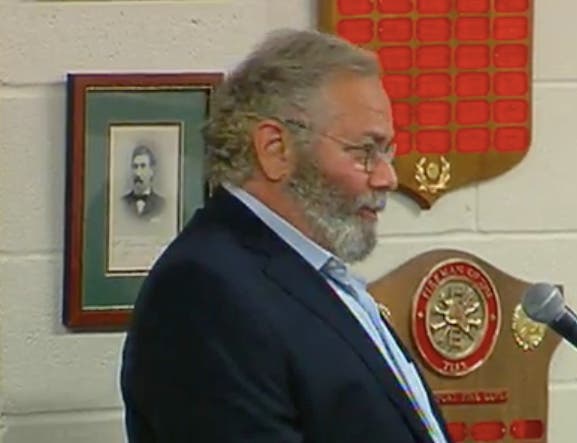
Orient attorney Salem M. Katsh, representing homeowners who have short term rentals, said, in fact, short-term rentals in Greenport are a historical practice. He added that without short term rentals, the idea that those houses would return to the year-round rental stock is a fallacy. "That's not the way supply and demand works," he said. "People who rent a house are not going to rent long-term."
He suggested the legislation could leave the village open to future litigation.
Ian Wile urged the board to "do something."
Karen Rivara said there's a need to maintain a community, and, as the owner of an oyster business, "Every time I get a full-time employee, I sweat over where they are going to live and how much I'll have to pay them for them to be able to afford to live here."
Denise Balzaretti of Cutchogue said her son bought two homes in Greenport, renovating them beautifully and renting them; he wants to have them for his own use, as well, she said. She said the family assumed they were grandfathered in when faced with the new legislation and said his property taxes doubled after renovating.
Of the 820 occupied residences in Greenport, 32 are STRs, she said, or 3.9 percent, which helps to generate income for the village. She added that there are strict rules of the house, including no noise after 10 p.m.
Blake Kirkpatrick said his family bought their Central Ave. home 11 years ago and they "fell in love" with Greenport, the ice rink, carousel, hot chocolate and area eateries.
"I believe wholeheartedly in the community and just registered to vote locally," he said. Their home is more than 100 years old and his family spent hundreds of thousands of dollars to bring it back to its historic luster, he said.
Now, Kirkpatrick said, his family's "personal circumstances have changed" and they need to rent the home. If the law passes and short-term rentals under 14 days are not allowed, they might have to sell the home he hopes to someday enjoy with his own children.
"This is our family home. We are not investors. We are using the income to defray costs," Kirkpatrick said. He asked that the village work together and not "single out" or "villainize" anyone. "We are all working here to get people's heads on beds in Greenport," he said, adding that the clientele for short-term rentals, which often includes families with young children and dogs, is not the same as those seeking B&Bs.
Verona Penalba, an artist, said she had to get two extra jobs to live in the village. "The world is changing," she said. "They travel more; this is what people are doing now." She asked that actual numbers and empirical data about short term rentals be presented so the public can make an informed decision.
Another resident suggested a happy medium, with perhaps a cap of five percent of the village's housing stock allocated for STRs.
Hillary Gulley said she and her husband built a home in Greenport; she is a writer/translator and he is a designer but got laid off during the home's construction. They live in the home but might need to rent it one day to pay for child care, she said. She said she wanted to put a human face on the issue. "The point is, the world is changing, and there needs to be flexibility on some level," she said.
Resident John Saladino, who also serves on the zoning board of appeals, addressed the issue of litigation suggested by the attorney. He said there are only a few ways something could be grandfathered in: it has to have been in existence prior to 1971, or by a variance. "It has to be legal to begin with," he said. Short term rentals, he said, are not a permitted use in a residential district. "The fact that somebody did it doesn't make it legal. We don't live on a prairie. There's a code we have to go by," he said.
For example, Saladino said, if a family owns two homes but don't live there, in his mind, that's a business.
He said the notion that the economy would collapse without short-term rentals is "nonsense" and he said he does not believe anyone on the board has an interest in stalling the legislation, also "nonsense. Everyone serves with the village at heart," he said.
Judy Kirkpatrick spoke after her son and read a letter from Karen Uceda, who runs a cleaning service for several homes used as short-term rentals; her husband is a handyman. The couple was able to buy their first home with the income. "Now we have our American dream," the letter said. If the law passed, their finances would be at risk, she said. "Please, don't take this away from us and from dozens of other families like us. We pay our taxes, but we feel our voices are rarely heard," the letter said.
Julia Moran traveled from her home in New Jersey — she owns a second home in Greenport — to speak because, she said, "this conversation matters." She said there are no official complaints and said the new legislation would divide residents. "I'd like to address the gossip that those who rent their houses are greedy while local business owners are hardworking. It's not a new song and it's not pretty." She said if the legislation is passed, the sentiment will be akin to building a wall around the village and said "outsiders" are considered to be "arrogant, entitled. They are, in short, not us. It's such a disappointment."
She referred to a village census she said reflected a decrease in population. "The people who lived here wanted to escape," she said. A past village board was "visionary" and new tourism in 2010 brought new life to the village, to "a place no one, not even locals, wanted to be," she said, as protest erupted from the crowd. "You can be visionaries or closed-minded. I hope it's the latter," Moran said.
William Swiskey said homeowners have rights and the village board has "picked at" the issue so long that he believes short term rentals are almost "quasi legal" and attorneys would have a good shot at litigation.
Chatty Allen said there had been "a lot of pulling of heartstrings" at the hearing from STR owners who might have to sell their homes if the legislation passed. "I'm sorry, but the village is not responsible for paying your bills," she said, adding: "We're losing people to work in this village. I grew up here and now, I don't know anyone. I used to know who lived in every single house and now, in the winter, they're all dark. We need the bodies in here to keep the village alive and thriving."
Others called out for quantitative data
Sofia Antoniades suggested the village has historically rented its homes to tourists and suggested lawmakers look at the real issues, caused by drunken behavior, and restrict the sale of alcohol.
Attorney Katsch stood up again and said zoning law regulates land use, not owner use. He said renting has always been allowed; clients, he said, have hundreds of thousands of dollars invested in their homes. And, he said, a hearing where individuals could speak for only five minutes with no input from the board was not a great way "to elucidate issues." He also asked for "real data. I don't think you have empirical evidence."
Hubbard said the issue has been discussed by the board for six years.
Kim Swann said her concern was the impacts on the kids and the school. She said she was fortunate to buy the home she grew up in and rents a portion to another local. She said while dining and shopping are one thing, the community needs residents to support fundraisers, to attend football games, "to show kids you believe in them and want them to have a good life. You don't want them to have to pick up and leave the houses they've lived in their whole lives because their parents can't afford to live here."
She said Wile said it best, to think about the horizon. "We don't want to be Montauk, with a trade parade," Swann said.
JoAnne Kiehl said there needed to be a crackdown on crowded and blighted year-round rentals, as opposed to "immaculate" short term rentals. The short-term rental market has built up the village in recent years, she said, adding that many who rent their homes "need to make ends meet."
Lucille Clarke, a fifth generation Greenporter, said she had also purchased her family home."If I can't afford to live here, I will have to sell and move — that's my children's reality. Chatty said said it best, it's not our responsibility to subsidize someone's second home. We shouldn't carry that burden. If you can't afford to live here, sell your home and find a place where you can," she said.
Diane Peterson said she has four children and none can afford to live in Greenport. "We're at a crossroads in the village, taken over by a wave of tourism. We have to strike a balance," she said.
Trustee Roberts read letters from Alexa Seuss, a Greenport High School graduate who cannot afford to rent in Greenport; an East Marion fire chief who had to move out of Greenport due to skyrocketing housing costs; and Marc LaMaina of Lucharitos, who said he wants his staff to be able to live in the area. "I want to be able to operate my business and continue to thrive — 365 days a year. I hope that's not too much to ask," he said.
The board will discuss the issue at its next work session on Oct. 17.
Patch courtesy photos.
Get more local news delivered straight to your inbox. Sign up for free Patch newsletters and alerts.