Community Corner
Crowd Packs Peconic Landing to Learn About Plum Island's Treasures
Guests learned about an inventory of the rare plants and animals on Plum Island, considered by some as an untouched natural paradise.


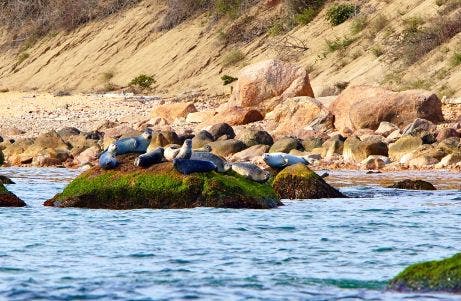

GREENPORT, NY — Imagine an island virtually untouched by development. An island where seals frolic offshore, rare plants flourish, and untouched beaches stretch pristine beneath the sun.
Imagine the excitement of exploring that island, tracking down rare species and plants and discovering nature in all its glory uncovered for the very first time.
That's what New York Natural Heritage Program biologists said they experienced, having completed their field work and written findings on the first ever four-season biological inventory of the plants and animals on Plum Island.
Find out what's happening in North Forkfor free with the latest updates from Patch.
A crowd packed Peconic Landing's Community Center auditorium in Greenport Thursday night for a presentation on the Plum Island Biodiversity Inventory.
The presentation gave guests an update on a year-long inventory of mammals, reptiles, fish, insects, and plants completed during 2015.
Find out what's happening in North Forkfor free with the latest updates from Patch.
Natural wildlife flourishes on Plum Island, experts say: Despite the island’s history of human influence, Plum Island hosts the largest seal haul-out in New York, is inhabited by more than 200 species of birds, and is home to many rare plants, but until recently little else has been known about the island’s biodiversity.
According to those advocating for preservation, and not the sale of Plum Island’s, opportunities abound for conservation management and restoration of biodiversity as well as public access, education and enjoyment.
Southold Town Supervisor Scott Russell was joined at the presentation by Randy Parsons, land conservation specialist with The Nature Conservancy on Long Island and Matthew D. Schlesinger, Ph.D., chief zoologist from the New York Natural Heritage Program and lead scientist on the Plum Island inventory work.
Russell began by discussing Southold Town's unanimous vote in 2013 to adopt new zoning on Plum Island to put the brakes on potential development, should Plum Island be sold, as required by the federal government in 2008.
Southold's zoning on the island includes an 125-acre Plum Island research district, comprising 20 percent of the island, and a 350-acre Plum Island conservation district for the remaining 80 percent, a natural preserve. The goal remains to create some kind of research facility that could possibly keep the more than 340 year-round jobs that currently exist on Plum Island in town.
Russell said the town seized a unique opportunity to preserve Plum Island and said it's his mission to ensure that jobs remain on the island for those employed there.
This year, Rep. Lee Zeldin has worked to halt the proposed sale. In July, Zeldin, a member of the House Transportation and Infrastructure Committee, announced that another legislative proposal that he introduced in the House of Representatives to save Plum Island passed unanimously with bipartisan support.
The amendment to the financial services and general government appropriations act of 2017 prohibits any of the funding within the appropriations bill to be used to market or sell Plum Island. The bipartisan amendment was co-sponsored by Reps. Joe Courtney and Rosa DeLauro of Connecticut, and Reps. Peter King and Steve Israel of New York.
However, the United States Senate must pass an appropriations bill with Zeldin’s proposal in order to become law.
Passage of the July amendment came after a previous bill passed in May, to stop the sale of Plum Island to the highest bidder. In order for that bill, H.R. 1887, to become law, the U.S. Senate also must pass the bill.
“It is time for the United States Senate to act and pass my proposals so that we can pursue a better direction for Plum Island that would allow for continued research, public access and permanent preservation of the island," Zeldin said.
While the Senate didn't act to pass the legislation during the last session, efforts continue and the hope is that action might be taken by November with an omnibus bill, Parsons said.
Parsons said more than 300 employees commute to work on the island; currently as many 65 organizations are rallying to save and preserve Plum Island, he said.
"We're very optimistic the island can be protected, with public access to both the ecological and historic assets over there," he said.
Schlesinger then led the crowd through an enthusiastic presentation of all the flora, fauna, and wildlife found on the island.
"It s a story with a lot of unknowns," he said. "Our goal was to suss out unknowns and figure out what might live there that had never been looked for before. It's a story of things we got excited to look for, and surprises."
Schlesinger gave a history of Plum Island, from the 1600s when the island was sold to Samuel Wyllys, to 1827 when the lighthouse was built by the United States government, to 1898 when Fort Terry was constructed and when, in 1901, the government took full ownership of the island. In 1946, the Fort was decommissioned, and in 1954 the Plum Island Disease Center opened. In 2008, the federal government passed legislation requiring that Plum Island would be sold, sparking a sea of efforts to Save Plum Island.
Plum Island's rich natural treasures
Discussing the 2016 Plum Island Biodiversity Inventory, Schlesinger said the four season inventory had four goals, to document significant coastal natural communities, locate and map rare plant populations, survey for select animal groups, and make management recommendations.
Wildlife documented included bats, small mammals, reptiles, amphibians, butterflies, tiger beetles, carrion beetles, sea turtles, and moths, he said.
A total of 444 plant species were found on Plum Island, with most native and 32 new ones identified, Schlesinger said; 17 endangered, threatened or rare plants were found.
"It's possible we lost a lot of rare plants Plum Island once had," Schlesinger said. "There are historical species from Plum Island that can't be found anymore."
Laughing as he read a quote from the Wall Street Journal from January, 2002, "The island has no wildlife and no animal leaves Plum Island alive," Schlesinger said, "It's not true. The island has a lot of wildlife and lots leave Plum Island alive. Ideally not with any diseases. That's the main goal."
A total of 215 bird species were identified, with 57 at risk, 63 species documented to be breeding, and 13 breeding at risk species.
Piping plover are on the rise, with approximately 15 osprey nests, Schlesinger said.
Other species such as snowy egrets, the glossy ibis, and the black crowned night heron are virtually gone, he said.
Whole colonies of gulls and wading birds were wiped out after raccoons stowed away on a ferry and made their way to Plum Island in 1995, he said.
Mammals seen on Plum Island include muskrats, white tailed deer and a beaver, in 2001, evidence that maybe some animals can swim from Connecticut to Long Island. While Plum Island has a "fantastic" habitat for New England cottontail rabbits, no one has ever documented a rabbit of any kind on the island, but the site might serve as an ideal place to reintroduce them, Schlesinger said.
Bats were found in underground military bunkers on the island, he added.
Plum Island is the largest haul out site in New York State for the more than 300 seals that frolic there; sea turtles and whales are also found.
No frogs or salamanders have been located, he said, perhaps because of salt due to Hurricane Sandy.
Many moths were studied; one moth so rare that it hasn't been seen in 100 years and doesn't have a common name, Papaipema duovata, was found. "It was a pretty exciting find," Schlesinger said.
Replenishment of the beach could destroy the rare hairy necked tiger beetle, he said.
Plum Island, Schlesinger said, has not been managed for natural resources. "It's patrolled for security but for the most part it's untouched in today's day and age," he said. In order for the island to reach its full potential, species management is necessary, he said. Relocation or eradication of raccoons, Schlesinger said, "would go a long way to bringing breeding bird colonies back."
He also suggested a large meadow near the fort should be mowed less, with more appropriately times mowing.
Schlesinger also said should the public eventually be allowed to visit, it would be sensible to keep visitors out of some military bunkers until more is known about the bats; his hope is that the beach will remain as "beautiful and pristine" as it is now.
"I would like it if, in the future, all the special plants and animals could continue to walk free, and continue to have a home," Schlesinger said.
After the presentation, guests asked a series of questions concerning the presentation.
One woman asked if there were any safety concerns about toxins on Plum Island after the testing that's been done there.
Schlesinger said the New York State Department of Environmental Conservation has worked with the federal government on many issues and the DEC is "very satisfied."
Parsons added that New York State Governor Andrew Cuomo and the DEC have been "very tough with Plum Island" with Cuomo sending a letter to the U.S. Department of Homeland Security and General Services Administration calling for both agencies to submit to a consent order requiring them to present a comprehensive environmental cleanup plan for Plum Island and giving the state final review of the island's conditions before any sale.
"A lot of attention has been given to it," Parson said, adding that much of the public speculation about danger is "rumor and myth." However, he said, "We know some sort of germ warfare research was done there; I would say it's being focused on."
With many visitors and more than 300 employees, Parsons said, "I don't think the island is nearly as dangerous as mythology would have you believe." The worst toxic situation he's encountered, he said, involved a fuel oil spill in regard to a heating system.
One woman said she was concerned about developers such as Donald Trump, who at one time expressed interest in Plum Island for a golf resort, offering big money to purchase the parcel.
Parsons pointed to other examples, such as Camp Hero in Montauk and Governors Island, where solutions were found so the public can enjoy the resources in perpetuity.
Plum Island photo courtesy of Lorenz Photography. Crowd photo by Lisa Finn.
Get more local news delivered straight to your inbox. Sign up for free Patch newsletters and alerts.