Neighbor News
- The Cutchogue Wickham's Fruit Farm -
- Let's Keep It in the Family - I'm Taking a Stand on This - Thanks a Lot -
By Danny McCarthy
Lucius H. Hallock was born in Franklinville {now Laurel} NY on April 16, 1853. He originally didn’t wish to become a farmer and studied the carpenter’s trade under Jamesport resident William L. Hallock. According to the January 14, 1932 The County Review: “{Lucius Hallock} helped to build a number of churches throughout the county, from Babylon to Sag Harbor. His hobby was the erection of tall church spires, the higher they were, the better he liked it.” Ezra Hallock, the brother of Lucius, became sick and died, in 1874. Lucius’ duty was to return to his father and the farm. And the business was the Halyoake Farm, with George W. {Whitfield} Hallock {the father} & Son {Lucius} as proprietors. “{Lucius} made a study of farming, of transportation methods,” and was able to place business methods in the right manner. “How well he succeeded is known by the fact that his farm is recognized as the model farm throughout the eastern states.”
There was “a concrete wharf, a mile of protected channel deep enough to float large vessels, that included the farm freighter Halyoake.” {The Halyoake was a steamer owned by the Hallocks of Halyoake Farm.} “Crops were taken from this and other Orient farms to the various markets that have been established in various New England cities.” As a matter of fact, the Halyoake Farm ended up boasting “the largest overhead irrigation plant in the country,” due to Lucius Hallock’s ingenuity.
An East Hampton Star 75 Years Ago column dated 1913 lays within the pages of the Orient SPLIA (Society for the Preservation of Long Island Antiquities) that carries the Hallock farm complex entry. The Hallock farm in Orient had a Skinner overhead irrigation system. John W. Hand of “Northwest” in East Hampton found the Orient Skinner system worked successfully. Mr. Hand installed the same system “to cover a considerable portion of his farm given to small fruits.”
The Halyoake farm also had become “electrically operated as far as it can be made so and is equipped with every important scientific device.”
In 1922, the Orient Halyoake Farm was among one of the most up-to-date farms on Long Island where many farmers visited and Farm Bureau meetings were held throughout the year. According to the January 19, 1923 The Long-Islander, the year 1922 alone showed that the Halyoake Farm had its amount of raised produce include 6,401 barrels of potatoes, 2,461 bags of onions, 737 bags of Ely carrots, 10,000 bushels of Late carrots, 306 barrels of Ely beets, 1,121 crates of celery, 93 bushels of Lima beans, 236 barrels of cucumbers, eight tons of hay, 80,000 quarts of Brussell Sprouts, 20 pounds of Brussell Sprout seed, 296 barrels of cauliflower, and 572 barrels of Late beans.
Southold Town Founder Peter Hallock is in direct line as ancestor of Lucius Hallock. Lucius Hallock had his business dreams answered and thought to branch out. He ended up authorizing and being the editor of the third edition of A Hallock Genealogy, which the Whitaker Historical Collection and the Southold Historical Society both have in their respective archives!
The Orient SPLIA volume lists the famous Hallock farm complex on the south-west corner of Halyoake Avenue and Platt Road in Orient. The house appears on the 1838 U. S. Coast Guard Survey and was referred to as “White.” The volume also says: “George W. Hallock took a run-down farm and, working scientifically, revolutionized farming. On 68 acres he spread 1000 tons of manure imported from New York City and 65 tons of fish-scrap available locally.” The Rural New Yorker dated July 30, 1892 read too that George W. Hallock also made use of 12 and a half tons of chemicals, and that “He is a strong believer in the good effects of fertilizers.”
Dan Horton gave a tremendous rundown of information on the Halyoake Farm in the April 8, 2004 Traveler Watchman in his Halyoake: A Self-Sustaining Farm article. Among some of his discussion included the facts he learned from Frank Wippert. Mr. Wippert’s father “worked for the Hallocks, making coal deliveries around Orient and managing the stables.” Frank Wippert shared that he “worked at the grading house grading potatoes and onions.” He remembered when he was a youth that “the tug Water Royal and the steam barge Halyoake were built on the farm.” Mr. Wippert also stated that Halyoake had its own acetylene plant in the early 1900s. George W. Hallock III was the last farmer/owner of Halyoake farm, which “lasted until the mid-1950s.” “Sculptor Bob Berks and his wife live in the house that was Hallock’s farmhouse. The ‘cookhouse’ was donated to the Oysterponds Historical Society.” Stop in the Whitaker Historical Collection and review the article, maybe even on microfilm!
Lucius Hallock died on December 1, 1933 at his Halyoake home in Orient. Robert Berks died in 2011 in Orient {NY} of natural causes.
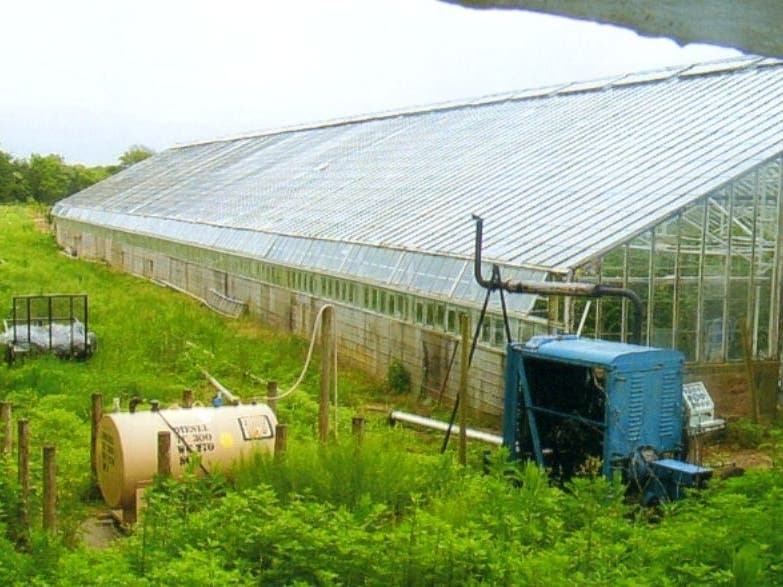
Did you know that the Cutchogue Main Road Wickham’s Fruit Farm has a greenhouse, and that that greenhouse came from the Halyoake Farm?
According to the GO North Fork column online in the North Fork Chamber of Commerce website, Tom Wickham is a “10 Generation Cutchogue Farmer.” Tom’s son Jon owns the farm and Tom is Jon’s farm manager. Tom’s wife Geke is also responsible for the farm now. Tom remarked: “You can grow anything on Long Island; the challenge is selling it.”
Tom Wickham gave me first-hand information about the greenhouse that was originally built on the Orient Halyoake Farm. “{It} was taken down and moved to Blue Point, just west of Patchogue, where the new owners used it to grow roses. We bought it from that owner, disassembled it and rebuilt it on our Cutchogue farm during 1967 and 1968 where it has been used to grow tomatoes ever since. The greenhouse was manufactured by the Lord & Burnham Company in the early 1900s. It is 200 feet long by 56 feet wide and has over 4,000 panes of 16-inch wide glass fitted between roofbars made of cypress wood. We are still using the original glass and roofbars.”
Tom continued: “This greenhouse is ideal for tomatoes in the winter and early spring because, unlike newer greenhouses with plastic or polycarbonate roof panels, almost all the sunlight passes through glass, heating the house and promoting plant growth and tomatoes of high quality.”
I do think it’s really fascinating that the Halyoake greenhouse is on the property of Wickham’s Fruit Farm, and I appreciate “letting it be known” with Tom Wickham’s help!