Politics & Government
Future Of North Fork Farming Hangs In Balance, Solutions Sought
North Fork farmers say they're trying hang on, find ways to evolve in a changing world, with spiking land costs and new business models.


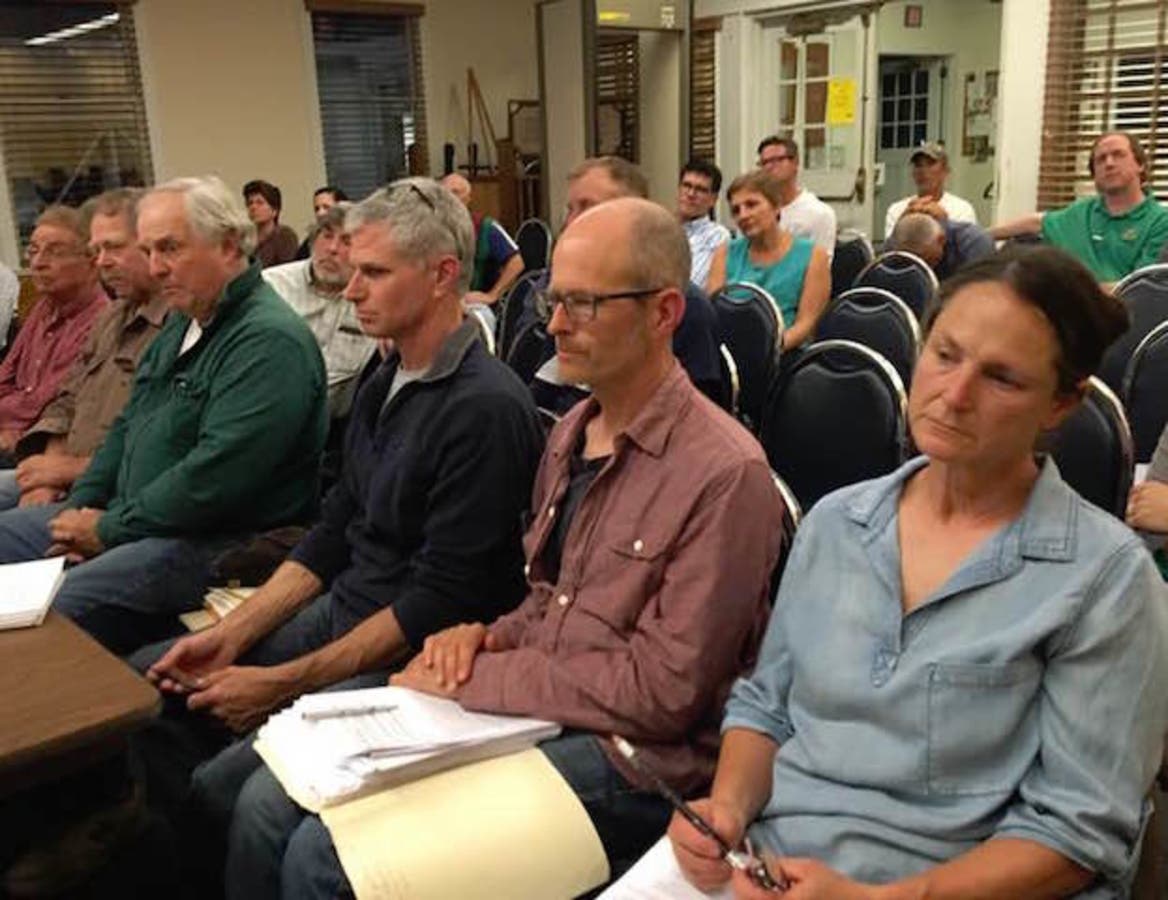
SOUTHOLD, NY — A large contingent representing the Southold Town agricultural community turned out Wednesday night for a joint work session with the town board and the town's agricultural advisory committee where the future of farming on the North Fork was on the proverbial table.
"The meeting is an opportunity to work together to address the changing needs of agriculture and those of the community," Southold Town Supervisor Scott Russell said, before the meeting, which was slated to focus on various zoning issues.
Russell, due to a family emergency, was unable to attend.
Find out what's happening in North Forkfor free with the latest updates from Patch.
Chris Baiz, chairman of the ag advisory committee, said he believed the intent of the meeting was to "introduce the second half of what was put on the books" in April, 2017, including agricultural definitions in the town code. Permitted uses, he said, were the next step; also discussed was the definition of "farm operation" now in the town's zoning code definitions, with further definition of agricultural processing.
Baiz said Russell told him the plan was to have several meetings to discuss the issues.
Find out what's happening in North Forkfor free with the latest updates from Patch.
Issues may differ depending on what a farm is embarking upon, with a traffic intensive use demanding the need for site plan approval but a business that is processing, marketing or warehousing perhaps not as "sensitive" to issues including traffic and consumer demand, Baiz said.
Southold Town Councilman Bob Ghosio asked how it was possible to anticipate what could evolve at a business. "I don't think anyone, quite frankly, thought the lavender farm would become what it became."
Councilman Jim Dinzio and Councilwoman Jill Doherty said they both had had no idea what the meeting was meant to be about and would need to read the materials, which had not been distributed beforehand to allow for discussion.
A number of issues were discussed, including instances when the planning board might waive a public hearing or move forward with an expedited review, and permitted uses in low density zoning.
Procedures and policies should be written down, even if not codified, for future boards, all agreed.
Issues discussed also included food at farm stands. "Are they allowed to prepare food and have tastings of the broccoli?" Dinizio asked.
Mark VanBourgondien of the ag advisory committee said processing on farms is not allowed in the code right now. "It needs to be in the code if we are going to keep up with today's pressures," he said.
"I'm trying to push the button on how far you want to go — sit down meals?" Dinizio said.
VanBourgondien said no one knows what the future holds. "But we need to start somewhere," he said, adding that issues such as corn, served at some farm stands, is cooked and buttered — does that constitute as processed? "What constitutes as processed?" he asked.
Dinizio asked to review the New York State Department of Agriculture's Agriculture & Markets Law, saying the board needs to study the law. "We're moving away from the card table with garden produce on it," he said. "How far do we want to go before we want to start saying these things are restaurants?"
After the meeting Kathryn Sepenoski said the entire board should be versed in the Ag & Markets law.
Dinizio then said farmers need to come to the board to explain what they need to be successful — to remain in business — then the board would discuss options, add their own input, and bring it to the public for a vote.
Ag advisory committee member Karen Rivara suggested listening sessions where the public and the farming community could weigh in on agricultural issues.
Baiz said the goal is to have farmers with smaller parcels able to generate a cash flow, stay in business, and support local families. "I know guys that are not planting because it costs more to plant than what they get for the crops," Baiz said.
VanBourgondien said there are moving targets, with new business models and ideas farmers have never thought of in an ever-evolving industry. "It's hard to tell you what we need," he said. "It's going to be all over the page."
Baiz said branding the area as "North Fork of Long Island" is critical; farmers have come a long way than just raw crops, he said. "It's a brand name," he said.
Rivara discussed an oyster farmer years ago who had a picnic table where customers opened their oysters themselves and enjoyed the water view; those business owners were told allowing for the customers to sit and eat wasn't in the code, she said. "We were trying to address their situation with this code."
But, she said, "We're trying to adjust to situations as they come up. You're never going to get in front of it that way."
Baiz said the farming community needs to be given what they need so they can process their products and sell them directly to consumers, the only way they will be able to sustain a farm with escalating land costs.
Dinizio asked if excising the middle man would help in the farm to supermarket process would help; Baiz said it would.
Another issue, Dinizio said, centers on people who might come to eat oysters at a picnic table — if that venture is successful, the town could see 40 cars in a residential area with people wanting to shuck and sample oysters. Traffic and other ancillary issues need to be vetted, he said.
Listening sessions, Rivara said, would help farmers to outline their challenges and give the board a "sense of where people are trying to go."
"Our education comes from you," Dinizio said.
Ag advisory member Jim Glover said the first iteration of the farm stand code allowed only raw product; the second, current version allows for 40 percent, processed accessory items — and in the next, and third version, "We would like to be able to process on the farm," he said.
"We have to be able to drive as much revenue on the farm with as little revenue possible, without renting commercial space, to reach how much we need, per acre, to stay," Baiz said. "We have to elevate what we have here to meet cost structures. Otherwise, families won't be able to live and operate here."
VanBourgondien pointed out the problems aren't unique to the North Fork, with small family farms struggling nationwide, dairy farms shuttering by the end of the month, and a large national nursery declaring bankruptcy.
"It is nationwide and local family farms are the first ones to fall," VanBourgondien said.
"The agricultural economy, as you know, is on the ropes," Baiz said. "I'm not sure what's going to help it but I think on the North Fork, the eastern end of Long Island, we need to make enough cash to keep the farms alive — to stay here and pay our operating costs, our insurance, our taxes."
Baiz added as local families go out of businesses, farm properties are scooped up by people from the city who purchase the land.
"You asked what we need," VanBourgondien said. "Agriculture needs the flexibility to change . . . new ideas, new processes."
Ag advisory committee member Doug Cooper said the town would need to be willing to accept that "agriculture is constantly changing."
One frustration, VanBourgondien added, is, "If it's not in the code, it's not allowed. It would be nice if someone came in with a new business model and you said, 'Let's sit down and see what we can do to make you a success.' That's the kind of change we need to help this industry survive."
Dinizio said he doesn't want a restaurant on a piece of farmland in a residential area. "I don't want a disco. Don't be playing 'Pump Up The Volume' at 11 o'clock at night. None of that has anything to do with farming," he said.
"We don't disagree," Cooper said.
"I'm looking for a way to quantify or qualify what a farmer is," Dinizio added. He brought up the lavender farm and said there was no traffic study for the business initially because in the beginning, the belief was that the only goal was a farm stand. "No one ever thought farming would be considered 1,000 people on 17 acres, just standing there. How is that a farm?" he asked.
Ag advisory committee members countered that a crop was grown at the farm.
Councilman Bill Ruland, town board liaison to the committee, himself a farmer, said if agriculture is to flourish "and not just prevail, you need not just a farm but a farmer." He and Cooper are both in their 70s, "we're going to time out," he said. "The target is moving. What will replace it? Sixty years ago you winged it. If you didn't put all your eggs in one basket you could prevail."
All agreed further discussion was necessary; Ruland said another meeting would be held with Russell, who'd had points he wanted to discuss.
"Compromise and consensus is a big part of doing anything," Baiz said, adding that listening sessions would facilitate communication.
Patch photo by Lisa Finn.
Get more local news delivered straight to your inbox. Sign up for free Patch newsletters and alerts.