Schools
Greenport Science Whiz Kid Wins Prestigious Award
Tenth grader Joe McInnis has been wowing with his research on honeybees' colony collapse disorder that could mean a worldwide breakthrough.


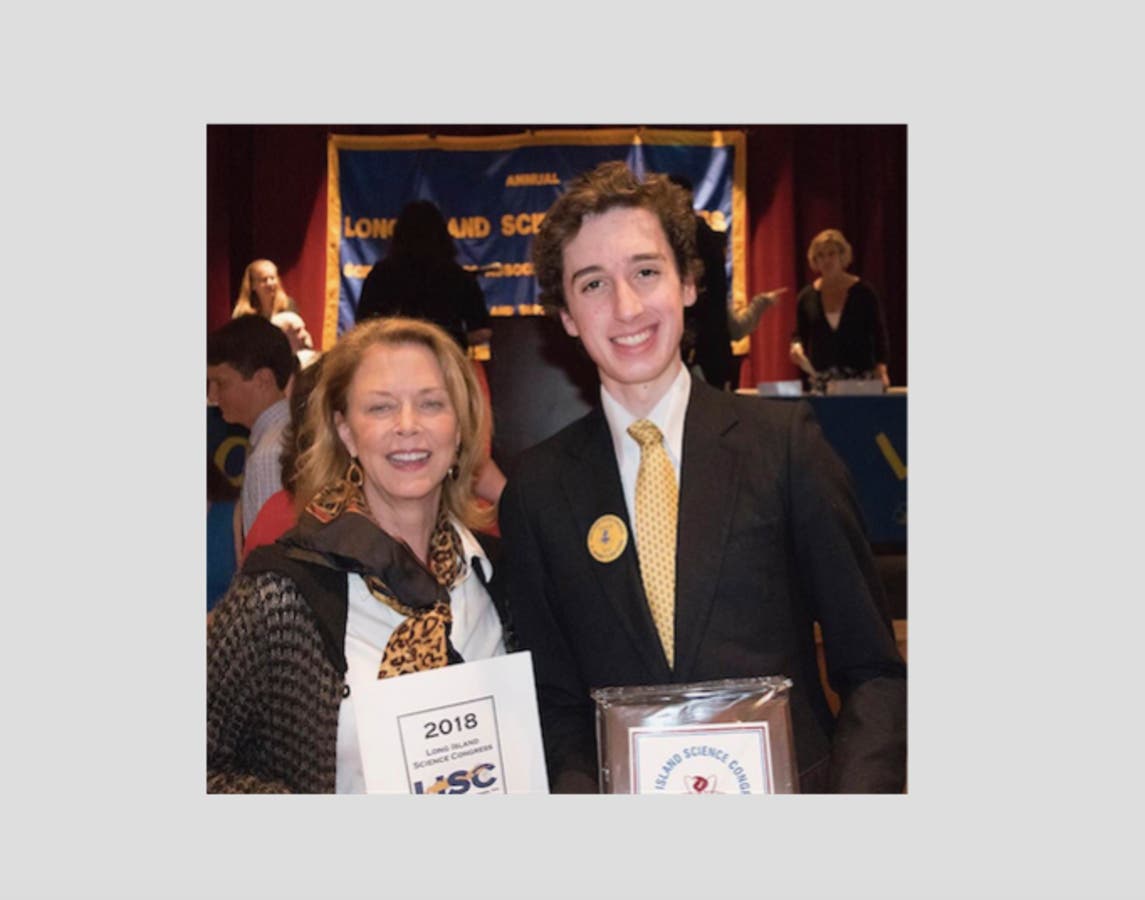
GREENPORT, NY — He may be just a tenth grader, but Joe McInnis continues to wow with his groundbreaking research in the science community — research that could have mean a worldwide breakthrough.
Joe recently received the Long Island Science Congress Senior Division's highest honors for his presentation on Iridovirus-6 and colony collapse disorder at the Long Island Science Congress Senior Division Competition on April 18.
He was chosen from 1,200 students from Nassau and Suffolk Counties in grades 10 through 12, the Greenport Union Free School District said.
Find out what's happening in North Forkfor free with the latest updates from Patch.
In addition to receiving highest honors, he was also presented with an award from the Science Teachers Association of New York State – Suffolk County Division and the Robert Nelson Memorial Award; the latter is given to only one 10th grade student each year.
The Robert Nelson Memorial Award honors Robert Nelson, the coordinator of the Long Island Science Congress for over 40 years — Nelson’s goal was for students to be able to conduct independent scientific research in their school, the district said.
Find out what's happening in North Forkfor free with the latest updates from Patch.
"Joe is a committed young scientist. He has put forward a tremendous effort for a very important cause. It is inspiring to work with students who have the passion and scholastic aptitude to work toward critical scientific discoveries. From his independent work to his partnership with our faculty mentor, MaryKathryn Baker, we are all impressed with his accomplishments," Greenport High School Principal Gary Kalish said.
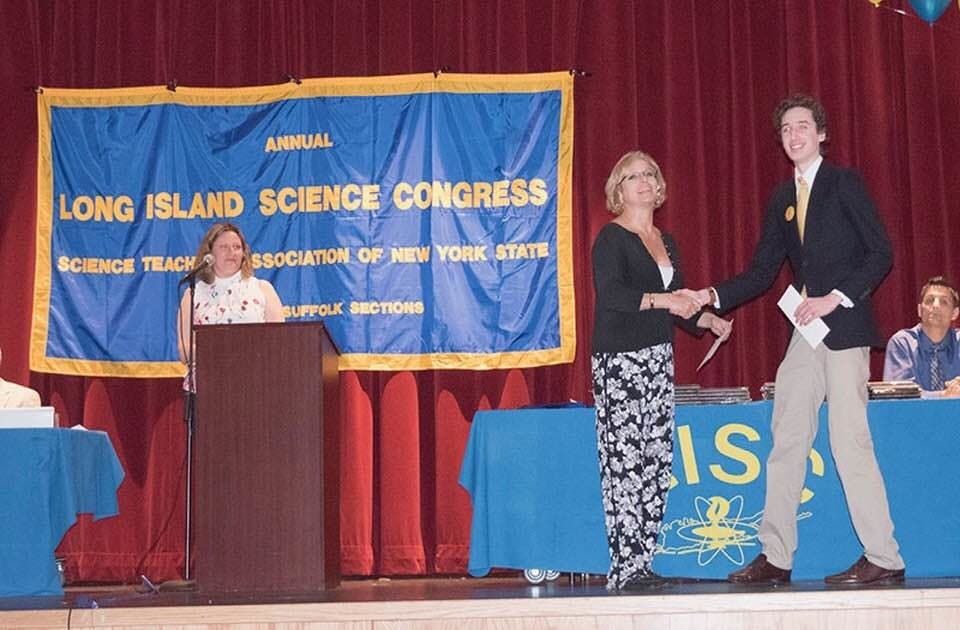
The awards acknowledge what the North Fork community has known for years — Joe is a shining star ascending rapidly in the scientific stratosphere.
In 2016, when he was in eighth grade, the young Greenport science student kicked off a GoFundMe to help with a project that could mean an international breakthrough in the study of bees.
Joe has worked with veterinary pathologist Douglas Gregg, who's retired from the Plum Island Animal Disease Center, the GoFundMe page says.
"He's helping Joe pursue a theory that an unusual viral infection is compromising honeybees' immune systems and causing colony collapse disorder. It's looking very promising. Dr. Gregg had worked on a similar kind of virus both as part of his PhD thesis and while at Plum Island and is one of very few that specializes in that particular strain," the page, posted by Joe's father Robert McInnis, states.
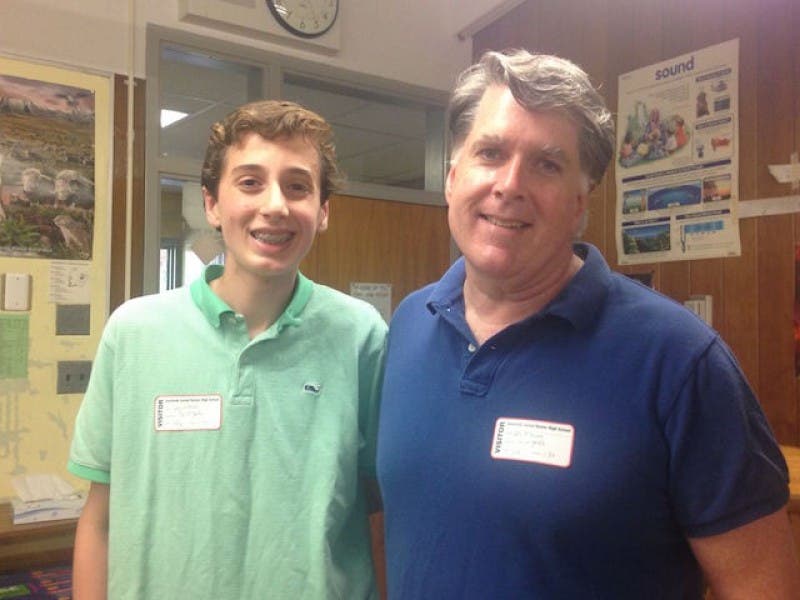
In 2016, Joe also spoke at Southold Middle School about his project.
"Pollination by honeybees produces 30 percent of our food supply and bees are dying at a rate of 30 percent each year," the page says. "As the bees say, 'If we die, we're taking all of you with us.' There are many who believe that there's a significant chance this study could help prove that this immune-suppressing virus is weakening the bees enough to allow other elements to kill the bees that normally wouldn't be a problem for them."
Joe has also won a $250 award at the New York State Histotechnological Society, the youngest ever to receive a grant from that organization, his father Robert said.
"With the assistance of Dr. Gregg, Joe is doing highly complex work, that only graduate students and above might do, which involves lots of supplies, some expensive equipment such as a microtome and microfuge, costly stains and even a molecular biology technique called PCR, or polymerase chain reaction, involving duplicating DNA sequence," McInnis said. "Right now, they're making progress in a makeshift lab using donated equipment, but things have progressed to a point where additional funding is needed to complete the study. This is an important issue to Joe and, of course, the survival of us all hinges on identifying the cause of colony collapse disorder and finding a solution."
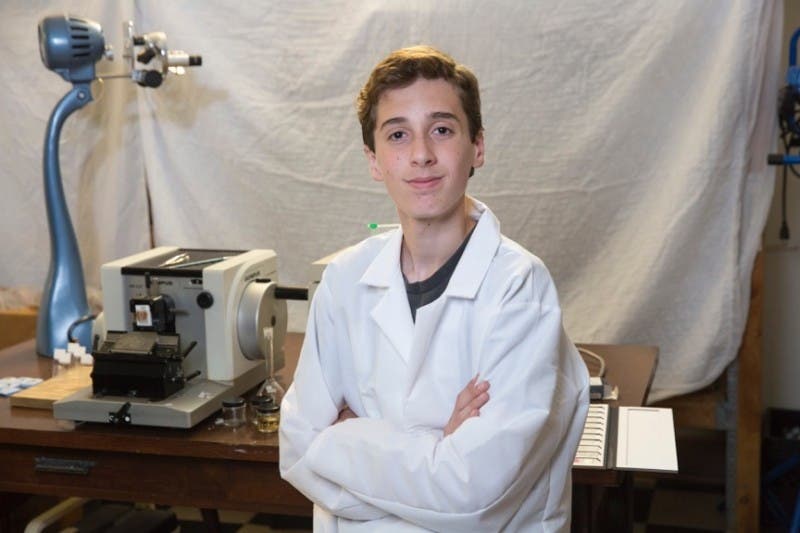
Joe's project aims to explain the colony collapse disorder in bees, and to shine a light on why bees may be dying off.
Speaking to students in Southold, he explained why some have traditionally felt bees might be dying, such as pesticides, parasites, disease and stress.
Without sharing too many of the details in print until his work is copyrighted, Joe said he's always been passionate about science and when he met the science teacher, his mentor, he was excited to keep pushing the boundaries.
His mentors, Joe said, have been "amazing," he said
"I am speechless and I don't often get speechless," said Southold/Greenport School Superintendent David Gamberg. "I am absolutely amazed at the level, the caliber and the intensity with which you are pursuing this project," he said, adding that his presentation was "exceptional."
The presentation engaged students and had them following along, much like a "mystery" being solved.
McInnis, Joe's dad, said he was proud of his prodigy. "He's such a nice kid. He's loving this."
As for his "breakthrough" project, Joe has made presentations locally to share his work with the public. "I've always liked bees," he said. "This is just really great."
Added his mentor, "This has worldwide implications."
Patch courtesy photos.
Photo of Joe McInnis and his father by Lisa Finn for Patch.
Get more local news delivered straight to your inbox. Sign up for free Patch newsletters and alerts.