Community Corner
'Heroes Don't Get Zeros': Hospital Workers Want COVID Crisis Pay
After two previous rallies last month, union representatives and front line workers will march to Stony Brook University Hospital Wednesday.


EAST END, NY — Health care workers and three public unions will rally Wednesday to demand that Stony Brook-affiliated hospitals provide crisis pay for who have been on the front lines during the coronavirus crisis.
Officials and members of 1199SEIU, Civil Service Association Local 114, Public Employees Federation, the United University Professions and others are slated to attend the rally and march, called "Heroes Don't Get Zeros", which will take place in Stony Brook on Wednesday from noon to 1:30 p.m.
Those planning to attend have said that Stony Brook University Hospital, as well as Stony Brook Eastern Long Island Hospital in Greenport and Stony Brook Southampton Hospital, "have forgotten the critical roles members of our unions have played in ensuring that all hospitals work smoothly during the COVID-19 pandemic," a release said. "Members of all the participating unions deserve to be recognized as the healthcare heroes they are for fighting to save lives, while endangering themselves and their families, during the COVID-19 pandemic."
Find out what's happening in North Forkfor free with the latest updates from Patch.

The march will begin at Nicolls Road and South Drive in Stony Brook and ends at Stony Brook Hospital, where the rally will take place.
Masks are required.
Find out what's happening in North Forkfor free with the latest updates from Patch.
In June, front line workers held rallies in both Greenport and Southampton. Kenya Clinton Coles, who attended the earlier rally, said she believes that "all conversation about recognition of the employees at Southampton and Eastern Long Island Hospital has ceased."
She added: "It is embarrassing and heartbreaking that the employees at Stony Brook have worked endlessly and tirelessly during this pandemic," she said. "Many institutions have step to the plate to show appreciation to their employees. They have recognized their employees for value and dedication during the pandemic and, as it continues. Stony Brook has made it crystal clear their value is not with their employees."
Officials at Stony Brook University Hospital responded with a statement to Patch: "Stony Brook University Hospital is dedicated to fostering a positive work environment where all employees are valued, supported and respected. On behalf of the community members for which we provide care, we are very grateful for the important work that our healthcare providers and other essential employees have put forth in response to the pandemic."
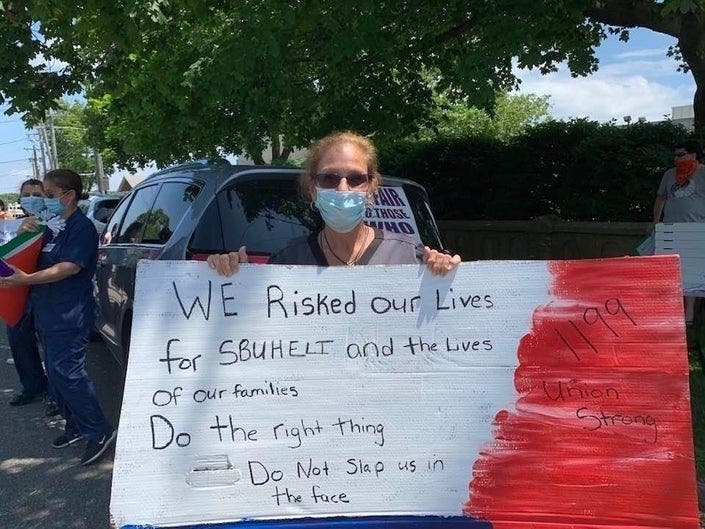
Holding signs and chanting in June, the group of front line workers who held a rally outside both Stony Brook Southampton Hospital and Stony Brook Eastern Long Island Hospital in Greenport cried out: "What do we want? Crisis pay! When do we want it? Now. Be fair to those who care!"
Those marching, represented by the 1199SEIU United Healthcare Workers East union, said they are asking for the same crisis pay afforded hospital workers in other networks, including a $2,500 recognition payment and a week's vacation.
According to a union source, 1199 has said it wants workers to get the industry standard set by the Northwell Health network, $2,500 per worker.
"Stony Brook Southampton Hospital (SBSH) and Stony Brook Eastern Long Island Hospital (SBELIH) are in talks with 1199," said a spokesperson for both Stony Brook Southampton Hospital and Stony Brook Eastern Long Island Hospital at the time. "We value the skilled work of every member of our staff. Our primary concern has always been, and continues to be, our employees' safety as they provide the highest quality of care for our patients. We work every day to foster a positive work environment where all employees are valued and respected."
Joan Kart, who attended the rally, said workers wanted crisis pay for all employees who showed up for work in the face of the crisis. "And management does not want to give us a fair and equitable pay. The community stood up with us through the whole time. Now the management is turning their back on us."
Speaking about the experience of working during the pandemic, Kart said asking for crisis pay was "not an unfair" request: "We've given up a lot. We've been in the hospital sick ourselves. We haven't been able to see family members — it was three to four months that we haven't see any of our grandchildren. It was hard on all of us. We'd go home at night totally exhausted."
'At the end of the day, I felt thankful to God, I prayed that I didn't bring COVID home to my family'
She added: "Sometimes, it was really bad, when you had to intubate people that you know. And they shouldn't have been there — but the COVID got to them. It was hard for all of us."
Kelli Gatlin, who protested outside Stony Brook Southampton Hospital, said hospital workers faced the coronavirus crisis, despite the risks. She works in endoscopy but she was brought back into patient care to help meet the growing need, often unable to see her own family.
"What choice did we have?" she asked. Not only did they need to work, she said, but as health care workers, they were called to help others despite their own fears.
And now, she said, she and her colleagues are waiting for some equity and fair resolution.
Clinton Coles, a nurse at Eastern Long Island Hospital, described facing her own fears in order to serve coronavirus patients.
"At one point, I just went into the bathroom and cried," she said. "I realized there was no way I would go through this experience without seeing or treating a coronavirus patient."
She recalled one woman in the hospital, who was deeply emotional, fearful not only because she had coronavirus but because she was afraid she may have infected her mother.
The woman was completely alone, very ill, and very emotionally distraught, Clinton Coles said.
"Mine was the only face she saw," she said. "I had to be there for her. And anyone I work with would have done the same. That is the very essence of human caring."
But with a baby grandson, Justin, who was born premature and spent months in the hospital before returning home in December, the risks were very real, Clinton Coles said.
"The thought of putting this little life in danger . . ." she said. "At the end of the day after work, when I got in the car, I felt thankful to God. I prayed every day that I didn't bring COVID home to my family."
There are the moments that haunt, Clinton Coles said. One patient appeared to have been doing well, and she told the woman's daughter that her mother was holding her own. But that day, her blood oxygen level plummeted and she had to be transferred; later, the woman died. "I felt so guilty," she said, knowing that the woman's daughter would get the call telling her that her mother hadn't survived. "The virus is like that, it's so fast," Clinton Coles said. "You never know who would get it, who would be next. It was terrifying."
Clinton Coles brought her baby grandson to the rally in Greenport. "I want them to see Justin as a symbol of what nurses and other staff put on the line to provide excellent care during the pandemic," she said. "And to know recognition is warranted at whatever we proposed to the employers."
She added: "We went back to work each day knowing that we had to go beyond care — if that is possible."
Get more local news delivered straight to your inbox. Sign up for free Patch newsletters and alerts.