Politics & Government
Historic Orient Church For Sale, Community Urges Preservation
"We need to save it, because once it's gone, it's gone." — Robert Hanlon, Orient Association.


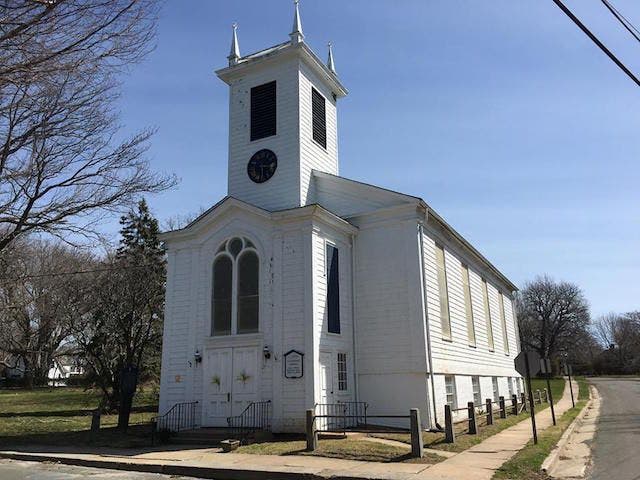


ORIENT, NY — A passionate group of Orient residents looking to preserve a historic church in the hamlet are working to find ways to keep the structure protected from private development.
Ed Caulfield of the Oysterponds Historical Society and Bob Hanlon, president of the Orient Association, have met with Southold Town Supervisor Scott Russell a few times in past weeks to discuss the possibility of a "partial town purchase" of the Methodist Church on Village Lane in Orient, Russell said.
Normally, such a purchase wouldn't be the subject of a public discussion but since the proposal was a community initiative, the discussion was scheduled, he said.
Find out what's happening in North Forkfor free with the latest updates from Patch.
"It came to our attention months ago that smack dab in the middle of Orient, on Village Lane, the Methodist Church, which has been there since 1835 "is going to be up for sale," due to the consolidation of Methodist churches in the area," Caulfield said.
The church, he said, "has been there forever."
Find out what's happening in North Forkfor free with the latest updates from Patch.
Caulfield said a community meeting was held in February at the church, which was "packed;" a survey wassent out to the Orient community by the Oysterponds Historical Society.
Caulfield said while many surveys have gone out in the past, this one generated close to 300 responses. The first question, he said, involved whether the community would support preserving the church for public and community use; 89.2 percent said they supported the idea, and 50 percent of respondents said they would volunteer "time and energy" to the upkeep of the property. Another 62 percent said they would support the initiative financially, he said.
Another component to the preservation efforts, the pair said, is to keep Hallelujah Park, which also sits on the parcel, from being sold. "It has one of the most beautiful trees on the North Fork," Caulfield said.
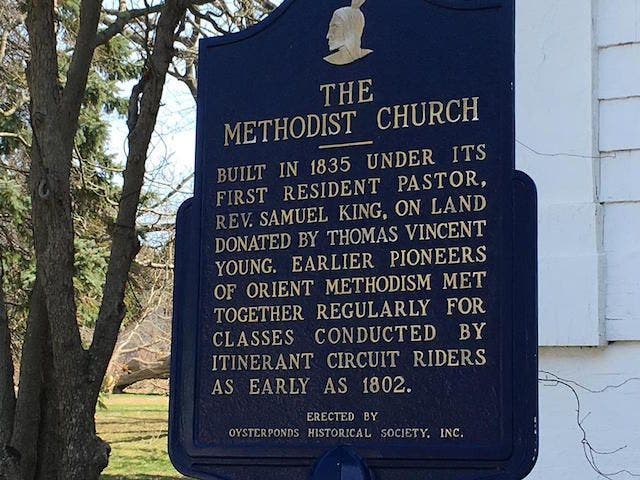
Caulfield said this Oysterponds Historical Society was partnering with Hanlon and the Orient Association in "looking for a path forward to achieve the goal of preserving a historic church in a historic community."
He added that all involved are open to all suggestions and that his group was also speaking with Suffolk County and the Peconic Land Trust to explore options.
While Suffolk County Legislator Al Krupski said has been "very supportive," Caulfield said, Krupski has said the county's support requires some sort of "participation, yet to be determined, from the town."
Justice Louisa Evans asked if the OHS had considered purchasing the building.
Caulfield said yes, but the price tag of $950,000 was prohibitive.
Hanlon said even if every man, woman and child in Orient kicked in $1,000, "we wouldn't have enough. To expect the community to do it is not realistic."
But, he said, the community was committed to raising the funds to support the resource; realistically, those funds could be used to maintain the property and building at a cost of approximately $30,000 to $50,000 per year, he said.
"We don’t want to create something that becomes a burden on the county or town in maintaining the park or facility," he said.
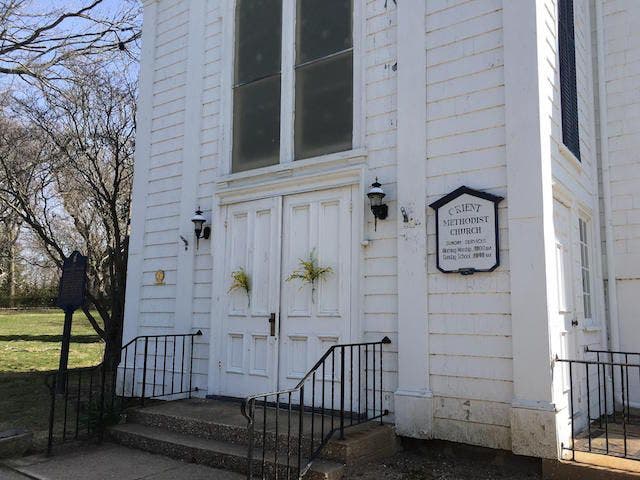
The building, Caulfield said, already has "some measure of protection" through the town's historic preservation commission, but only the facade was protected, not the interior or grounds. "If it was in private hands, the new owner could close off the property and might make changes to the building. The interior would be lost and use of the facility would be lost," he said.
The goal, Caulfield said, was to create a coalition, with a commitment from the county. "We'd like the town to be a major player," he said. And while he said he understands the town has been reluctant in the past to become involved with preservation of buildings, there are ways the town might become involved without being "on the hook for a historic building."
Caulfield said he's like a brainstorming session to be organized with the town, county and Peconic Land Trust, to explore possibilities.
The church, he added, is urging the process forward because they need the funds from the sale at some point in the near future.
Caulfield said he'd like the parcel to remain a park and in his opinion, he'd like to see the interior remain exactly the same, but that decision would be made by a board.
One use might be to house some of the OHS's extensive collection of artifacts. "They're tucked in attacks, under the bed," he said. "Part of our plan was to at some point acquire a property or build a facility to keep this history preserved."
Evans asked about the altars and pews inside the building.
Hanlon said the church has "a really amazing interior" with semi-circular pews from the late 1800s, two stained glass windows and a historic organ; Caulfield said the organ was rare and could even draw tourists in its own right.
The church, Hanlon said, might serve as a good space for small performances and complement the current activities at Poquatuck Hall.
Also, Hanlon said, the building is an important piece of the past, affording "historical insight" into past religious life in the community, something that's becoming more rare as "one by one, these churches are disappearing."
The Greenport Methodist Church was sold to a developer and i about to be renovated into private homes, and as is the Cutchogue United Methodist Church, which might make a fine library, but "doesn't speak to a true historic record. Here's a chance, on a somewhat smaller scale, to preserve something that's a bit of a gem."
While the building could be used for a number of uses, which would be decided collectively, Hanlon said, "In the meantime, we need to save it, because once it's gone, it's gone."
Town concerns
Russell spoke to the issue. "I'm a very hard sell on this," he said.
He outlined concerns, including who would be responsible down the line for "large, singular events," such as the necessity for a new roof. "Once it's out of the risk of going into private hands, enthusiasm might wane," Russell said, referencing a situation in the past where a building was transferred to a private group who could ultimately not raise funds necessary for roof repairs. "That wasn't the original deal," he said.
As for those who might want to utilize Community Preservation Funds for preservation of old buildings, Russell said the referendum passed recently opening up the doors for CPF monies to be used for water quality.
"Now you're going to throw buildings into the equation? How far can you stretch the CPF?" the supervisor asked. "If we are going to take money away from the CPF, people have to go to a map and say, 'What land don't you want to preserve."
Hanlon said he understands that the town can't preserve historic buildings but several other mechanisms might exist; the OHS, he said, is the most likely steward and raise the $30,000 to $50,000 per year necessary for maintaining the property and building.
Caulfield agreed; he said the community was strongly committed to the project and he was certain funds could be raised for any maintenance or emergencies. In addition, both men said, the Peconic Land Trust has expressed willingness to try and help.
Hanlon also suggested the town could consider focusing on using monies to preserve the park with an easement, to keep it open land. He said there are other groups more well-suited to stewardship of the building.
Russell also said he was concerned about setting a precedent. There are many key properties and buildings in town with community support for preservation. "The slope gets to be very slippery," he said.
In addition, the supervisor added, if the town did decide to preserve buildings, priorities and a plan would need to be developed first, as it has been with land preservation, where a hierarchy exists. "I don't think a building should dictate a plan, the plan should dictate the building," he said.
Other issues, Russell said, include the fact that the building is already protected to some extent by town code.
And, he said, the public access issue is another critical point; parking and signage must be considered, especially since the area is already grappling with a lack of parking.
Another question Russell posed was, if the building was preserved as a community building, would anyone, from any hamlet in Southold, be able to hold events there.
The space would be run by the OHS, Caulfield said. Hanlon compared the proposal to Poquatuck Hall, which hosts events from many groups.
Caulfield said his aim was to get all the key parties around a table for discussion and identification of possible solutions.
Russell said again he was a hard sell but he'd take part in the meeting.
Southold Town Councilman Jim Dinizio suggested selling the valuable organ to raise funds to purchase the building. "If you want to keep Orient looking the same, and I drive by and see the church, that's all I need."
"Several years ago, Independence Hall in Philadelphia was having financial concerns. Jim said they should sell the Liberty Bell," Russell joked.
The group agreed to plan a future meeting.
Patch photos by Lisa Finn.
Get more local news delivered straight to your inbox. Sign up for free Patch newsletters and alerts.