Community Corner
Lawmakers Urge Sanctions To Cripple Deadly Fentanyl Pipeline
"Fentanyl killed my granddaughter. I am so glad that Washington has realized that this epidemic is more than just the local heroin dealers."


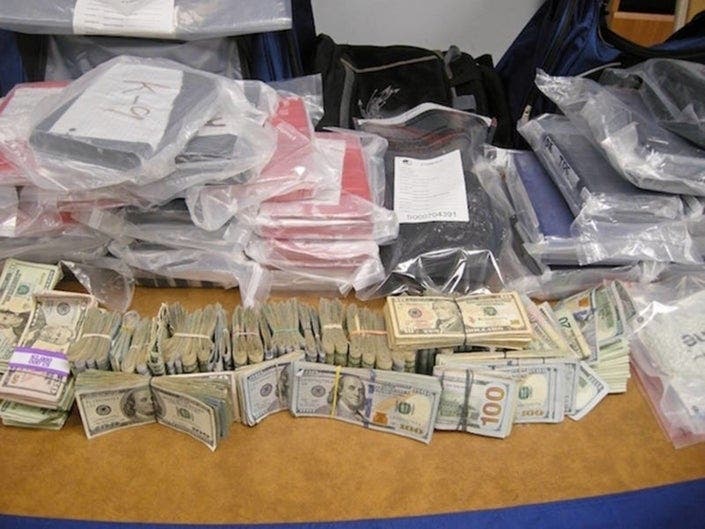
LONG ISLAND, NY — Lawmakers are getting tough and calling for action in the fight against deadly fentanyl.
This week, U.S. Sen. Chuck Schumer held a press conference on Long Island urging House movement on the Federal Sanctions Act, which was passed by the Senate last month and aims to put the brakes on China and any other countries where drug manufacturers and other organizations have been involved with trafficking the insidious drug to the United States.
“Chinese laboratories have been cooking up formulas of death and freely exporting lethal fentanyl across Long Island, where it is killing too many people, and it has to stop,” Schumer said at the event, held at the Nassau County Police Department in Baldwin, according to a Newsday report.
Find out what's happening in North Forkfor free with the latest updates from Patch.
In recent months, Schumer held a press conference to unveil the Fentanyl Sanctions Act, aimed at pressuring China and combatting the lethal opioid crisis ravaging U.S. communities.
The "first-ever" legislation includes a "broad and powerful sanctions tools" that will allow the United States to target illicit fentanyl production in China, Mexico and throughout the world. Fentanyl, a deadly synthetic opioid, is laced into other drugs and is a deadly killer, he said. "This drug is predominantly coming from China," he said. "This has to stop. The slow-burning fire of fentanyl is now a five-alarm inferno here in America...We can't just keep watching as China and Mexico pour gasoline all over that conflagration," he said.
Find out what's happening in North Forkfor free with the latest updates from Patch.
The "tough, powerful and targeted sanctions," he said, include up to $600 million in federal dollars allocated to identifying producers and traffickers, as well as fentanyl networks; directing President Donald Trump to identify and make public those foreign producers and using "precision economic policy and sanction tools to cripple operations," denying those pharmaceutical companies access to United States markets and freezing assets, Schumer said.
"We're not talking about someone making drugs in their kitchen. These are big China pharma companies," he said.
The legislation also would direct the president to establish an international opioid control regime and create a commission on synthetic opioid trafficking. "The sanctions are key," Schumer said.
At the earlier press conference unveiling the legislation, Schumer noted that China had announced plans to fulfill a commitment to the United States and treat all variants of fentanyl as a controlled substance. While he said China's administration deserved credit for that regulation, he added: "China still has to implement and enforce this new law...China has a habit, when they make money on something, they don't care about the consequences."
Local Long Island prevention advocates applauded the proposed Federal Sanctions Act this week.
“Law enforcement in this country cracked down on pill pushing doctors and has been focusing lately on street level heroin dealers," said Jeffrey Reynolds, president and chief executive officer of the Family and Children's Association in Mineola. "The fentanyl crisis demands an international approach given that that drug now kills more people than heroin and is flowing into the US from China. If we see America’s opiate crisis as a wildfire out of control, Senator Schumer’s bill will finally shut down the gas line that fueling the flames. As we begin to turn the corner in reversing opioid death rates, this is a critical piece of unfinished business. The House needs to act and they need to approve this measure right now."
Longtime broadcast journalist Drew Scott, who lost his beloved granddaughter Hallie Rae Ulrich to an overdose, also said the efforts to curb the fentanyl pipeline are critical. "Fentanyl killed my granddaughter. I am so glad that Washington has finally realized that this epidemic is more than just the local heroin dealers. Fentanyl is pedaled by labs in China and mailed in small quantities to our area. And we’ve learned small quantities kill lots of unsuspecting people."
Last August, after New York saw an uptick in overdoses linked to insidious fentanyl, lawmakers said it was "shockingly easy" for Americans to have the deadly drug delivered right through the mail.
More than 72,000 Americans died from opioid overdoses in 2017, according to preliminary estimates released by the Centers for Disease Control and Prevention last year. The CDC cautions that the figures are an underestimate because of deaths for which an official cause remains pending.
A significant number of the overdose deaths were reported to be caused by fentanyl, with the CDC estimates attributing nearly 30,000 deaths in 2017 to the synthetic opioid. That represents a sharp increase over 2016, when just over 20,000 overdose deaths were reported to be caused by fentanyl, according to the preliminary data.
And what's most shocking is that the drugs are delivered through the mail right to a person's post office box, with little or no safeguards in place to keep the fentanyl from infiltrating communities across the proverbial board and cutting a deadly swath of destruction across all demographics — shattering lives and families.
A Senate permanent subcommittee released an investigative report about how "shockingly easy" it is for Americans to order deadly fentanyl through the mail from overseas sites, many affiliated with China.
According to the report, the fentanyl is flooding the United States, sent from labs in China and sent to the United States through the mail. "It's shocking to people to find out that this is coming to people through the U.S. mail system," said Rep. Sen. Rob Portman of Ohio, chairman of the Senate's permanent subcommittee on investigations.
Those sending the deadly drugs "exploit the vulnerability" of the American public and use the United States Postal Service to distribute fentanyl and other synthetic opioids, he said.
In June, 2018, the House passed legislation that would mean the United States would receive advance electronic data, or AED, on international shipments; the measure is still before the Senate.
According to Portman, currently, the USPS received AED only on about 36 percent of 500 million packages it receives yearly from international locations; on the flipside, the U.S. provides that information to 90 percent of the packages it sends internationally.
Portman said the situation as it stands is "wholly inadequate." He added, "How many more people have to die?"
When kicking off the report, the subcommittee set out to discover how difficult it was to order the drugs online and found that it was "shockingly easy," Portman said. All it took was a quick search of the internet; of six websites surveyed and inquiries sent, those involved were "quick to respond, unafraid of getting caught" and offering discounts as well as other drugs, including carfentanil, as strong as an elephant tranquilizer, he said.
Of the sites surveyed, there were 500 payments tracked, with more than 300 payments from Americans in 43 states, and a street value of pills totaling $760,000 that would end up on United States streets in sleepy towns and urban centers.
Robert Cintron, vice president of network operations for United States Postal Service also testified before the Senate's permanent subcommittee on investigations of the Homeland Security and governmental affairs committee.
For international mail, he said network operations is responsible for the mail once it arrives at a USPC international service centers and after it is cleared by U.S. Customs and Border Protection, or CBP, up until it has been sorted and transported and is ready to be sent out for delivery.
"Together with our federal agency partners, we have committed to aggressively increasing data on inbound packages coming into the United States in order to improve the targeting of illicit drugs entering the country," he said.
The number of countries sending AED to the Postal Service has grown from 8 to 23 countries, he said last year.
He added: "In collaboration with federal agencies and state and local law enforcement, improved investigative techniques have increased our ability to interdict opioids such as fentanyl."
Fentanyl, according to the National Institutes of Health, National Institute on Drug Abuse, is a "powerful synthetic opioid analgesic that is similar to morphine but is 50 to 100 times more potent."
Fentanyl, often used for surgery, is typically used to treat patients with severe pain or to manage pain after surgery, or to treat patients with chronic pain.
The drug received a flurry of attention in 2016 when a toxicology report from the Midwest Medical Examiner's Office determined that Prince died from fentanyl toxicity.
According to a New York Times report, fentanyl took the lives of at least 220 in 2016, according to medical examiners' records.
Fentanyl's deadly grip
Fentanyl's rise in popularity isn't a surprise, said Reynolds.
"Fentanyl has become a major deal in Long Island and elsewhere, which frankly, isn't a shock. We all saw this coming a few years ago, and now many of the skyrocketing overdoses are attributable to drug combinations that include fentanyl," Reynolds said.
Fentanyl's allure lies in its potency, Reynolds said.
He added, "There are literally thousands of heavily addicted folks in our region searching for the best and most cost-effective solution they can find, and the stakes continually get higher."
Get more local news delivered straight to your inbox. Sign up for free Patch newsletters and alerts.