Community Corner
Residents Blast 'Negligent' 'Ill-Conceived' Plan for Proposed Long Island Sound Dredge Site
Incensed residents spoke out fiercely in opposition to the proposed open water dumping of dredge spoils, calling it a "slap in the face."


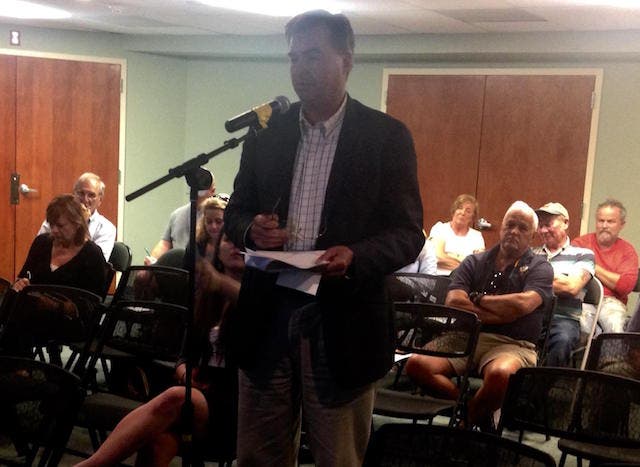
NORTH FORK, NY - Incensed residents spoke out Wednesday about a proposed dredge material site proposed for the Long Island Sound off New London Harbor, not far from Southold Town.
Two meetings were held on the plan, one in Riverhead and a second at the Mattituck-Laurel Library, where a small group came to speak out fiercely in opposition.
The United States Environmental Protection Agency issued the proposal to designate a dredged material disposal site to serve the eastern Long Island Sound region; the eastern Long Island Sound disposal site, or ELDS, would be located offshore from New London, Connecticut, and would be available for the disposal of dredged material from harbors and navigation channels in eastern Long Island Sound in New York and Connecticut.
Find out what's happening in North Forkfor free with the latest updates from Patch.
The EPA says its aim is to "support the goal of reducing or eliminating open-water disposal of dredged material in the Sound. These restrictions are intended to promote the beneficial use of dredged material, such as beach nourishment, or other alternatives to open-water disposal whenever practicable."
The New London site, which is scheduled for closure in December, will still close, but a portion will be expanded to the west to accommodate the new disposal of dredge material.
Find out what's happening in North Forkfor free with the latest updates from Patch.
Environmentalists have expressed outrage at the continued use of the Sound for dumping of dredge spoils.
The United States Army Corps of Engineers estimates the dredging needs in eastern Long Island Sound to be approximately 22.6 million cubic yards over the next 30 years, which the New London site could facilitate.
The public hearings were in response to a draft environmental impact statement, that's available for public comment and review until June 27.
The designation of dredged material disposal sites by EPA only makes those sites available for use by future dredging projects; it does not authorize the disposal of any material from any project, the EPA said. "Any proposal to place dredged material at the ELDS will have a project-specific authorization and must satisfy the stringent requirements of the ocean disposal regulations. Dredged material that does not pass the stringent testing requirements and is determined to be toxic are not, and will not in the future, be placed in the open waters of Long Island Sound. These materials currently and in the future will require either containment or treatment," the EPA said.
The meeting included a presentation discussing the three alternative sites considered. The United States Environmental Protection Agency has the authority to designate a long-term site and, along with the U.S. Army Corps of Engineers, reviewed alternatives, including a possible no action alternative.
Originally, 11 sites were considered, with the final number down to three, EPA representatives said.
Studies conducted included physical conditions of the sediment in each site, environmental review, and the haul distance for dredge material.
The EPA's Bernard Hague, of the EPA's New England District, discussed the three sites, including New London, Niantic Bay and Cornfield Shoals
He said the fate of the disposed dredge materials was studied, as well as bottom stress, and benthic health, or the health of organisms on the sea bottom.
Bottom stress is low in New London, he said, with "little or no concentration of contaminants" at each of the three site.
Material disposed at the New London site "would stay" put, he said, but would continue to be mobilized at Cornfield Shoals, and would be "partially mobilized at Niantic Bay.
As for the benthic impact, Hague said there would be "short term impacts" on organisms at the bottom of the dredge site and while "some would survive, others would be buried. But the benthic community recovers," he said.
The impact to fish habitats, he said, would be minimal, because "fish move out of the way."
In conclusion, Hague said, the New London site was the "preferred alternative."
Steve Wolfe of the U.S. Army Corps of Engineers gave a history of aquatic placement of dredged material, dating back to the 1800s.
After the Clean Water Act in the 1970s, he said, the process for designating a disposal site became "more rigorous" and led to the Disposal Area Monitoring System, which was born in 1977.
He set out to dispel "misinformation". To begin, Wolfe said, "Toxic material is not placed in the Sound." While that may have been the case historically, with the passage of environmental regulations and constraints to the EPA, that's no longer true, he said, emphasizing the "stringent testing" that takes place.
Impacts to the sea bottom are limited to the direct footprint, he said, adding that some organisms buried can "dig their way out." What cannot, eventually "starts to grow back," he said.
Wolfe also said that lobster die-off and nutrient issues in the Sound "have nothing to do with dredge material placement."
Mel Cote of the EPA said the EPA intends to include its same restrictions on eastern sites, with a new interagency group, the Long Island Sound Regional Dredging "Team", proposed that would ensure all large dredging projects are thoroughly vetted, with an alternatives analysis, and an eye toward developing and promoting alternatives and cost sharing.
A final ruling for the proposed eastern Long Island disposal site is due by end of summer.
Officials, residents blast plan
Doris McGreevy of Mattituck voiced her opposition. Long Island, she said, has a high rate of cancer, and any disturbance to the environment, "whether you claim that it's okay — is not okay."
As for dredged material placement, she asked, "Who's watching the Army Corps of Engineers?" She said she believed the USACE, during the dredging of Mattituck Inlet, only delivered 70,000 cubic yards of the proposed 100,000 materials for beach nourishment; someone needs to monitor the Army Corps, she said.
And, she said, while it's been said that no refuse from Connecticut ever washes up on North Fork beaches, as a person who does beach cleanups, she's seen balloons and other trash. "To say it doesn't happen is questionable."
Suffolk County Legislator Al Krupski said the proposal is "the same, simplified, sad tale, to try to justify dumping Connecticut waste product in the Long Island Sound. This is simply to justify something that New York is not allowed to do but somehow, Connecticut feels they should be allowed to do."
He said the presentation "was not well done at all."
And, Krupski said, with all the money spent over years to clean up the Long Island Sound, and so much effort made to improve water quality, "When you dump garbage in the Sound, you're going the wrong way."
The presentation was inaccurate in some respects, he added, especially in regard to organisms being able to free themselves after being buried by dredge spoils. "The fact that fish can get out is not true. That shouldn't have been part of the presentation."
As for the proposed Long Island Sound Regional Dredging "team", Krupski said the "idea of creating another bureaucratic work group, another government entity to work full time to justify dumping matter in the Sound" is the last thing the public needs.
The whole issue represents a "long history of missteps and poor decisions," Krupski said, adding that federal agencies did not adequately consider alternatives to open water disposal despite an agreement by the governors of New York and Connecticut that the practice should cease.
Cries from elected officials and the public have been "ignored," he said. "The EPA and the USACE have failed the citizens of New York and Connecticut."
To continue potentially toxic dumping dredge spoils into the Sound, an important resource, is "unjustifiable and negligent," Krupski said. "I encourage you to abandon this plan."
Southold Town Supervisor Scott Russell, who spoke at the Riverhead hearing, raised several issues, primarily focusing on an environmental impact statement that he said "was faulty and incomplete. There is nothing in the report that provides specific standards for testing on all projects and largely excludes dredging projects of under 25,000 cubic yards from scrutiny. That sounds like an insignificant project but it is a 10-year permit. Suppose 20 or 30 projects are undertaken? The current proposal says that each would be evaluated on an individual basis. That's called segmentation, which is not permitted under federal law. Further, no actual analysis or field work has been done studying marine life or the ecosystem. How will we really know the impacts? We don't."
The proposal is "ill-conceived and an insult to everybody who has worked to restore the Long Island over the past 20 years," Russell said.
Southold Town Trustee Glenn Goldsmith agreed. The Long Island Sound, he said, is designated as an estuary of national significance, with programs in place to protect and restore water quality.
"How does dumping toxins protect and restore water quality and the ecological integrity of the estuary?" he asked. "That sounds contrary to me."
Instead, he and others said, the plan seemed like the least costly way to proceed, and was likely why it was chosen.
"For all our hard work to go down the drain to the Army Corps can save a buck is a slap in the face of all those that want to protect the environment," Goldsmith said.
He said while the presentation "had a lot of nice charts, what it lacked was complete common sense. The idea that there won't be any environmental impact by dumping in the Sound is preposterous."
Currently, 98 percent of existing eel grass left in the area is sited near Fishers Island, directly adjacent to the proposed dumping site, Goldsmith said.
Coming from a family marina business, Goldsmith said he's been mandated by the Army Corps and New York State Department of Environmental Conservation to deposit dredge material on land. "This is a case of goverment saying 'Do as I say, not as I do.'"
Mattituck's Joanne Lechner was also dismayed. "The Environmental Protection Agency is supposed to protect," she said.
Southold's Doug Hardy, a retired oceanographer, discussed alternatives. With sea level rising, sediment might be warehoused to protect shorelines in the future.
"What this comes down to is money," he said. "This is the cheapest alternative you can think of."
Christopher Worth of Riverhead said the EPA has said, "whenever feasible," ocean dumping beyond the continental shelf should be considered. The reason why that alternative has not been embraced, he said, has been given "short shrift."
As for the long distances in travel time cited, he reminded that the EPA language does not say "it can't be unreasonable, it says it can't be feasible. We can do it. It's just a matter of spending the money to do it. It's just cheaper to put it in our Sound."
Worth demanded a cost analysis of what bringing materials out beyond the shelf would mean financially.
Regarding concerns regarding fuel consumption, Worth said the distance to bring the spoils out further is only 80 additional nautical miles.
"The proposed rule talks about the increased risk of encountering an endangered species in transit. What does that mean, we will hit a whale with a barge? Doesn't that happen all the time?"
Worth added, "This is about money."
Hugh Switzer of Peconic expressed disappointment with the presentation, saying he had come expecting a balanced report, with a cost benefit analysis as well as pros and cons. "I think it was very biased," he said.
Mattituck lobsterman Jim King said while be believes the plan "is the wrong thing to do," protests were futile. "It's the cheapest and easiest way to get rid of dredge spoils," he said. "We can sit here and scream all we want, and they will do it."
Get more local news delivered straight to your inbox. Sign up for free Patch newsletters and alerts.