Community Corner
Residents Discuss Roundabout For Dangerous Mattituck Intersection
Since the plan is pricey, others suggested there are some solutions that could be considered in the short term.


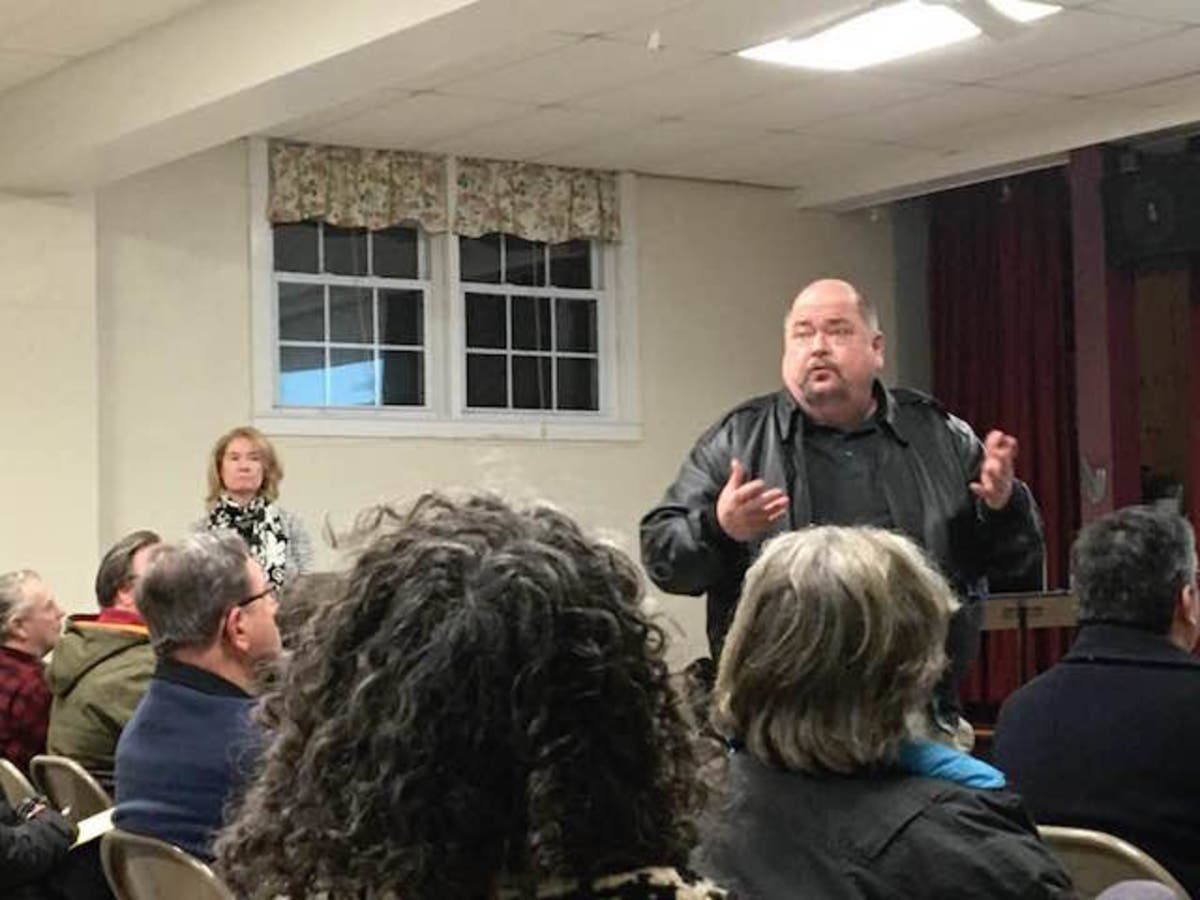
MATTITUCK, NY — The community came out Monday night to discuss three proposals pitched for a dangerous intersection in Mattituck — with a large majority of those in attendance speaking out in favor of a roundabout.
A meeting hosted by the Mattituck-Laurel Civic Association was held at the Mattituck Presbyterian Church to discuss "Three Traffic Solutions for the Intersection of Main Road, Love Lane and Old Sound Avenue."
To view the entire presentation and solutions proposed, click here.
Find out what's happening in North Forkfor free with the latest updates from Patch.
The begin, John Carter, president of the MLCA, gave a history of studies and research done in the past, including the 1999 Scenic Southold Corridor Management Plan, the 2005 Town of Southold Hamlet Study, the 2011 Mattituck Business Corridor Study, MLCA canvassing done from March, 2015 to April, 2016, followed by MLCA meetings and discussions, the MLCA's submission of alternatives in aa Traffic Calming Alternatives Report to the town in April, 2016, and Southold Town's Dunn Engineering traffic study draft in Nov., 2017.
Three options for change
Find out what's happening in North Forkfor free with the latest updates from Patch.
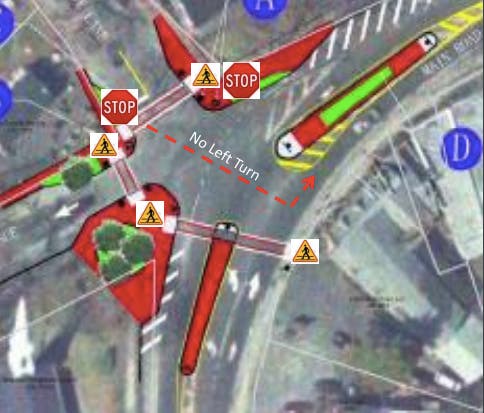
Option #1
The first option, born out of the 2011 Mattituck Business Corridor Study, calls for using medians, bulb-outs, and chokers, raised pavement and crosswalks, stop signs, and other traffic calming measures to simplify and tighten up traffic movement. The MCLA study also suggested a "no left turn" off Love Lane.
Pros to that plan, the MLCA said, include improvements to driver and pedestrian safety, making clear each driver's lane, responsibility and right of way; establishment of protective crosswalks, and eliminating the crossing of three lanes to go east off of Love Lane. The first option also facilitates flow of traffic on Main Road, fits into existing highway and street right-of-way, is doable and affordable, and is adaptable to future development, the MLCA said. Should the five or six acres of undeveloped property in the hamlet business zone be developed, that could impact traffic at the intersection, Carter said.
Cons include some change to Love Lane and Old Sound Avenue traffic and parking patterns, and the potential "no left turn" ripple effect on nearby streets, the MLCA said.
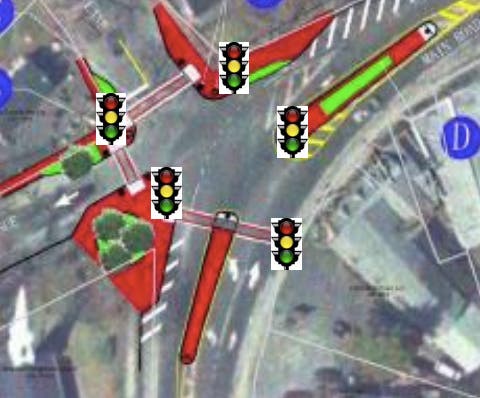
Option #2
The second option is similar to the first, with pros including establishing protective crosswalks, but adds traffic lights and continues to allow for a left turn off of Love Lane onto Main Road. Cons would be the potential new traffic patterns, the potential of traffic lights interrupting flow-through traffic on Main Road, cost and schedule, the MLCA said.
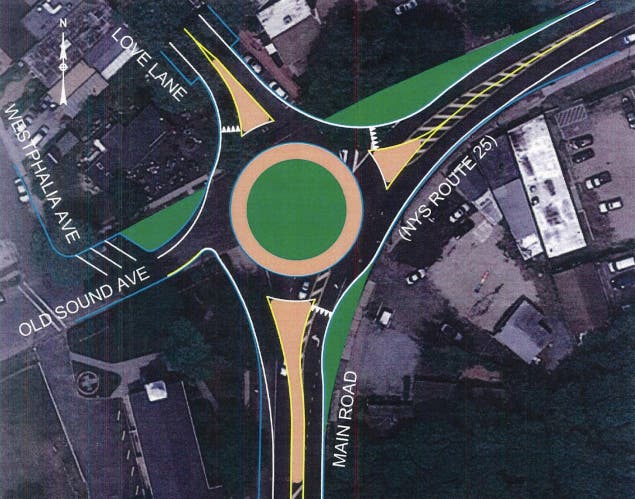
(Roundabout conception design from Dunn Engineering study, courtesy MLCA)
Option #3
The third option, for a roundabout, includes pros such as being a proven design solution in the right traffic environment and and being efficient at moving traffic through irregular intersections, the MLCA said.
Cons include questions such as whether or not there would be loss of parking, sidewalk and green space on Love Lane and Old Sound Avenue, potential condemnation of private property south of Main Road, and large vehicle accommodation. Other questions involve the degree of pedestrian protection and whether or not the new traffic pattern would be intrusive to Old Sound Avenue and Love Lane — as well as if there would be a ripple effect on other streets.
Cost and schedule, as well as adaptability to future development, were also discussed.
Present at the meeting were Southold Town Board members Bob Ghosio, Jim Dinizio and Bill Ruland, as well as town engineers Michael Collins and Jamie Richter, Southold government liaison Denis Noncarrow, Suffolk County Legislator Al Krupski, and a representative from New York State Assemblyman Tony Palumbo's office.
According to Carter, during past discussions, concerns for traffic and pedestrian safety have always been a chief concern.
Any solution, Carter said, needs to accommodate the needs of businesses, the theater, and church for access. "Parking in the hamlet is a major concern," he said.
Richter reminded that all illustrations so far are conceptual designs only.
Resident Art Beisel began the question and answer session by discussing the first option, which suggested stop signs at two places, and crosswalks. He suggested possible rumble strips to slow down traffic and perhaps lowering speeds from 30 miles per hour to 25 miles per hour at the intersection and "make it more palatable."
He also suggested turning Love Lane into a one way street heading north, with angled parking to increase the number of spaces.
Another resident asked about the Riverhead traffic circle and how it compared to the option proposed; Richter said traffic circles and roundabouts are not the same. The proposed option for Mattituck would act as a roundabout he said, adding that a roundabout is much more user friendly. The issue lies in teaching motorists how to safely use a roundabout, he said. The roundabout in Mattituck, he said, would make it easier by putting crosswalks on every road, and letting pedestrians walk in one direction, then the other.
He said the Riverhead traffic circle was smaller than the one proposed for Mattituck.
Resident Althea Travis said the roundabout would offer "something distinctive", characterizing the hamlet with plantings and perhaps a monument.
Meryl Kramer said she was wondering how the roundabout would facilitate pedestrian traffic, one of the MLCA's chief concerns. "I'm not convinced," she said.
Richter said as it stands, crossing Main Road from Love Lane is 120 feet, "a nightmare to get across. I don't recommend it to anyone." But, he said, a raised island with ramps would allow someone to cross more safely.
One resident expressed a concern that handicapped parking and parking in front of the church would be lost.
Richter said the renderings did not provide for any detail and assured those concerns would be addressed.
Another resident suggested that Old Sound Avenue be a two-way street, or that one-way traffic on Old Sound Avenue be reversed.
Former Town Councilman Bill Edwards said he grew up with roundabouts in New England. "It's hard to imagine one that's safe for pedestrians," he said, asking if anyone would want to cross the traffic circle in Riverhead.
Richter brought up the example of Five Corners in Westhampton, a place that was once a "nightmare intersection" that had residents crying out in opposition but which has since been embraced.
Jean Schweibish said she lived in the Westhampton Beach area when the traffic circle was being built; it was initially designed to be a roundabout, she said.
"Five Corners is not Main Road. It's much sleepier," she said. "I'm not sure this is what I'd like to see here," she said, adding she's concerned about the impact on traffic if new businesses are developed on the south side of Main Road, with a stream of traffic heading out onto Main Road.
Edwards said he did like the roundabout plan because it solved a dangerous situation; his own wife was in an accident when she was pulling out of Love Lane and a motorist was making a left onto Old Sound Avenue, he said.
He said he felt sorry for the businesses on the other side of Main Road, as customers traditionally don't want to go far or walk halfway down Wickham Avenue to cross the street and the new plan could provide relief.
Carter asked if the circle could be oblong or egg shaped; Richter said it could and options were being considered with the town's transportation commission to see what best fits the location.
Richter said town was coordinating with the New York State Department of Transportation and the Suffolk County Department of Public Works so whatever solution was decided upon would be "approvable through their eyes."
He added that transportation grants were available to pay for the project. The roundabout would cost approximately $6 to $10 million, he said.
Other residents said no matter what the plan, people don't pay attention to stop signs or speed limits; some suggested a stoplight at New Suffolk Avenue because motorists heading east can't see around the bend. A traffic light would also slow down traffic coming from the west before it reaches the proposed roundabout, they said.
Others suggested lights in the road to help guide pedestrians and traffic.
Robert Harper said he's seen many "close calls" at the Riverhead traffic circle, which "people don't know how to use. . . I think it's fortuitous that there's a hospital across the street because pedestrians are taking their lives in their hands."
Harper also said people ignore traffic signs near crosswalks and said he was concerned about bottlenecks caused by traffic lights.
Teresa McCaskie said lighting of the proposed roundabout would be an important issue to address, including "what type of lighting will be acceptable for the community. Safety is the top priority but there should be discussions on how to illuminate" the roundabout, she said, adding that LED lights can be blinding for someone driving.
Beisel also advocated for turning arrows on any traffic lights.
The group discussed a timeline; Beisel asked if the town could implement some temporary measures until the final plan was created a few years down the road.
"We can't directly do anything because this is a state road," Collins said, adding that only Love Lane or Old Sound Avenue could be addressed by the town.
Beisel suggested making traffic one way heading north, or angled parking, could be created on Love Lane.
Others said if the width of roads were narrowed it would slow down motorists.
Another man said he'd lived in Mattituck his whole life — accidents had once led to fatalities near his mother's home near Route 48, he said — but he added that a traffic light and left turn signal had solved the issue.
"I think it's a much bigger issue than just Love Lane," he said, adding that traffic was a townwide concern. "It's the whole area. The problem we are having here is volume. Volume creates problems."
Richter said the town was addressing the issue with a traffic summit and also through discussions with the town's transportation commission.
Another resident applauded the proposed roundabout, something she said "would be the least disruptive" option.
Schweibish also asked if there were temporary, affordable traffic calming measures that could be adopted until a final roundabout plan was put in place.
Richter said the first option wasn't what he'd call affordable. "It's not a $40,000 quick fix," he said, but closer to $1 million.
He reminded that initially a roundabout was proposed for the portion of the road near Wendy's Deli in Mattituck; a temporary light was installed but when the cost was projected at almost $8 million, the temporary light stayed. "When you do something temporary it's probably forever," he said.
Benja Schwartz of Cutchogue suggested alternative routes from Main Road to Route 48 to reduce traffic congestion.
Bob Hanlon of Orient said it sounded as though the sentiment of the community was "leaning toward a traffic circle."
In the meantime, he suggested rumble strips to alert motorists to speed zones, or implementing the "no left turn" on Love Lane option or a stop sign.
Krupski reminded the group of what happened in the past when a traffic circle was planned in Mattituck where North Road meets Sound Avenue in Mattituck; when that option became too expensive, the light stayed, he said. "If you don't want history repeating itself, go for the best option."
Addressing next steps, Collins said all the information garnered would be brought to the town, and then to another meeting with the state, county and Dunn Engineering; any plan would need to meet the county and state's design requirements, he said. "It's not only what people want, it's what's do-able," he said.
A final presentation will be made to the public before a final report, he said. Grants are also available for projects with multiple modes of transportation and the Mattituck project would fit those guidelines, due to the Long Island Rail Road, pedestrians and vehicle traffic in the area.
The goal is to wrap up the final steps by April and submit an application for grant funding by October, he said.
Mary Eisenstein, past president of MLCA, said when the civic was first formed, the goal was to take a holistic view of the hamlet. "Going forward into the future, we're thinking about what the hamlet is going to look like," she said.
Richter said the goal was to come up with recommendations and come back to the community for final input.
Main photo by Lisa Finn.
Renderings courtesy Mattituck-Laurel Civic Association.
Get more local news delivered straight to your inbox. Sign up for free Patch newsletters and alerts.