By Danny McCarthy
The Church of Christ became The First Presbyterian Church of Southold. The Rev. John Youngs organized the church here on the 21st day of October in 1640. The original cemetery here might well be called God’s Acre for it contained about one acre of land and was devoted to the holiest purposes. It was the site of the meetinghouse for public worship as well as the hallowed place for the burial of the dead on the highest ground in the settlement. Near the northeast corner of this acre the first settlers built their first church edifice. The first God’s Acre forms the northwest corner of the present cemetery. This original public graveyard has been enlarged from time to time, including some eight acres, and five acres being added by 1740.
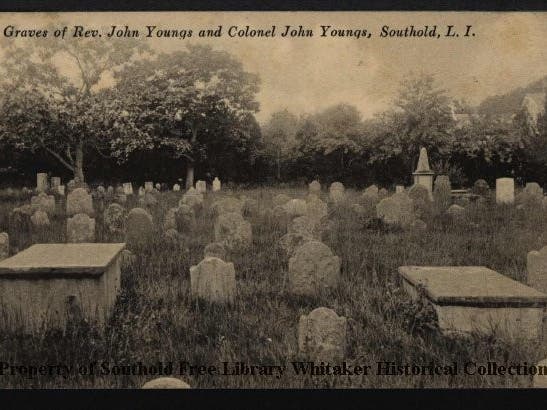
The tombstone of the first pastor is a massive horizontal table with an inscription on it. He died February 24, 1671-72 (1672/73) at the age of 74. He had been connected in some way with the parish church of St. Margaret’s, Reydon, in Suffolk County, England. Suffolk County was an original county of NY State created in 1683 that was named for the county of Suffolk in England from which its earliest settlers came.
Substantial tables cover the graves of the Rev. John Youngs, Colonel John Youngs, William Wells (Esquire), Barnabas Horton, and John Conklin. A few others of the Founders have gravestones but most of them in unmarked graves, as does every woman of the first generation. The first pastor’s grave was made near the church edifice and on the sunny side of it. His tombstone inscription appropriately credits him with being the “First Settler of the Church In Southold.” William Wells died only three months and 11 days prior to Rev. John Youngs on November 13, 1671 at the age of 63. He is buried not far from his companions John Youngs Sr. and Jr. - Wells laid claim to Plum Island and Corchaug and the claims were ruled as unjust, illegal and self-serving; the constable and overseers overturned the rulings.
Barnabas Horton was a native of Mouseley in Leicestershire. He was born in 1600. He died in Southold on July 13, 1680. He was one of the outstanding first settlers of Southold as well as an overseer of the town. Barnabas Horton was a baker by trade. He was the chief of staff of Pastor Youngs. Barnabas and his sons were wealthier than any other family in Southold.
The committee of arrangements for the 250th Anniversary Celebration of the formation of the Town and the church in 1890 deemed it advisable to set up a monument for the two-fold purpose of the site of the first meetinghouse and commemorating the Founders of the place and this was accordingly done. On the left of the monument may be seen the tables that cover the graves of the Rev. John Youngs and his eldest son, Colonel John Youngs. The higher one is the pastor’s. At the extreme right is a white marble column crowned with a pyramid of darker marble that marks the grave of Ezra L’Hommedieu, who was regarded as the greatest man that ever lived from birth to death in Southold. He was born on August 30, 1734. Soon after the of the Revolutionary War on the 6th of April 1784, the State of New York enacted the law enabling religious societies of all denominations to elect trustees to be bodies corporate to administer the temporalities of their respective congregations. This law was highly probable to be written by the Hon. Ezra L’Hommedieu, then a member of the First Church of Southold, the State Senate and the chairman of its judiciary committee, delegate to the Continental Congress from NY, a member of the NY State Assembly, delegate to the NY State Constitutional Convention, and the county clerk. The First Church of Southold was the earliest in Suffolk County and the earliest on Long Island to elect its trustees and file its certificate of incorporation. The church trustees gave assurance to the townspeople that as in the past so also in the future the meeting should always be open for town meetings and other public gatherings and the cemetery always open for burials. L’Hommedieu was responsible for convincing farmers that the Native American tradition of placing seashells around their crops was more than just a tribal custom. This led to a thriving bunker fishing industry. L’Hommedieu helped to design the lighthouse at Montauk Point. He also owned a brick factory on Robins Island. He died on September 27, 1811.
Colonel John Youngs may be accurately described as an illustrious son of an illustrious father. He was baptized at Southwold, England on April 10, 1623 and as a youth accompanied his father and family to Salem in 1637. He was a man of many talents being at varying times magistrate, captain of militia, judge under the jurisdiction of Connecticut and high sheriff of Long Island. He was also a very large landowner. He knew the Indian tongue and was chosen as interpreter.
In front of Ezra L’Hommedieu’s monument at the extreme right is the massive table over the grave of the second pastor, Rev. Joshua Hobart . He was doubtless the first highly educated physician who practiced the profession in Southold. The tables over the graves of Barnabas Horton, William Wells and John Conklin are westward of the Rev. Joshua Hobart’s. He closed his long life in 1717 and 10 years later, the town voted that a tombstone be purchased to mark his grave and honor his name. There was an inscription tablet that was missing and the tradition is that the British destroyed it during the War of Independence. There are, in the oldest part of the graveyard, several other tombstones from which the inscription tablets are gone.
John Conklin’s family origins were with the glass blowers of Italy, Lorraine and Normandy as well as England. He was identified with two early Long Island settlements, those of both Southold and Huntington.
The ancestry of Capt. John Underhill can be traced back to England where he was born somewhere between 1597 and 1600. He came to New England about 1630 and became the scourge of the Native Americans in a series of raids. He lived in Southold in the early 1650s. The historic marker in front of the Southold Free Library marks the site of Underhill’s residence and describes him as a “renowned military leader and Indian fighter” and states that he lived “on this Feather Hill site.” He led a “complete destruction of the Pequot Indians when he burned their village, killing men, women and children alike!” in an expedition to Saybrook, Conn.
The Reverend Epher Whitaker was born in Fairfield, NJ March 27, 1820. After an early career in printing, he graduated from the Union Theological Seminary of New York in 1851 and was then ordained pastor of the Presbyterian Church of Southold. He wrote History of Southold, Long Island—Its First Century 1640-1740 and Ready for Duty, a brief biography of Lt. E. F. Huntting, and plenty more. (Huntting was a Civil War soldier who gave his life for the Union cause; his name was inscribed on the monument that stands at the village proper which pays tribute to the Southold men who served in the Civil War). Through Whitaker’s efforts, the town records of Southold from 1651 onward were preserved and published. He was designated pastor emeritus and often called “Suffolk’s Grand Old Man.” He proposed the public celebration of the 250th anniversary of the formation of the town and church of Southold and collected and helped to erect the granite monument on the site of the first meetinghouse to commemorate the founders of the town and church. Dr. Whitaker started the movement for the Southold Academy in 1866. He passed away in 1916. “Here sleeps my body tombed in the dust, Till Christ shall come and raise it with the just.”
The Whitaker Historical Collection was dedicated during Southold’s 300th anniversary celebration in 1940 and is named in honor of Rev. Epher Whitaker who resided in Southold from 1850 to 1916. He encouraged the townspeople to preserve their rich and unique heritage.
The “Mr.” or “Mrs.” before a name, either in the town records or on a colonial tombstone, was indicative of social distinction. The prefix “Mr.” embraced clergymen, planters of good family and estate who were members of the General Court and those with sufficient education to manage the affairs of the colony.
Grave Doubts About Missing Sarah Carpenter
According to a September 29, 1884 Brooklyn Eagle article, retired merchant Andrew Carpenter wrote a letter to Superintendent Campbell referring to the fact that Mr. Carpenter had no clue whatsoever as to his daughter Sarah’s whereabouts. A baker named Alfred Taylor spotted a woman answering Miss Sarah Carpenter’s description. Mr. Taylor was shown a picture of the missing woman and said he noticed her particularly because he thought it was strange that the well-dressed lady was out so late. He said she carried a bundle with her and looked pale and sickly. Miss Sarah Carpenter left home early on a Wednesday in September 1884. She seemed to have something on her mind. She was walking with her head bent down and appeared to be in distress. Mr. Carpenter had no doubt that it was his daughter that Mr. Taylor saw. A lady claimed she saw Sarah Carpenter passing her residence. Mr. Carpenter thought the lady saw his daughter as well.
Sarah Carpenter’s description is as follows: Thirty-eight years old, five feet three inches tall, 120 pounds, dark complexion, brown hair and brown eyes, plain black velvet bodice, blue-black velvet skirt, black hat, feather, black and red striped shawl, rubber cloak, laced boots, black satchel, and two plain gold rings.
She was supposed to see the family physician on the day she went missing. She had been in poor health for some time and was thought to be melancholy. Miss Carpenter’s father was beginning to despair of seeing her alive again.
Two days after Miss Carpenter’s disappearance, Mr. Carpenter received an anonymous letter stating that the writer had read a description of the missing lady and believed he had seen her upon the Cunard steamship company’s pier on the same morning that she had left home. When the ship Bothnia of the Cunard line was leaving the dock, her gangplank was being pulled in and a solitary female evidently much excited and carrying a small satchel, ran down the dock and the gangplank had to be pushed out to allow her to board the vessel. According to the writer, the Bothnia arrived at a port with a passenger named Mrs. Blake who looked so much like Sarah Carpenter. Mrs. Blake, supposed to be Miss Carpenter, was missed the second day and was drowned. There was no such name as Blake on the passenger list. If the passenger had money, she would have been able to pay her fare on the steamer at the last minute, and her name may not have been on the list.
Mr. Carpenter, through his son Frederick, sent a cable dispatch to Liverpool, which read: “See purser Bothnia. Cable every particular of lady drowned. Describe fully all articles left.”
There is a Carpenter monument located on the grounds of the Southold First Presbyterian Cemetery listing Sarah Carpenter’s name.