Politics & Government
Vietnam Veterans Honored at Northport VA Hospital
Three days of tribute and reflection this weekend as hospital hosts replica of Vietnam Memorial Wall.
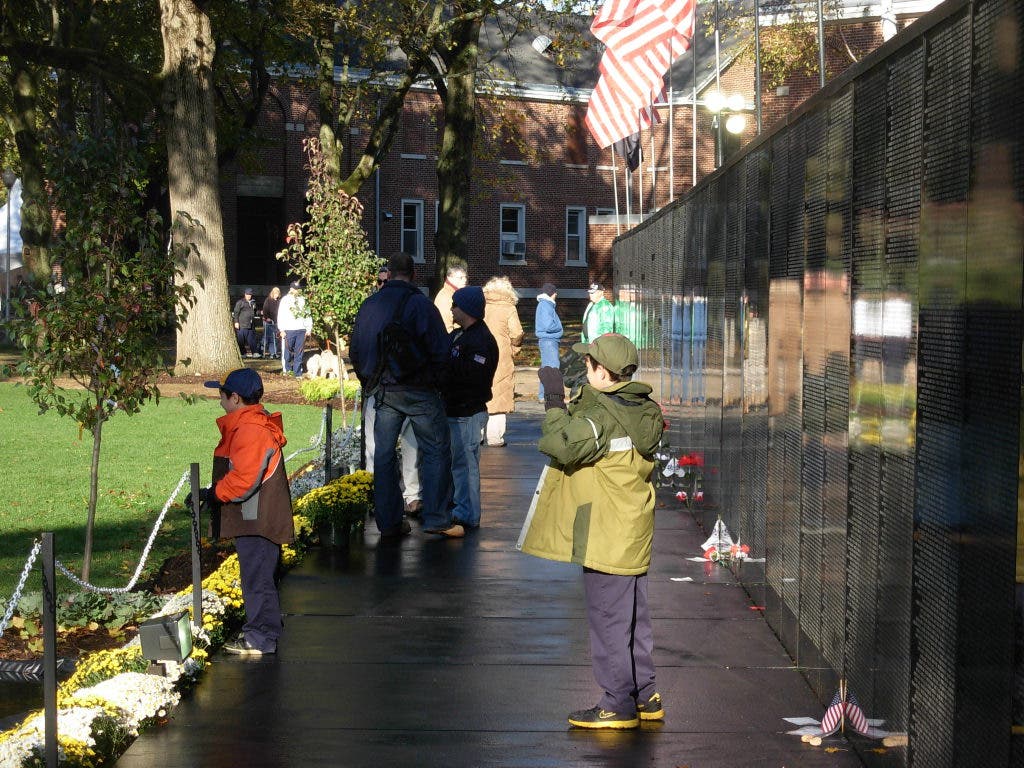


In a weekend marked by moving tributes and solemn reflection, the hosted the Dignity Memorial Vietnam Wall, a faux-granite, 240-foot long replica of the Washington, D.C., memorial which lists the names of the 58,267 Americans who died or are missing in Vietnam.
The wall had been exhibited in Huntington last year, but the medical center is the first in the nation to play host.
In honor of its temporary installation, new grass, a walkway, landscaping, and a reflecting pool had been installed on the medical center’s grounds by Gary Duff Designs.
Find out what's happening in Northportfor free with the latest updates from Patch.
Throughout the three-day event, a number of dignitaries spoke, including Democratic U.S. Reps. Steve Israel and Timothy Bishop. Huntington Town Supervisor Frank Petrone, who was slated to give a speech Saturday evening, was unable to attend due to illness. But Councilwoman Glenda Jackson was on hand for the event, which had to be moved into the medical center’s auditorium due to the inclement weather.
Richard Kitson, president of the Vietnam Veterans of America, Chapter 11, sought to dispel what he called the myth of the draft. Of the 2.8 million Americans who served in Vietnam, 75 percent were volunteers vs. 33 percent in World War II. The average age was 19. Only one third of those who served are still alive.
Find out what's happening in Northportfor free with the latest updates from Patch.
Saturday's Nor'easter brought blustery winds, rain, and snow but by Sunday morning the weather had cleared, and visitors were once again walking the wall’s length. A sargeant who had served in Vietnam in 1967 and 1968 was at the walkway’s entrance, eager to share his story.
“See this?” he asked, pointing out a name on the wall. “That’s Eugene G. O’Connell. That’s my name.”
O’Connell went on to explain in his Irish brogue that there was another serviceman with the same name who had been killed in Vietnam. His mother, who watched the nightly news, saw his name come across the TV screen but O’Connell said her intuition – plus the fact that she had received a letter from her son that very day – told her that he was alright.
O’Connell’s brother Bart also served in Vietnam. Both volunteered. Sixteen years ago, Bart died at the age of 45 from the effects of Agent Orange.
O’Connell said that while he was serving, his mother would receive phone calls in the middle of the night from people opposed to the war, asking her the size of the coffins she would need for her sons. Then they would laugh and hang up.
“Anti-war people are entitled to their opinions,” O’Connell said. “But not to do that to some of the parents.”
Amanda Sokolowski, a member of the planning committee who was in charge of hospitality, said over 200 people had helped to make the weekend event a success. One of those volunteers was Bruce Antin, a member of the Vietnam Veterans of America, Chapter 11 who served from 1968-69 as part of the 101st Airborne. He spoke proudly of the VVA’s involvement in the creation of the Vietnam Veterans Memorial Garden, which was installed at the medical center last year, and looked forward to the ground-breaking of a new museum in Washington, DC in 2012 which will display all the items that people have left at the memorial throughout the years.
Leigh and Michael Sofarelli are part of the effort to collect photos for all of the names on The Wall as part of the new museum. Click here for more information if you have a photo of a friend or loved one.
At the end of the weekend’s ceremonies, Joe Sledge, Public Affairs Officer for the medical center, said he was pleased with the response to the exhibit. Of all the activities, he found the closing ceremony the most moving. At the end, all the Vietnam veterans lined up along the wall and shouted “Welcome Home!,” a reference to the response that was denied veterans when they returned from the war.
Asked to sum up the three days, Sledge put it simply. “The most important message I took away was that we learned from the past.”