Community Corner
100s Of Park Slopers Sign Petition Against New Homeless Shelters
Neighbors of two city shelters planned for Fourth Avenue have started a petition and an activist group to seek answers about the plans.


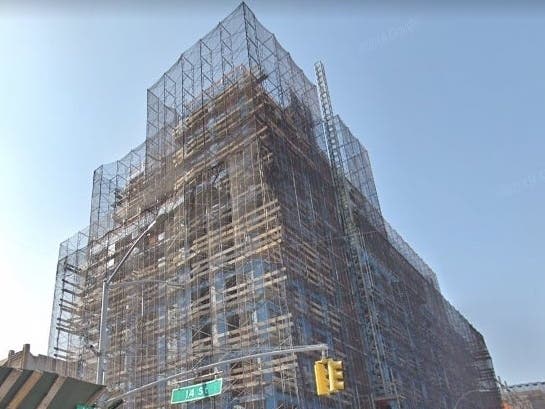
PARK SLOPE, BROOKLYN — A group of neighbors who live near two new homeless shelters set to open later this year have started organizing against the plans, even as the buildings continue to rise on Fourth Avenue.
The shelters, a 12-story building at 535 Fourth Ave. and an 11-story complex at 555 Fourth Ave., have been leased out by the city's Department of Homeless Services as part of Mayor Bill de Blasio's plan to tackle homelessness in the city by building 90 new shelters. Together they will offer more than 250 units for homeless families and 29 permanent supportive housing apartments, according to WIN, the nonprofit that will run them.
But some neighbors have formed a group, Fourth Avenue Matters (FAM), to organize against what they have called the "slap-dash" plan for the developements. Another group with similar concerns, the Fourth Avenue Committee, has gained more than 400 signatures on a petition against the plans.
Find out what's happening in Park Slopefor free with the latest updates from Patch.
"We're not necessarily for or against a shelter, but we think the lack of planning going into this enormous building is a scandal," Dan Guido, one of the neighbors leading FAM said. "We spend more time thinking about liquor licenses and outdoor seating for bars than we do thinking about what 1,200 homeless people will do for the community."
The group and petition were formed in the weeks following a Town Hall meeting about the two shelters earlier this month, where neighbors said they were left unsatisfied by the information city officials and WIN provided. Some neighbors have emailed various elected officials and WIN repeatedly with specific questions to little or no response from the offices, they said.
Find out what's happening in Park Slopefor free with the latest updates from Patch.
One of the main points of contention for both groups has been the city's decision to lease the buildings from two "bad actor" developers.
Slate Property Group, which is constructing the 555 Fourth Ave. building, has been issued 25 Department of Buildings violations since they bought the property in 2016, four of which are still open. Adam America, the group responsible for the 535 Fourth Ave. building, has been given 37 violations, four of which are still open. Both were initially slated to become residential buildings with both affordable and market rate units.
Neighbors who lived next to the properties, some whom say their homes were directly harmed by construction violations, argue that the city's $6.3 million and $4.6 million yearly rent at the two buildings has "bailed out" the developers' behavior.
"~$3500/month per apartment for that building is a sweetheart deal for two developers who have been a menace to this neighborhood," Guido said. "We have been hopeful that the market would demand improvements to their lackluster development efforts...None of these demands are now placed on these developers because they're being paid equivalent or higher rates for every unit in both buildings all at once."
Adam America did not respond to a request for comment. Slate responded with a statement, saying the company is proud to play a role in alleviating the city's homeless crisis.
"Slate has worked closely with the Department of Buildings, the Department of Homeless Services, and other city agencies throughout this process to address any issues along the way as a normal part of developing a building of this magnitude,” a spokesperson with the company said.
DHS entered into a $147 million contract for nine years with Adam America and a $114 million contract for nine years with Slate. The deals divide out to rent of $42,000 per family per year and $44,000 per family per year at the buildings, which the department said is within the market rate for the area.
Officials have said that these high market rate rents are necessary to carry out the mayor's plan of providing shelters closer to where homeless New Yorkers live and work, rather than concentrated only in lower-income communities. The developers, they contended, would be getting market rate prices even if it wasn't from the city.
The city's 90 new shelters, spread across the five boroughs, will fill the gap left by closing commercial hotel and "cluster unit" shelters that don't provide holistic services like those run by non-profits like WIN, according to DHS and WIN.
Councilman Brad Lander, who represents the district and lives near the Fourth Avenue shelters, said that even though he has had issues with at least one of the developers in the past, finding housing for the 60,000 New Yorkers who are homeless each night requires that the city works within the system that exists right now. He hopes that more shelters would be built by non-profits, rather than private developers, but that isn't the case yet, Lander said.
"If the city were only going to rent buildings for homeless shelters from angels we wouldn’t have any homeless shelters," said Lander, who put out an FAQ about the shelters this week. "We need to meet the needs of homeless families and to do that you have to pay the market rate price — the only alternative that I would see is that homeless shelters would continue to be only in low-income communities."
He added that the buildings will need to pass Department of Building and DHS standards before they are allowed to open. WIN will handle its own security and maintenance of the buildings once Slate and Adam America are done with construction, WIN President Christine Quinn said.
Other members of FAM have said that, developer issues aside, the buildings should have gone toward the neighborhood's lack of affordable housing instead of turned into shelters. A mix of market rate and affordable units in each apartment would fit better with the diverse community in the Fourth Ave. neighborhood, where Gowanus, Park Slope and Sunset Park meet, FAM member Daniel Price said.
" Ideally, the buildings would be at least 50 percent affordable — if not more — preserving the rich integration we love about this neighborhood while providing housing to our neighbors who need it most," Price said.
FAM members and the Fourth Avenue Committee petition also contend that the influx of people to the shelters will make the Fourth Avenue block overly concentrated. They worry about the impact on the nearby school P.S 124, on traffic and about the fact that the shelter will add to several other city-run facilities on that block, including a waste transfer station, an asphalt plant and a sanitation department garage.
Lander said that he, too, worries about the local school and has already met with the principal and Department of Education officials to start planning for when the shelters open. He plans to continue meetings in the months before the shelters open, he said.
The Fourth Avenue shelters will be restricted to families, mainly single mothers with children, WIN said. Many of those children will still attend their own schools outside of the neighborhood, but some will go to P.S. 124.
Neighbors have also questioned WIN's ability to run shelters like those being built on Fourth Avenue, mainly because of their size.
Quinn said, though, that the Fourth Avenue buildings are by far not the largest that WIN manages.
Several others of larger size, including one in East New York with 215 units and another in East Flatbush with 198, have become some of the organization's most successful in terms of low incident numbers and appropriately-timed discharges, she said.
"Every shelter we run we are good neighbors," she said. "We have security everywhere and we are very clear that we are going to be a positive to this neighborhood."
Some neighbors have contended, though, that examples like the East New York shelter, which is between a school bus depot and a rail yard, aren't at the center of residential neighborhoods like the Fourth Ave. buildings.
In response to the groups organizing against the shelter, Quinn said that it is typical to have a "small minority that is very vocal" against shelters when they are proposed.
WIN's recent surveys have shown that 59 percent of New Yorkers, and 62 percent of Brooklynites, support a shelter being added to their neighborhood, she added.
"We know for a fact that the petition signers do not speak for the majority of Brooklyn and majority of their neighbors," Quinn said. "We understand when a shelter comes to a neighborhood that people have questions, we understand they have concerns and we’re happy to address those, but we’re gratified that the vast majority of Brooklyn-ers support these kind of facilities."
Get more local news delivered straight to your inbox. Sign up for free Patch newsletters and alerts.