Community Corner
Help Wanted: It's Turtle Time On Western Highway
It's egg-laying season for snapping turtles and Western Highway is an obstacle course. Signs are up and volunteers are needed.


BLAUVELT, NY — It's turtle time in Blauvelt and West Nyack, and more volunteers are needed to help direct traffic on Western Highway. And carry the occasional mama snapping turtle — carefully — to safety.
These are what The Turtles of Western Highway Facebook page calls South Orangetown's oldest residents. Every year, the females head to nesting grounds at the edge of the Hackensack River to lay their eggs.
In New York, thousands of turtles are killed each year when they are struck by vehicles while migrating to nesting areas. In Rockland County, Western Highway and Sickletown Road cut through the ancient pathway. So, for the past decade, volunteers have spent about a month to help the turtles out. And back.
Find out what's happening in Pearl Riverfor free with the latest updates from Patch.
“This year, with the warm weather a month ago, we really do not know when they are going to show up,” volunteer Jane Murphy told Patch. “We are going to start walking the road on Monday, May 15.”
Why care about snapping turtles? Aside from being amazing prehistoric reptiles, they are useful. They keep the eco-balance in the natural wetlands in Rockland, which help keep the drinking water system safe.
Find out what's happening in Pearl Riverfor free with the latest updates from Patch.
The turtle protectors, in addition to patrolling, have put up a fence at the “hotspot” that's the center of the traditional crossing. They've built 27 mounds of the kind of sandy soil that's attractive to mama snapping turtles just inside it, hoping to attract the young females.
“We hope to keep them on the safe side,” Murphy said. “We're losing too many of the larger turtles. There are hardly any of them left.”
But some of the older ones are persnickety about their nesting ground, and they'll scale the fence and cross the road to the sunny field beyond. Or they'll try.
.jpeg)
This is where the spring volunteer effort reaches its peak. For three weeks, protectors patrol about 1/3 mile of Western Highway, watching for turtles. The goal is to have three people per hour on the road.

“We'll put them on a mound, but if they're constantly trying to get over the fence instead, we'll walk or carry them over and back,” she said.
Female turtles take 12 to 24 hours to lay eggs and head back, so Murphy brings binoculars.
“I always scan that field. You can see them chugging along. When they get close, if traffic's not crazy, I'll let them walk and just stop traffic.”
If traffic is, as usual, heavy and fast, the trick to picking up a snapping turtle is to put your hands just in front of the hind legs, and lift the turtle at an angle to minimize struggle. Hold the turtle out about 2 feet in front of you to avoid being peed on. It's scary until you do it, Murphy said.

“The first time I was left alone on the road, I thought either I face my fear and get this turtle or it will be killed,” she said. “I did it. I was jumping up and down, drivers were applauding. That shift, I saved four turtles.”
And yes, the volunteers come back around Labor Day to help baby turtles cross the highway back to their year-round habitat.
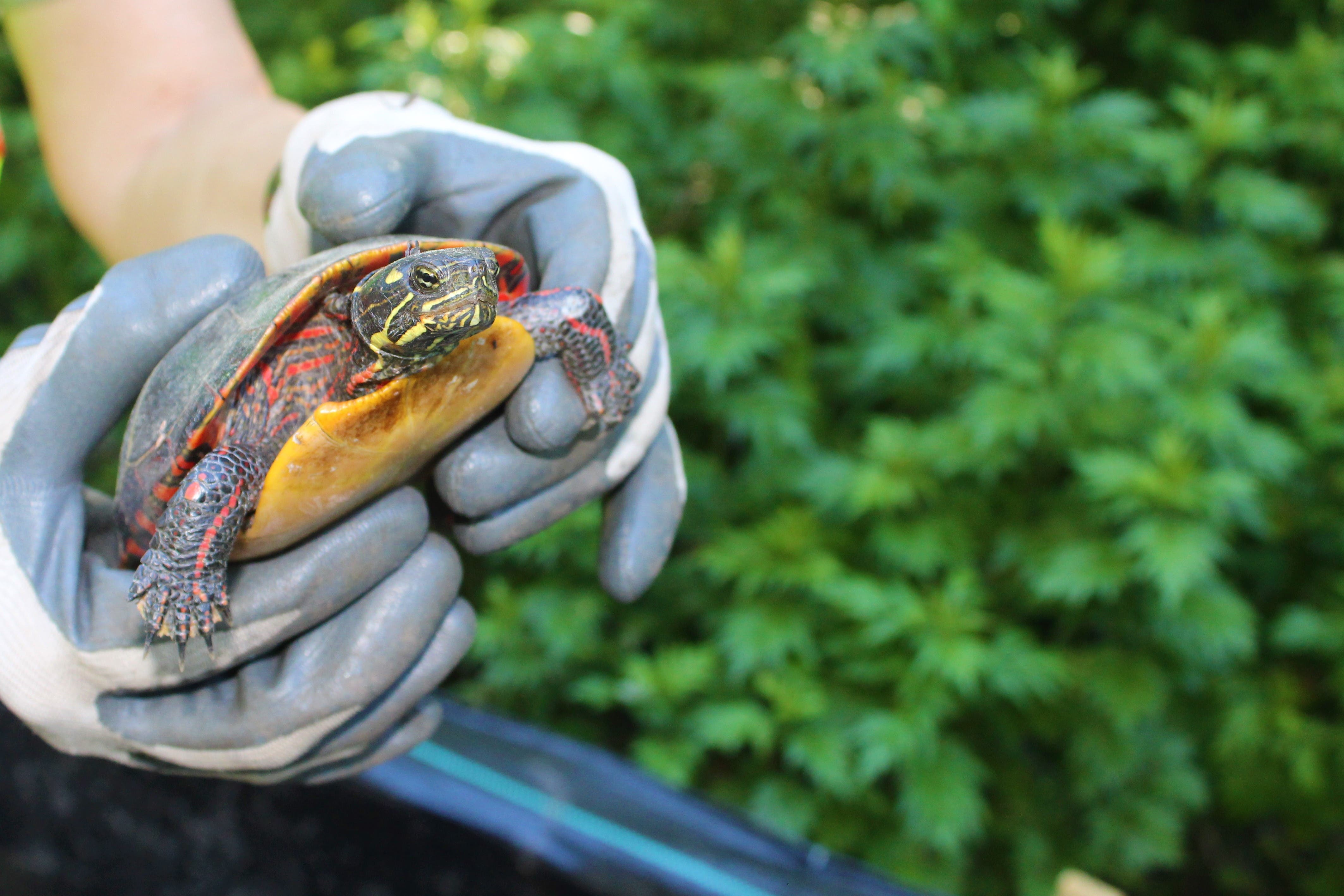
It's a coordinated effort. Orangetown police put signs up warning drivers. It works, too — there hasn't been a turtle killed on Western Highway during the nesting migration in five years, Murphy said.
The protection group has expanded its efforts in the past decade, and is working with people at five other locations now, said leader Carolyn Hill. "We're trying to spread the word. Spreading the word does make a difference. So often people just aren't paying attention to a turtle in the road. Even just putting signs up helps — asking for the next four weeks, look where you're going!"
One of their expansion projects is Sickletown Road in West Nyack. Last year only one turtle died there, compared to 10 the year before, Murphy said.
SEE ALSO: Releasing Baby Snappers: The Turtles Of Western Highway
Want to help? Here is the link to the sign-up sheet http://bit.ly/WesternHwyTurtlesNeedYou to start scheduling times you are available to walk the road. (RAIN OR SHINE) For those who need an orientation, Murphy could set one up the weekend before. She'll be taking vacation time to help the turtles for another year.
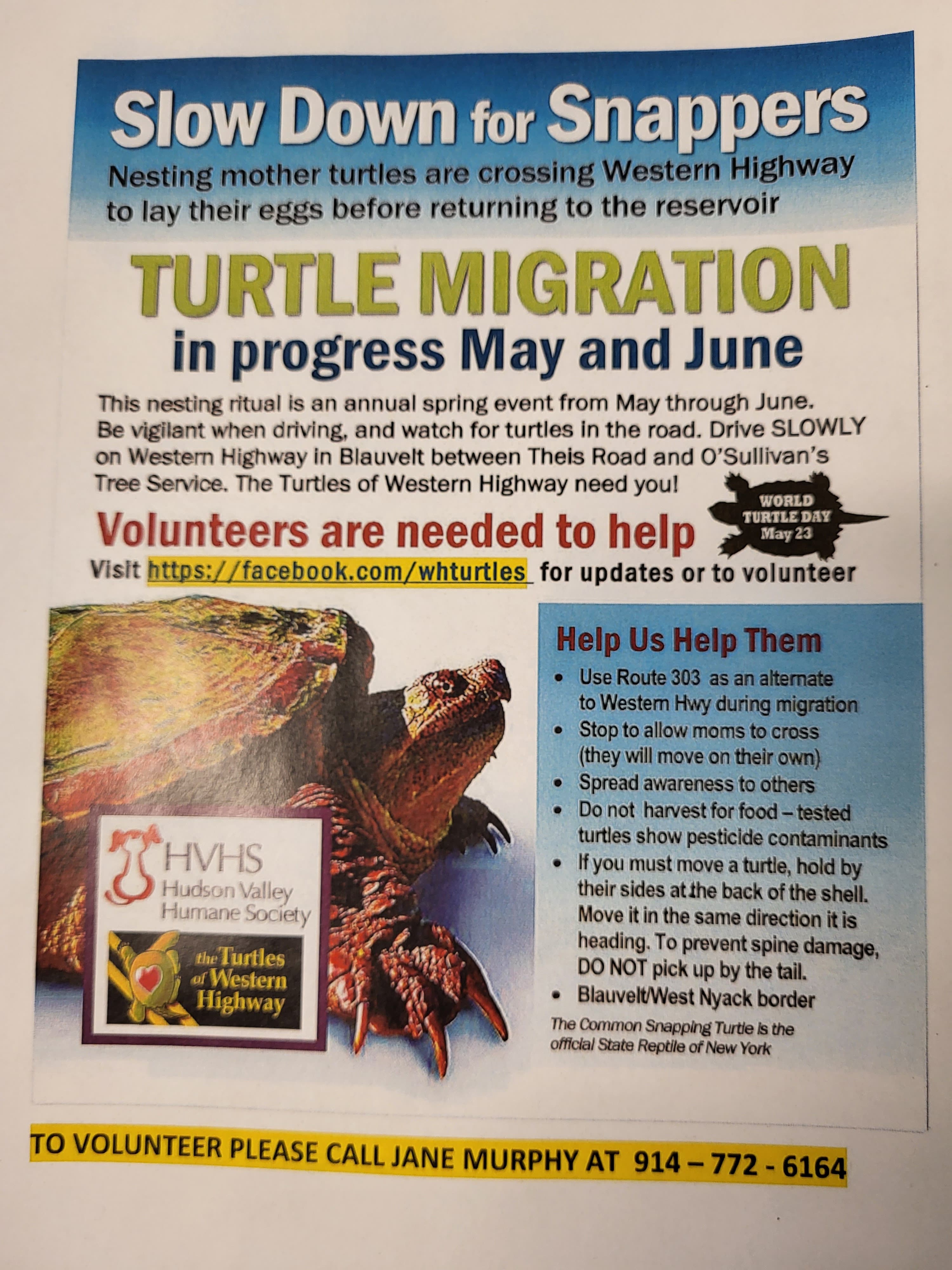
The New York Department of Environmental Conservation points out that turtles are migrating across roads all over the state, and it begs motorists to be careful.
The state's native turtles are on the move in May and June, seeking sandy areas or loose soil to lay their eggs. Drivers that see a turtle on the road should use caution—not swerve suddenly or leave their lane of travel--and take care to avoid hitting turtles while driving.In New York, thousands of turtles are killed each year when they are struck by vehicles while migrating to nesting areas. New York's 11 native species of land turtles are in decline, and turtles can take more than 10 years to reach breeding age. The reptiles lay just one small clutch of eggs each year, which means the loss of a breeding female can have a significant effect on the local turtle population.This time of year, it is especially important to be on the lookout for turtles and to drive cautiously, particularly on roads near rivers and marshy areas. If a turtle is spotted on the road or near the shoulder, drivers should safely stop their vehicle and consider moving the turtle to the side of the road in the direction the reptile is facing. Drivers should only stop and move turtles when it safe to do so and should never put themselves, their passengers, or others at risk.Most turtles can be picked up by the side of their shells. Do not pick up a turtle by its tail. Picking the turtle up by its tail may frighten or injure the reptile.It's important to use extreme caution when moving snapping turtles; either pick the turtle up at the rear of the shell near the tail using two hands, or slide a car mat under the turtle to drag the turtle across the road. Do not take native turtles into personal possession. All native turtles are protected by law and cannot be collected without a permit. Snakes can sometimes also be seen crossing or basking on the road. If safe to do so, please slow down and steer around them.For more information on protecting turtles and other reptiles, visit DEC's website. Read more about turtles in the June issue of DEC’s The Conservationist magazine. Don't miss out--subscribe today. Call 1-800 678-6399. View the new digital issue at The Conservationist webpage.
If you see and protect a turtle, send Patch a “snap”shot and tell us where! lanning.taliaferro@patch.com
Get more local news delivered straight to your inbox. Sign up for free Patch newsletters and alerts.