Schools
PRSD Staff Remembers 9/11, Following Days
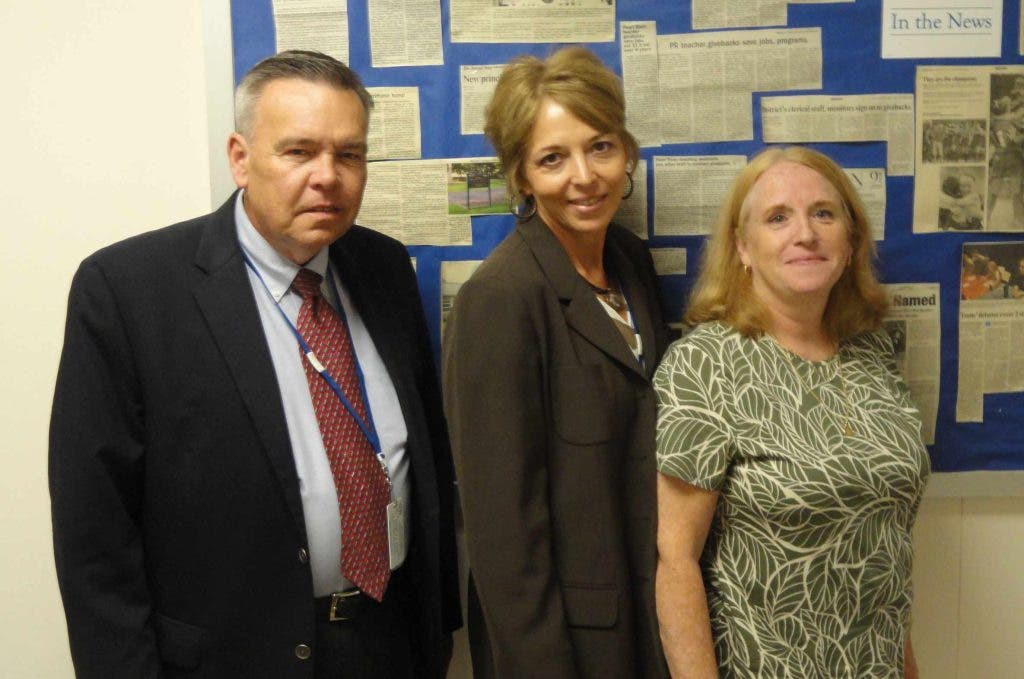
Franklin Avenue Elementary School secretary Rosemary O'Boyle, Pearl River School District Director of Community Relations Sandra Cokeley and PRSD Director of Operations Quinton Van Wynen share their memories of Sept. 11, 2001.

Pearl River School District Director of Community Relations Sandra Cokeley entered the office of then Superintendent of Schools Dr. Richard Mauer with some news Sept. 11, 2001.
"I said, 'I have no idea why I'm telling you this, but I feel you should know I was just informed that a plane just hit the World Trade Center," Cokeley said. "And the kindest, most compassionate man you could ever meet, in all seriousness, said to me, 'What does that have to do with us?"
At the time, Cokely had no answer for that question. Mauer thanked her and they went on with their day.
Find out what's happening in Pearl Riverfor free with the latest updates from Patch.
"And an hour later, it had everything to do with us," Cokeley said.
The anecdote is a reminder of just how unthinkable the terrorist attacks of that day were at the time, with most assuming the first plane was simply an accident right up until the moment that the second plane hit.
Find out what's happening in Pearl Riverfor free with the latest updates from Patch.
Cokeley, Franklin Avenue Elementary School secretary Rosemary O'Boyle and PRSD Director of Operations Quinton Van Wynen, then president of the district's board of eduation, sat down with Patch this week to discuss their memories and reflections what happened in the schools Sept. 11, 2001 and in the days that followed.
Such a Promising Start
Like many others, O'Boyle's first recollections of 9/11 begin with the beautiful weather.
"I got into work and we just got settled and somebody said a plane hit one of the trade centers," O'Boyle said. "In between which we were fielding phone calls because Donna McDonough, the PTA president, was in delivery that morning.
"We all kept saying it had to be a mistake. How far off was that pilot? Then once the second one hit, you knew. You just knew."
"(Before the second plane hit) you had this picture of the tiny private plane making a mistake. That's what you had in your mind."
Van Wynen was at home. His wife called to tell him to put on the television just moments before the second plane hit.
"It goes from the reporter saying it was a terrible accident and we are trying to get information," Van Wynen said. "The second plane hits and nobody is saying it is an accident. From that point on, if you were near a TV, you couldn't get away from it. Youv'e got reporters saying this building can't fall down. Then the first one falls down. Then the second one. Then it is non-stop for days and days and days."
Once the administration knew the severity of the event, the next issue was letting the teachers and staff know without telling the students, especially in the elementary schools.
"We were calling all the parents to make sure there would be somebody at home," O'Boyle said. "We're covering stafff so they can check on families. I don't think we as a staff even really could comprehend what was going on until we dealt with all that. It was probably that night that it really hit us. We knew, but it was doing what you had to do and the emotions hitting later.
"You couldn't focus on that because we had to hold it together in front of the kids. We didn't tell them. They were little. That was something a parent needed to do in their own way."
Many teachers rode the buses home with the students later that day to make sure somebody was home because so many people were stuck in the city, but school actually went on as normal as possible that day.
"We made a conscious decision not to close school early and if anything, to extend our day for those kids who needed us," Cokeley said.
"Even at the upper levels, we didn't shut down or anything," Van Wynen said. "The day went on. We had a school board meeting that night. You look back and can't believe we had a board meeting that night, but it was still developing."
Sept. 12
Van Wynen said the enormity of the event really started to hit home the next day, particularly when he had a conversation with the father-in-law of Kevin Reilly, one of those lost that day.
"You run into somebody and ask how you are doing," Van Wynen said. "His daughter had just gotten married. I ask if everything is ok and he says, 'No. Kevin's gone.' That was his son-in-law. His daughter had been married three weeks, maybe a month.
"This community got hit pretty hard. It rolled out in waves. You would hear another name and think, 'Jeez, I didn't realize he was in Manhattan. I thought he was on vacation. You can have all the news or the television, but it's talking to somebody whose son was a firefighter or whose nephew. My own son was a cop. I didn't see him for weeks."
Mauer met with the principals and administration the day of the attacks, then again first thing in the morning on the 12th.
"That was the worst meeting," Cokeley said. "The meeting the next morning was the worst because everybody reported who we had not heard from yet, staff and parents. And the list ended up being the final list. We lost a parent, a child of an employee and a spouse of an employee."
The teachers and staff then had no way of knowing what parents had told their children about the attacks.
"You don't know what their parents have said," O'Boyle said. "You have to be careful you don't tell them more than their parents have. Some parents don't want them to know anything."
O'Boyle remembers covering for the school's music teacher, who had to take a phone call.
"I'll never forget one little girl started to cry," O'Boyle said. "First, it was the fact that anyone took a phone call. She got nervous. And they were singing Proud to be an American. I said, 'What's wrong?' and she said, 'It's just so sad.' She was in third grade."
Reaction Outside New York
Van Wynen was inundated with calls asking about his son, who was not hurt in the attacks.
"I got phone calls from people who went to college with my son who hadn't seen him in a year and a half or two years, but they knew he was a New York City cop and they went out of their way to find his number and give a call to see if he was ok," Van Wynen.
Cokeley's son was a freshman at Manhattan College. He went to class that day, but was dismissed early due to the attacks.
"He went back to his dorm and he had 64 emails. People he didn't even know knew him asking if he's ok. And his response to everybody was, 'I'm fine. It's 230 blocks away."
That didn't mean the event didn't hit especially hard, just as it did for most New Yorkers.
"A couple of days later on campus, somebody put up a flier about turning the other cheek," Cokeley said. "He ripped that sucker off the wall. He was not a happy boy."
"You have to keep in mind, they partied in the streets when this happened ... for days," O'Boyle said. "I think anybody who has ever been a part of new York feels it very personally. How could this happen where I live?"
Van Wynen made a trip to see the birth of his granddaugther near Philadelphia three weeks after Sept. 11.
"I was pacing back and forth and I guess I had something on that said New York or Pearl River," Van Wynen said. "People at the hospital, this is three weeks later, they wanted to talk about it. Did you know anybody? Whats' going on? It's only 90 miles, but it is a world away. Normally, they don't even like me, but I got a pass for a few weeks."
10 Years Later
Van Wynen pointed out that the stories are already all over and that will only intensify this weekend. He wonders if it is necessary to re-open the wounds so many have.
"It's going to be brutal," Van Wynen said. "It's 10 years and it's a terrible thing and an open wound, but the media, every night now you have (things such as) George Bush remembers or the history of the World Trade Center: How it went up and how it came down. It's going to be every night now."
"You have to look at the overall picture," O'Boyle said. "We've lost so much. We will never be the people we were the day before this happened. We'll never be that naive again. It didn't just take down two buildings. It took down a part of our history when we thought we were safe. We were not safe. We were foolish to believe we were safe.
"But on the other hand, you have to look how New York responded. Beyond everyone around us, New Yorkers responded."
Get more local news delivered straight to your inbox. Sign up for free Patch newsletters and alerts.