Community Corner
More New Yorkers Need To Get Tested For New Coronavirus: Cuomo
New York hit its ambitious goal, now able to do 40,000 coronavirus tests a day, Cuomo said Sunday. Test-Trace-Isolate is the strategy.


So that New York can fully re-open, testing people for the new coronavirus is essential — and the state has finally reached its ambitious goal of being able to do 40,000 tests a day, Gov. Andrew Cuomo said at his Sunday briefing.
Now there's a new problem with the Test-Trace-Isolate strategy meant to contain the virus's spread: not enough New Yorkers are getting tested.
For example, the state's 70 drive-through sites, which can handle 15,000 people a day, are only doing about 5,000 tests a day, he said.
Find out what's happening in Peekskill-Cortlandtfor free with the latest updates from Patch.
It's very different than in March, when there weren't a lot of tests, test analysis kits, or authorized labs and so testing was reserved for recent travelers and people who had been exposed to someone with a confirmed case of COVID-19.
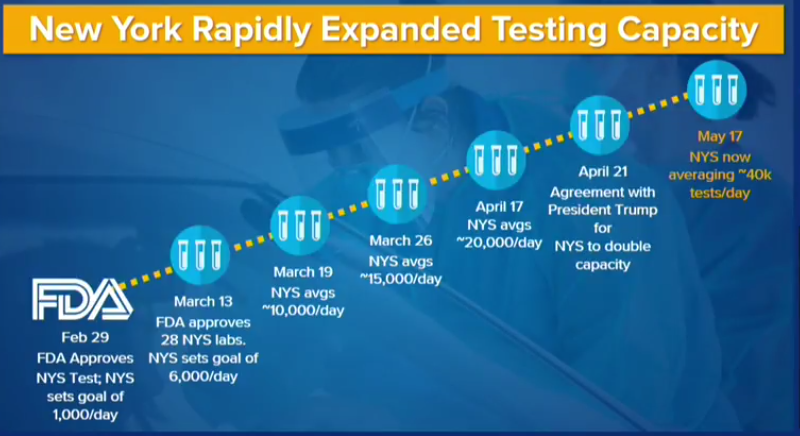
"New York has worked aggressively to build a massive statewide sample collection network and is now testing more than any state or country per capita, but our new problem is we have more sites and capacity than we're actually using," Cuomo said. "The more New Yorkers get tested, the better — and we are going to ensure to all individuals who will return to the workplace in phase one of our reopening plan have access to testing, and we are launching a new website to make it easier for New Yorkers to find nearby testing sites."
Find out what's happening in Peekskill-Cortlandtfor free with the latest updates from Patch.
The governor said New Yorkers can find the nearest COVID-19 testing sites on this new website. New Yorkers can enter their address to view a list and a map view of the nearest testing sites. The state has also partnered with Google Maps to display testing site results. New Yorkers can search "COVID testing near me" on Google Maps to easily find the nearest testing sites.
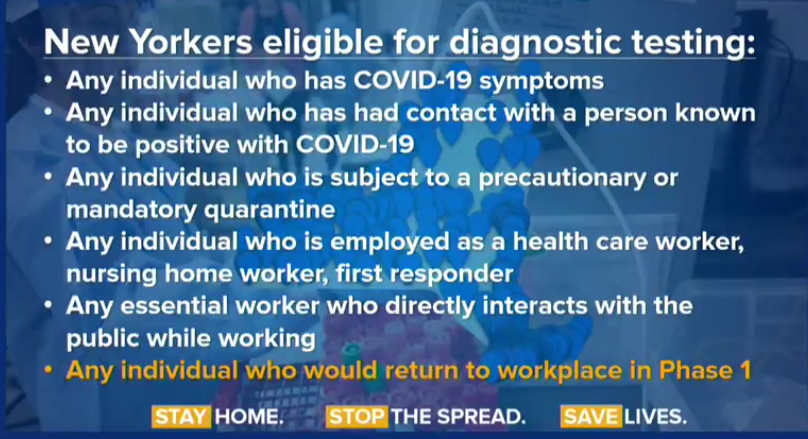
Also announced on Sunday: anyone who would be returning to work under Phase 1 of the state's reopening plan is eligible to be tested. Phase 1 includes construction; manufacturing and wholesale supply chain; retail for curbside pickup and drop-off or in-store pickup; and agriculture, forestry and fishing.
Plus, anyone now working who directly interacts with the public is eligible for testing.
Anyone who has any symptoms of COVID-19, including a cough, or a fever, or a loss of sense of smell or taste, can get tested.
Cuomo also announced New York State is partnering with CVS to bring testing to more than 60 CVS pharmacies across the state. Each site will be able to conduct 50 or more tests per day. CVS already tests in Connecticut.
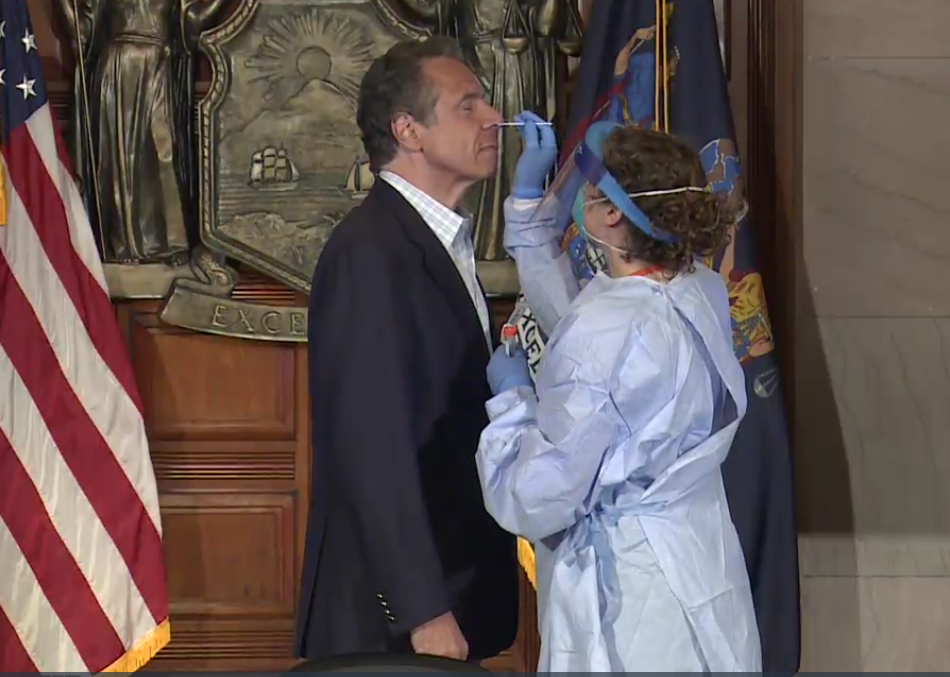
To show how easy it is, the governor had himself tested halfway through the briefing. His parting remark was "If I'm not here tomorrow, it means I tested positive."
Re-opening is proceeding slowly. On Saturday, Cuomo announced that elective surgeries could resume in Suffolk and Westchester counties, but restrictions remain in place for Orange and Rockland counties in the Hudson Valley and Nassau County on Long Island.
Half the state reopened on Friday in Phase 1 of the state's plan, but not the Hudson Valley, Long Island, New York City, the Capital Region or Western New York. They have still not met all the region-by-region criteria put in place.
The Hudson Valley hasn't met three benchmarks:
- Metric #2—Decline in Deaths. Region must show a sustained decline in the three-day rolling average of daily hospital deaths over the course of a 14-day period. Alternatively, regions can satisfy this metric if the three-day rolling average of daily new hospital deaths does not exceed 5. The first number in this cell represents the number of consecutive days of decline in the three-day rolling average of daily hospital deaths; if this number is 14 or greater the region automatically satisfies this metric. The second number represents maximum daily increase in the three-day rolling average of new hospital deaths; if this number is 5 or less the region automatically satisfies this metric. The Hudson Valley's score is 2/11.
- Metric #3—New Hospitalizations. Region must experience fewer than 2 new hospitalizations per 100,000 residents, measured on a three-day rolling average. New hospitalizations include both new admissions and prior admissions subsequently confirmed as positive COVID cases. The Hudson Valley's score is 2.41.
- Metric #7—Contact Tracing Capacity. Number of contact tracers in each region must meet thresholds set by the Department of Health, in collaboration with the Johns Hopkins University School of Public Health and Vital Strategies. The Hudson Valley is expected to meet this metric.
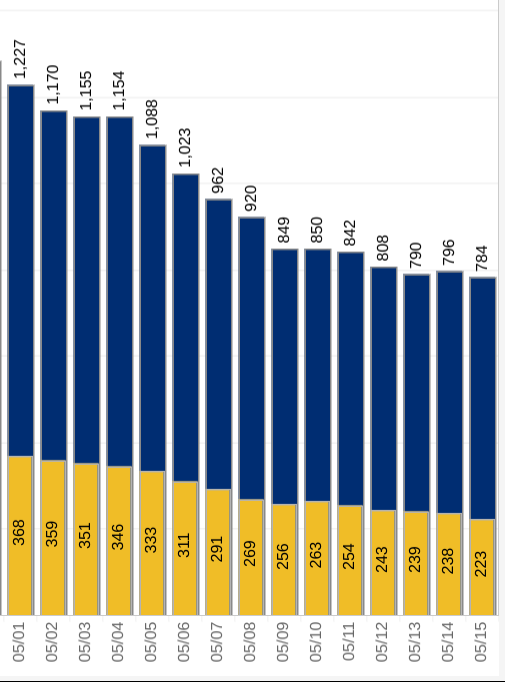
People sick with COVID-19 continue to come into hospitals throughout the Hudson Valley. The daily number of total hospitalizations shows a bumpy decline. Here's how far the region came May 1-15. (The peak was 1,888 total hospitalizations on April 11.)
Long Island has met five of the state's seven benchmarks. Still to go:
- Metric #2—Decline in Deaths. Region must show a sustained decline in the three-day rolling average of daily hospital deaths over the course of a 14-day period. Alternatively, regions can satisfy this metric if the three-day rolling average of daily new hospital deaths does not exceed 5. The first number in this cell represents the number of consecutive days of decline in the three-day rolling average of daily hospital deaths; if this number is 14 or greater the region automatically satisfies this metric. The second number represents maximum daily increase in the three-day rolling average of new hospital deaths; if this number is 5 or less the region automatically satisfies this metric. Long Island's score is 4/15.
- Metric #7—Contact Tracing Capacity. Number of contact tracers in each region must meet thresholds set by the Department of Health, in collaboration with the Johns Hopkins University School of Public Health and Vital Strategies. Long Island is expected to meet this metric.
With a rate of 1.97 per 100,000 residents, Long Island has hit Metric # 3.
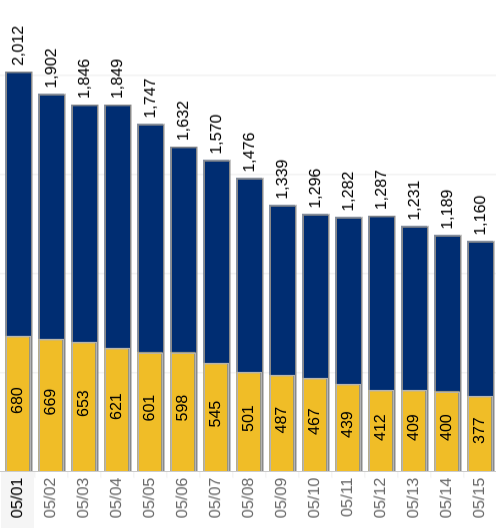
Here's what the decline in total hospitalizations May 1-15 looked for Long Island (the peak, on April 11, was 4,108 total hospitalizations.)
The Capital Region and Western New York will be opening almost immediately. Cuomo said the need for enough tracers to be hired and trained was "a purely administrative function."
At the briefing, Cuomo confirmed 1,889 additional cases of novel coronavirus across New York, bringing the statewide total to 350,121 confirmed cases. As of Sunday, the number of new people testing positive for the new coronavirus on Long Island and in the Hudson region:
- Dutchess-16
- Nassau-103
- Orange-64
- Putnam-9
- Rockland-70
- Suffolk-175
- Sullivan-14
- Ulster-15
- Westchester-127
Get more local news delivered straight to your inbox. Sign up for free Patch newsletters and alerts.