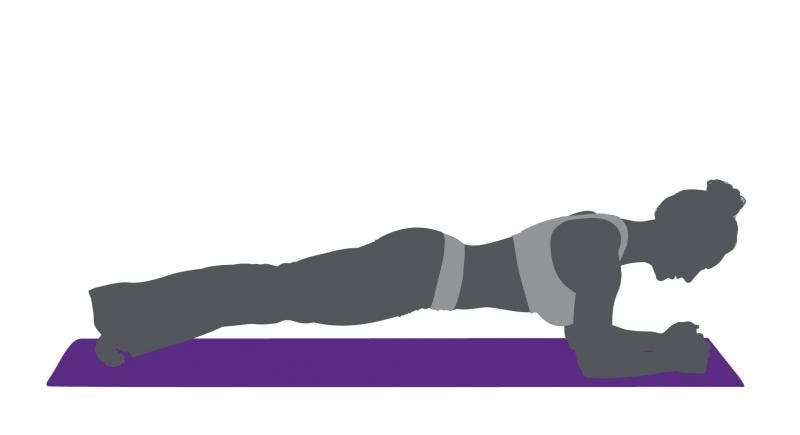
Planks not only work your six-pack, they can also save your life.
That’s because as you tone your midsection while doing the exercise, you’re also improving your flexibility and reducing your stress level.
When holding the plank position, the muscles that are being expanded and stretched – your shoulders, shoulder blades, collarbone, as well as hamstrings and the arches of your feet – all carry a lot of tension.
Find out what's happening in Port Washingtonfor free with the latest updates from Patch.
“Stress is a significant risk factor in cardiovascular disease,” said Evelina Grayver, MD, director of the coronary care unit at North Shore University Hospital in Manhasset. “Heart disease is a major cause of disability and the No. 1 killer in the United States. So decreasing that accumulated stress during the day is a huge health benefit. ”
Dr. Grayver also explained that stretching can also improve mood because as you stretch and expand the muscles you release endorphins – the body’s natural opiates – that calm the brain. Other plank perks: jacking up the metabolic rate to torch calories and targeting the most deadly area for fat – the abdomen.
Find out what's happening in Port Washingtonfor free with the latest updates from Patch.
According to research, subcutaneous fat (fat beneath the skin and on top of abdominal muscles) and visceral fat (fat below those muscles that surrounds organs) increases your risk of developing heart disease, diabetes, high blood pressure, stroke, sleep apnea, certain forms of cancer, and other degenerative diseases.
“The plank is a great way of challenging your entire body and increasing your metabolism,” explains Dr. Grayver. “When you do plank daily, you’re burning a lot more calories than when you’re doing traditional ab exercises, such as crunches and sit-ups.”
Those go-to-ab exercises concentrate on the rectus abdominis (your six-pack muscle), adds Dr. Grayver, but they forgo other core muscles, like the transverse abdominis (a girdle-like muscle that supports your internal organs) and the glutes. Plank hits these overlooked muscles.
And best of all, you can perform plank anytime, anywhere and tailor it to your fitness level.
The plank is a great way of challenging your entire body and increasing your metabolism. - Dr. Evelina Grayver, Cardiologist
How to plank:
- Lie on your stomach with your elbows close to your sides and directly under your shoulders, palms down and fingers facing forward. Tighten your abs/core muscles as if you are bracing to get hit in the stomach.
- Straighten your legs and flex your ankles (tucking your toes toward your shins).
- Slowly raise your torso and thighs up off the floor or mat. Maintain a straight line from head to toe.
- Keeping your abs engaged, try holding this position for 30 seconds to start
Take the 30-day Plank Challenge! See if you can gradually build from 30 seconds to 2 minutes. Use our infographic to guide your progress.
Download printer-friendly version.