Community Corner
Inmates Put Down Guns, Turn Backs on Drugs, Gangs with Life-Altering Program
Patch went into the Suffolk County Correctional Facility to interview inmates and learn about Council for Unity, changing lives.


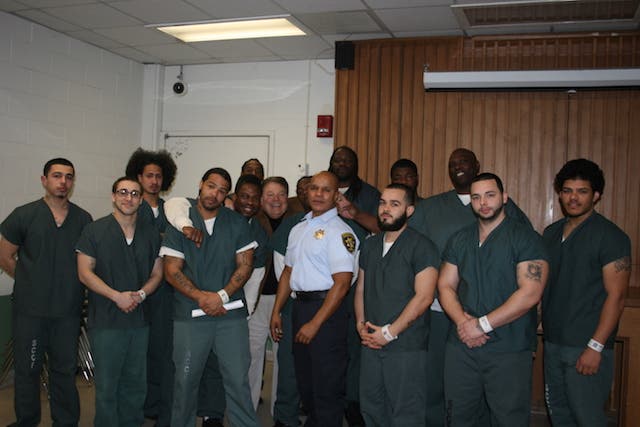
RIVERHEAD, NY - The inmates at the Suffolk County Correctional Facility in Riverside enter the room in green prison garb, quietly at first, heading to their seats, placed in a circle.
But after a few moments, the silence is broken by smiles, by warm greetings, by high fives and laughter, as the men who came to the prison as strangers greet friends now close as family.
They sit and begin to share, opening their hearts and sharing tissues as they bare secrets held close under armor hardened over time. The men, seen by society as hardened criminals, many with histories of deep gang ties and drug-related arrests, lay down perceptions at the door.
Find out what's happening in Riverheadfor free with the latest updates from Patch.
Within the walls of the jail, the men, who may seem at the outset to be tough convicts, their bodies scarred and tattooed, have had their minds, hearts and eyes opened to a new way of life, a new path, a life free of heroin and drug dealing, of gang banging and criminal behavior through a life-altering program, Council for Unity.
Council for Unity, founded by Robert DeSena more than 40 years ago, is a not-for-profit organization that specializes in reducing violence in schools and communities by replacing a culture of despair with a culture of hope.
Find out what's happening in Riverheadfor free with the latest updates from Patch.
"The Council for Unity's unique culture restores incarcerated men to their lost humanity and through their innovative curriculum enables their participants in Sing-Sing, the Suffolk County Jail and Rikers Island to slay the 'dragons' that landed them in prison in the first place," DeSena said.
According to DeSena, the Council's culture addresses the causes of criminality and drug use, not just the symptoms.
"When inmates immerse themselves in our curriculum, they finally address the 'dragons' that led them to a criminal lifestyle or addiction, and through the eight-step process of becoming a ''dragon slayer,' finally confront the dark instincts that led them to jail."
The program, since it was introduced into the jail by Sheriff Vincent DeMarco, has seen profound results.
"The journey into the Council's core mythology has profound therapeutic impact because our group model engages the entire circle to collectively attack the reasons for their slide into gang life or a criminal lifestyle," DeSena said.
How it works
At a Council for Unity meeting last Friday at the Suffolk County Correctional Facility, the men, who asked not to be identified, shared stories of deep pain that belied their street-toughened exteriors.
The men prepared presentations they were readying for a videotape that will be shown at Riker's Island; each inmate chose one of the steps to discuss.
The premise is simple but profound: The program teaches steps to slay internal dragons, including drugs, abuse, gangs, crime, and poverty and gives them the tools to turn a corner toward new lives.
The 8 steps include:
Step 1: Do not accept the negative perceptions of others: Create your own image of yourself
Step 2: Overcome the boundaries that limit your possibilities
Step 3: Be open to those who can guide you regardless of what they look like
Step 4: Discover your inner powers
Step 5: Face your dragon
Step 6: Serve others
Step 7: Learn to forgive
Step 8: Leave a legacy for others
Coaching them proudly, DeSena said, "You're going to leave a legacy."
For example, one young man program confessed that his ''dragon'' was addiction.
"The group got him to see that his addiction was not his 'dragon.' It was the reason he needed to get high. From that the inmate revealed that the cause of his addiction was a broken home life with abandonment from his father and being left with a mother who did drugs. The hopelessness and helplessness was too much to bear, and he turned to gangs and drugs. He numbed himself to the downward spiral that had him by the throat. He stopped caring, and he stopped feeling," DeSena said.
"The Council pulled him out of that maze, and through the support of the CFU family, he began to climb out of the pit. The culminating act of that session was when I made him stand up and invited all the other inmates to hug him. That was the springboard to his change. He discovered he had worth and that others cared."
Stories of hell, heartbreak — and hope
One by one, the stories shared at the group meeting shattered popular myths, that all prisoners are hardened criminals, violent, dangerous, cold and calculating.
They opened up about the despair over missed children's birthdays — one man missed his daughters's 16th, the ninth birthday he'd missed in a row — and beloved mothers growing elderly, year by year by year, while they serve time behind bars.
As they filed in and sat, the walls crumbled as the stories emerged.
One man discussed growing up with a brother who dealt drugs. "Everyone said I was stupid, not smart," he said. "My dad used to beat me."
After dropping out, he fell into the drug-dealing lifestyle to help support his younger siblings.
Now, he said, "If you believe the negative perceptions, you're never going to move forward."
Another man described growing up in racism-riddled Crown Heights, a West Indian who hated Jewish neighbors. And yet, it was a Jewish teacher who believed in him and gave him the tools for college and a career in business.
A mentor and friend
DeSena is no stranger to street life. Born and raised in Brooklyn, he was involved with several street gangs.
Counseling a young man consumed with thoughts of revenge over the death of a friend he felt was close as a brother, DeSena shared his own experience, the turning point when he had the chance to kill an enemy. And didn't.
"Let it go," he told the young man. "I want you to have a life. Serving 30 years to life won't change what happened."
DeSena turned his life around and became a high school English teacher in 1965; he founded Council for Unity at John Dewey High School in 1975.
It's with the ease of a friend and the concern and love of a mentor that he shares with the group; he asks them to pray for him over the death of a longtime Council member and colleague.
Together, they share hugs and tears, tissues and laughter, so much laughter. Inside the room, the institution is miles away and hope is born as a family bonds.
And like family, the help one another. One man describes entering prison filled with fury, wanting to kill his girlfriend.
"You gave me advice. You gave me courage and confidence in myself," he told the group. "You gave me the help I needed."
Out of the comfort zone
A story that had tears flowing came from one young inmate, 27, who described his deep and abiding love for his mother, a crack addict.
"My biggest fear was losing my mother," he said.
Terrified she'd die on the street while he was incarcerated, he said he was released from prison on April 3; on April 17 she was hit by a car and died four days later.
Even though his siblings had long given up on a mother whose life was consumed by drugs, he never had. "I loved her. She was my mom."
When she died, he was torn: He could pay for her burial with money gained from street crime, but he didn't want to tarnish her memory. "She's buried in Potters' Field somewhere," he said, tears streaming.
As the group stood up silently to surround him in a collective embrace, DeSena's voice, strong and steady, echoed, telling him there was no room for regret: "You were the good son," he said. "You never gave up on her."
Together, they share stories, face demons, slay dragons, and take steps within the program toward a new life. DeSena said those affiliated with Council for Unity can see lesser sentences and both educational and job opportunities upon release from jail.
"Programs like Council for Unity have helped us to substantially reduce gang violence in our jail, and in our communities. It is an excellent program that has helped many people go on to live law abiding lives following their period of incarceration," Sheriff Vincent DeMarco said.
And perhaps most important is the fundamental shift in thinking that gives each CFU member reason to hope, to believe in themselves as individuals worthy of love and community, of hope and family.
Within the walls of the jail, DeSena said, "Miracles are occurring, every day."
Get more local news delivered straight to your inbox. Sign up for free Patch newsletters and alerts.