Politics & Government
Nitrogen Loading, Southern Pine Beetles, Septic Systems Focus of Senator's Environmental Roundtable
Focusing on the urgency to address issues, Senator Kenneth LaValle's annual environmental roundtable brought a standing room only crowd.


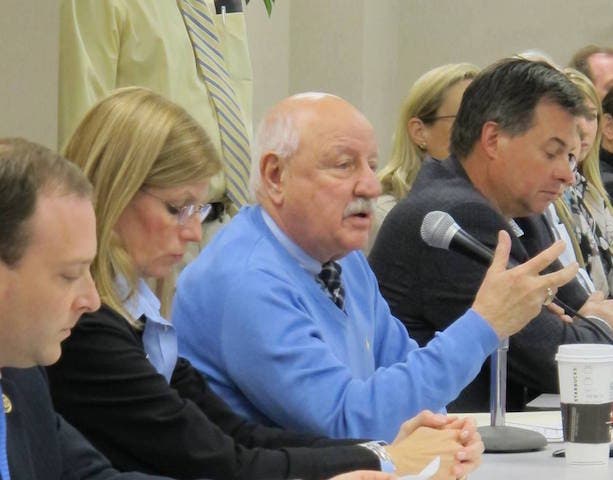
RIVERHEAD, NY-With issues including nitrogen loading in East End waters of critical concern to residents, a standing-room-only crowd packed the Suffolk County Community College Culinary Arts and Hospitality Center in Riverhead Thursday night for New York State Senator Ken LaValle’s annual environmental roundtable.
The evening, LaValle said, was “an overwhelming success.”
Discussions, he said, ranged from the Long Island Nitrogen Action Plan Draft, LaValle’s newly expanded Community Preservation Fund legislation, the increase in funding of the Environmental Protection Fund, the Southern Pine Beetle issue, and “other significant issues concerning the protection and preservation of our natural resources.”
Find out what's happening in Riverheadfor free with the latest updates from Patch.
According to Dave Bergen, Suffolk County College Associate Dean, who helped orchestrate the event, the crowd packed the room, bringing a wide range of environmental concerns to the proverbial table. Elected officials including Suffolk County Legislator Al Krupski brought years of dedication to environmental issues to the forum.
Representatives from an array of environmental groups and the East End engaged in thoughtful discourse on critical issues such as nitrogen loading.
Find out what's happening in Riverheadfor free with the latest updates from Patch.
A meeting will be held at the Suffolk County Community College Culinary Arts and Hospitality Center on East Main Street in downtown Riverhead on Tuesday from 1 to 3 p.m. to discuss the Long Island Nitrogen Action Plan Draft.
Also discussed was the need to provide funding and assistance to increase sewering districts in Suffolk County.
On the East End, where sewerage systems are not available, environmentalists echoed the battle cry regarding the need to push to bring the Suffolk County Health Department to approve new, modern septic systems.
“This is not something we can spend three years talking about. We have to get them in place,” Bergen said, recalling the urgency expressed by all at the meeting. “Let’s talk implementation.” Included in the implementation theme, he said, is a necessary discussion regarding cost.
Dick Amper, executive director of the Long Island Pine Barrens Society, discussed the Southern Pine Beetle, which could prove devastating, wiping out acres of trees if not addressed.
Rep. Lee Zeldin voiced his commitment to the preservation of Plum Island, Bergen said. And Kevin McAllister of Defend H20 spoke out against the toxicity of methoprene, sprayed on marshes for tick and mosquito control.
Bob DeLuca, president and CEO of the Group for the East End, discussed a report that spotlights what species could become endangered in the Peconic Estuary over the next 25 years, including scallops, mussels and winter flounder. The report, he said, was a “wake up call” for all.
Meanwhile, Adrienne Esposito, Executive Director for the Citizens Campaign for the Environment, spoke passionately about a move by the United States Army Corp of Engineers that will allow continued dumping of dredge spoils into the Long Island Sound despite vehement public outcry. Esposito said elected officials on the state and federal level need to come together to say “no” to the plan.
Suffolk County Legislator Al Krupski agreed that the Army Corp dredge spoil management plan had a ”disappointing” outcome; he also discussed progress to control wildlife and progress on advanced wastewater treatment systems in Suffolk County.
Other issues discussed including the need to do more to promote solar and alternative energy resources; the possibility of using open space such as parking lots for solar panels in a public-private partnership — in an alternative to cutting down trees — was explored.
Karen Rivara, president of the Long Island Farm Bureau, spoke eloquently about the need to amend state rules in relation to aquaculture and to recognize the market for kelp, which is environmentally friendly. Pesticides, and the need to reduce pesticide use while also recognizing the need for some pesticide use, as long as it’s minimal, were also a topic of discussion.
Another issue addressed was the need for deer fencing, to prevent millions of dollars of crop loss. Others cried out about the tick-borne disease crisis on the East End and the need for federal and state assistance to address escalating concerns.
Others called for officials to nix penta-treated telephone poles and asked that all utility poles be buried underground.
The event was a success, all agreed.
“It was referred to as the most well-attended environmental forum for eastern Long Island over the last several years,” with key elected officials and environmentalists all present, Bergen said. ”The dialogue that took place was exceptional and now, hopefully, it’s up to the elected officials to take that back to the community, consider all comments and plan accordingly.”
“I appreciate the input from the many organizations, environmental groups, and the governmental officials of all parties who attended the roundtable. It truly assists my focus as I develop my legislative agenda for the year as I continue to work to preserve the character and quality of life within the First Senatorial District,” LaValle said.
A video of the event will soon be made available for viewing by LaValle’s office.
Patch photo courtesy of Ken LaValle.
Get more local news delivered straight to your inbox. Sign up for free Patch newsletters and alerts.