Community Corner
Officials Provide Update on Fish Kills
Local officials met on Saturday to discuss possible initiatives to solve the problem.


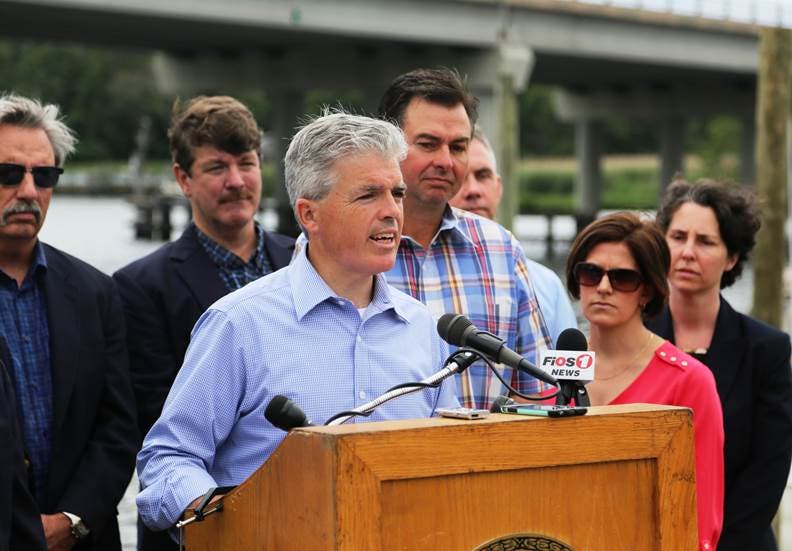
Officials held a conference on Saturday to provide an update on the recent fish kills on the East End.
Suffolk County Executive Steve Bellone was joined by environmental, state, county and town officials in Riverhead to discuss the issue.
During the event, officials asked the federal government for additional assistance to help the region with its nitrogen pollution crisis after the second major fish kill in the Peconic Estuary, a federally designated estuary of national significance.
Find out what's happening in Riverheadfor free with the latest updates from Patch.
Recently, hundreds of thousands of dead fish have recently washed up on the shores around Flanders Bay in the Peconic Estuary, which is one of 28 federally designated estuaries of national significance by the United States Environmental Protection Agency (EPA).
One factor believed to have caused this is an excess levels of nitrogen spewing from residential septic systems and cesspools as well as fertilizer.
Find out what's happening in Riverheadfor free with the latest updates from Patch.
“We as a region, and as a nation, need to protect our federal estuaries, and we need wastewater infrastructure to do that,” Bellone said. “Unfortunately, nothing can be done in the short term to stop this fish kill or an algal bloom from happening.”
However Bellone says the trend can be reversed by investing in and upgrading the wastewater treatment infrastructure.
“To do that, we need additional assistance from our leaders at every level of government to help us combat this problem,” he said.
Bellone also said a report citing the specific causes of the fish kills from the New York State Department of Environmental Conservation (DEC) and Suffolk County Department of Health is expected to be released within weeks.
In the meantime, residents and visitors are advised to adhere to all posted signs at facilities.
Since the first fish kill, the Suffolk County Department of Health has conducted extensive testing and repeated water sampling at various waterways, including the South Jamesport Town Beach, Peconic River, Meetinghouse Creek and Reeves Bay.
“No question the biggest problem is nitrogen in our waters. We have to get more resources from the federal government-this is very important,” Jim Gilmore, head of the New York State Marine Bureau said. “We have had several occurrences of fish kills but never of this magnitude. And nitrogen exacerbates the problem. We want the fish in the water, not dying on the beaches. Algal blooms fueled by nitrogen are making it worse.”
Riverhead Town Supervisor Sean Walter advises local residents who have property on the riverfront not to fertilize it.
“Your moral obligation is to stop using fertilizers,” he said “We are doing so much to impair the estuary, and we are not giving fish a fighting chance to survive.”
The officials also discussed several initiatives and programs the county is participating in to stop the harmful effects that nitrogen pollution has caused towards the region’s waterways for decades.
The possible initiatives include:
- With the help of Governor Andrew Cuomo and Senator Charles Schumer, Suffolk County has secured nearly $400 million in funding for the largest expansion of sewers in Suffolk County since the 1970s. The funds will be used for 4 sewer projects which were chosen based on the highest potential to reduce the amount of nitrogen. The levels would be reduced by 25% in designated areas.
- Suffolk County signed an intermunicipal agreement with the Town of Riverhead to begin a pilot program to test irrigation of our facilities with sanitized wastewater effluent. The County also awarded the town $8 million to upgrade its Advanced Wastewater Treatment Facility, including the construction of a new sewage treatment plant to meet increased standards of nitrogen removal.
- Suffolk County has identified pilot programs for implementation in the region in addition to the on-site septic demonstration program launched in 2014, including Shallow Narrow Drain Fields, which are used to disperse wastewater to the soil environment as a natural fertilizer, and Vegetated Gravel Recirculating Filtered Wastewater Treatment Systems, an innovative, alternative, non-proprietary wastewater treatment system that reduces nitrogen from wastewater effluent by planting nitrogen-absorbing vegetation above cesspools.
- Suffolk County protects its waters by actively acquiring open space around vulnerable bodies of water. The Suffolk County Legislature recently passed a resolution that allows the County to extend an offer to acquire Broad Cove, a 99-acre parcel of land located at the mouth of the Peconic Bay in Riverhead. This cove is considered by the Nature Conservancy to be one of the top 10 Long Island properties in need of protection.
- Suffolk County will host an Algal Bloom Symposium next month where leading national experts will convene to discuss and identify ways to monitor and manage harmful algal blooms.
- Suffolk County recently released a comprehensive water resources management plan. The 1,000+ page action plan lays out a number of additional programs and initiatives the County will be undertaking in order to stem the tide of nitrogen.
Get more local news delivered straight to your inbox. Sign up for free Patch newsletters and alerts.