Health & Fitness
CDC Issues a Lyme Disease Update
According to the latest CDC update, in the majority of cases a deer tick must be attached for 36 to 48 hours or more before Lyme Disease bacterium can be transmitted.



The Centers for Disease Control and Prevention (CDC) has issued an information update, dated Jan. 11, 2013, concerning Lyme Disease. [Lyme Disease bacterium is also known as Borrelia Burgdorferi and is spread through bites by the deer tick (Ixodes scapularis).]
It has been known that a deer tick needs 10 minutes to two hours to latch onto the host’s skin, cut through it, and insert its feeding tube. However considerably more time is required for the disease-causing bacteria to travel from the tick to the host.
According to the new CDC update, in the majority of cases a deer tick must be attached for 36 to 48 hours or more before Lyme Disease bacterium can be transmitted. Other and earlier reports had indicated that this time is about 24 hours.
The deer tick (also called the "blacklegged" tick) has been responsible for the spread of Lyme Disease in the states of New York, New Jersey and Connecticut and other parts of the Northern Hemisphere. Lyme Disease was named after Lyme, Connecticut where it was first encountered in 1975.
The deer tick has eight legs, a lifecycle of about two years and can feed on mammals, birds, reptiles, and amphibians. It does not fly or jump. It sucks blood from an infected host and transmits the infection to its next host.
The types of deer ticks that carry Lyme Disease are:
- Nymphs (a major threat) which are small and difficult to spot and feed during the spring and summer
- Adult ticks which are active during cooler months and are much easier to notice because of their larger size
The CDC update reported that Lyme Disease cannot be transmitted by eating venison but hunters need to be aware because hunting and dressing deer can result in contact with infected ticks. It pointed out that “there is no credible evidence that Lyme Disease can be transmitted through air, food, water, or from the bites of mosquitoes, flies, fleas or lice.”
It also stated, “Although dogs and cats can get Lyme Disease, there is no evidence that they spread the disease directly to their owners. However, pets can bring infected ticks into your home or yard. Consider protecting your pet, and possibly yourself, through the use of tick control products for animals.”
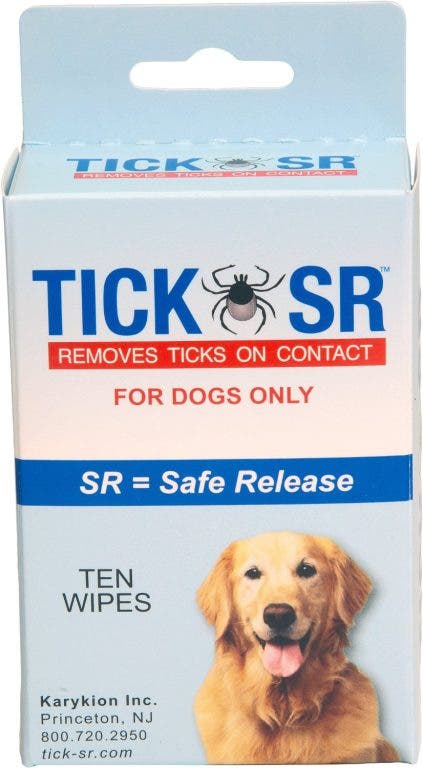
In addition to tick control products, tick removal products intended for fast, easy and safe removal of ticks from dogs have recently entered the marketplace. Called Tick-SR, they are available from its producer or on the Internet at amazon.com.
Find out what's happening in Rivertownsfor free with the latest updates from Patch.
The CDC is a federal agency reporting to the U.S. Department of Health and Human Services.
Centers for Disease Control and Prevention, Bacterial Diseases Branch, Foothills Campus, Fort Collins, CO 80521, 1-800232-4646.
Centers for Disease Control and Prevention, 1600 Clifton Rd. Atlanta, GA 30333, USA, 1-800-CDC-INFO (1-800-232-4636). www.cdc.gov/lyme
Tick-SR, Karykion Corporation, 101 Wall St., Princeton, NJ, 1-800-720-2950, sales@tick-sr.com, 1-800-720-2950, www.tick-sr.com