Politics & Government
The Long Road To Storm Resiliency: Working On Sandy Recovery
In the coming years, millions of federal dollars will be flowing into Nassau. But where is it all going to go?


In the wake of Hurricane Sandy in 2012, which caused billions of dollars in damage to the East Coast, the federal government made a decision: it wasn't going to be good enough for communities to simply rebuild things as they were. They had to rebuild smartly to better face the next storm. From that, Rebuild by Design was born: a contest held by the Department of Housing and Urban Development to find the most innovative and effective design solutions to protect coastal areas from the next Hurricane Sandy.
One of the winners was the Interboro Team, a collaboration between Dutch and American designers, to make Long Island's South Shore more resilient. Their plan focused on Mill River, which starts in Hempstead Lake State Park in Rockville Centre and runs through Lynbrook, East Rockaway, Oceanside and Bay Park before emptying into Reynolds Channel. During Sandy, the river swelled and flooded homes up and down its bank. The Interboro plan, called "Living with the Bays," would make the river more resilient and less likely to flooding, and would incorporate design ideas that could be replicated near bodies of water all over Long Island.
Living with the Bays was awarded $125 million in 2014. And since then, nothing much has visibly happened. Development has been quiet, and slow. Some start dates have been delayed, but progress continues. Now, the South Shore sits on the cusp of being renovated, with millions of dollars coming to the area. The project is large in scope and involves many smaller works. Some residents will likely never see, while others will make a big impact.
Find out what's happening in Rockville Centrefor free with the latest updates from Patch.
The completion of the plan is still years off. But things are getting under way. The South Shore is finally rebuilding.
The Design For Rebuilding
Living with the Bays is a massive project broken up into smaller ones. All of the projects are designed to meet at least one of five goals: increasing resiliency, quality of life, environmental improvements, waterfront access and public education. Most of the projects accomplish multiple, if not all, of those goals.
Find out what's happening in Rockville Centrefor free with the latest updates from Patch.
The Living with the Bays team, using public input, came up with 35 different projects all over the Mill River basin that range from building a bathroom at a local park to completely reinvigorating the wildlife and natural protections of existing bodies of water.
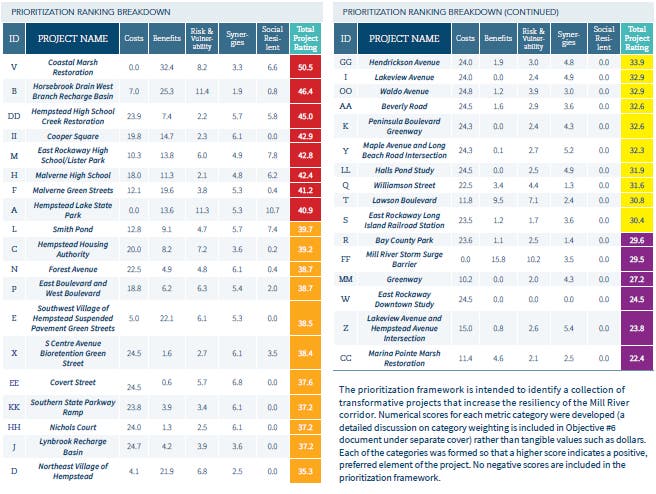
Not every project is going to be done, though. They were decided upon using input from a citizen's advisory committee. While all of the projects will help the area, some will have a much greater impact. The plan prioritizes those projects that will get the most bang for the buck, so to speak. They are:
- Coastal Marsh Restoration — Implement marsh enhancement to protect edges and create
higher elevations. - Horsebrook Drain West Branch Recharge Station — Construct ground-level and underground recharge basin at Mirschel Park in Hempstead with above-ground park improvements.
- Hempstead High School Creek Restoration — Restore creek habitat and stabilize banks to ameliorate the erosion, overgrowth and debris within the creek.
- Cooper Square — Construct an underground recharge basin under existing north parking lot in Hempstead to mitigate flooding.
- East Rockaway High School/Lister Park — Implement elevated bulkhead, backflow preventers, sports
field improvements, teacher parking drainage and elevated path as part of the Greeway. - Malverne High School — Improve wetland upstream of the school to provide stormwater attenuation, improve water quality and function as a living laboratory.
- Malverne Green Streets — Construct green streets incorporated with bioretention cells and pervious pavement to store and treat stormwater.
- Hempstead Lake State Park — Restore North Ponds habitat and install floatables catcher and sediment basin to improve water quality. Repair Hempstead Lake Dam and northwest spillway. Construct Environmental Education and Resiliency Center and portions of Greenway.
Many of the most important projects are focused on restoring the wetlands of the river and making communities nearby more easily able to deal with stormwater. Repairing the wetlands, designers say, will restore their natural ability to absorb and mitigate stormwater.
Green streets and bioswales are design elements that incorporate plants into the area. Bioswales take in water to help prevent flooding, and also use the plants to filter out sediment and other dirt.
Some of the biggest changes will come to Hempstead Lake State Park, where most of the project is focusing. Work will focus on restoring a dam in the northern part of the lake and dredging some of the northern ponds, allowing them to hold more water during storms.
The Long, Winding Road
To help improve the focus of the project, the newly formed Governor's Office of Storm Recovery (GOSR), which took over management after the office was formed in 2013, held a series of meetings with a Community Advisory Committee and a Technical Advisory Committee. The committees helped narrow the focus of the project and figure out what was reasonable and what was a pipe dream. The project was too broad in its original scope for the money it received. Parts of the project were changed, or eliminated all together, like the original idea for a sluice gate at the mouth of Mill River that would be closed during storms. According to a report, the sluice gate alone would have cost more than three times the amount awarded for the entire project.
Work has been slow, but steady. According to the Living with the Bays website, construction was originally supposed to begin in the last quarter of 2017. That timeline has since been updated, and construction is now slated to start this spring.
But according to the progress report put out by GOSR, not all of the projects will begin at the same time. Some municipalities, like the Village of Rockville Centre, have already approved some work to begin. Others will take more time.
"For some projects, the associated designs are not overly complex and can proceed into regulatory review and permitting with relative ease," the report reads. "Other projects will require extensive evaluation of existing conditions through data collection followed by preliminary design and alternatives evaluation before proceeding into subsequent design, permitting, and construction phases."
GOSR also said that some some projects, like those at Hempstead Lake State Park, cannot begin until the extensive environmental review process is completed. According to the schedule, that may not be until the end of 2019.
According to the Rebuild by Design website, construction is supposed to be done by the end of 2020, with the entire project wrapping up in 2022.
For a more in-depth look at all of the projects planned as part of Living with the Bays, you can read GOSR's report on the project.
Following The Money
So where is all of those millions of dollars going? For the most part, it's going to municipalities.
While GOSR will be in charge of the work at Hempstead Lake State Park (since it's state property), the Town of Hempstead, Nassau County and the villages in the area will be in charge of local projects.
"GOSR has active Technical Advisory Committees in municipalities where projects will be implemented," said Matt Monahan, GOSR press secretary. "GOSR will manage architectural and engineering phases before the municipalities put projects out to bid, procure contracts and manage construction."
Which means that municipalities will be able to hire the firms they are most comfortable with and over see the construction within their borders. It also means that, in the coming months and years, millions of dollars will be flowing from Nassau County to local contractors, helping to stimulate the local economy.
Monahan said the plan is for the work to impact residents as little as possible. The work on Hempstead Lake shouldn't impact residents at all, he said. "For other elements, GOSR is engaged on very productive, ongoing, communication with local municipalities," said Monahan. "Work will be coordinated to mitigate inconvenience to the greatest degree possible."
This October marks the sixth anniversary of Hurricane Sandy. For some, it's a distant memory. But for many Long Islanders, particularly those on the South Shore, it is still something they face every day. Though progress on Living with the Bays is slow, it is steady. And it will hopefully protect the South Shore from the next Sandy, so residents don't have to relive that nightmare.
For more information on Living with the Bays, visit the GOSR website.
Top Photo: Mill River. Courtesy Governor's Office of Storm Recovery.
Get more local news delivered straight to your inbox. Sign up for free Patch newsletters and alerts.