Crime & Safety
This LI animal welfare agency helped on 9/11 in a big way. WATCH exclusive video.
An NYPD dog began collapsing but, after vet treatment, "started pulling his handler back to 'the pile,'" said Suffolk SPCA Chief Roy Gross.


NEW YORK, NY — A portion of the twin towers stood like a broken skeleton, looming over a hulking mound of twisted metal and burning debris, as thick ash filled the air giving the appearance it was snowing.
It was about 6 p.m. on Sept. 11, nearly a half-day after officers from the New York Police Department's elite K-9 Unit joined the frantic search for people trapped in the rubble of what once was the world's tallest pair of buildings.
It was at that point that the Suffolk County Society of Prevention of Cruelty to Animals arrived to help with veterinary care just a block and a half away on Chambers Street.
Find out what's happening in Sachemfor free with the latest updates from Patch.
Find out what's happening in Sachemfor free with the latest updates from Patch.
.jpg "WTC skeleton")
Gross, an SPCA officer, and a veterinarian loaded themselves up with supplies and climbed up onto the pile of debris to let dog handlers know they were there and that medical services were available to provide relief to the exhausted animals.
NYPD officials had called in Suffolk because the agency had one of three state-of-the-art Mobile Army Surgical Hospitals in the United States at the time, and its services were sorely needed given the search conditions. The search area was large — about a 17-acre complex — and the potential scope of casualties was like nothing the world had ever seen.
The number of people working the grid was massive, and more reinforcements were expected within days, if not hours.
The 40-foot hospital unit, which was purchased with mass incidents in mind such as the Sunrise wildfires of 1995, had only been in operation a little over a year as a self-contained hospital with stabilizing pods, a decontamination unit and a surgical table.
Suffolk SPCA was the only humane law enforcement agency authorized to assist first responders in the hot zone. But until officers began working with the Office of Emergency Management, there was no protocol in place and they took patients as they came in.
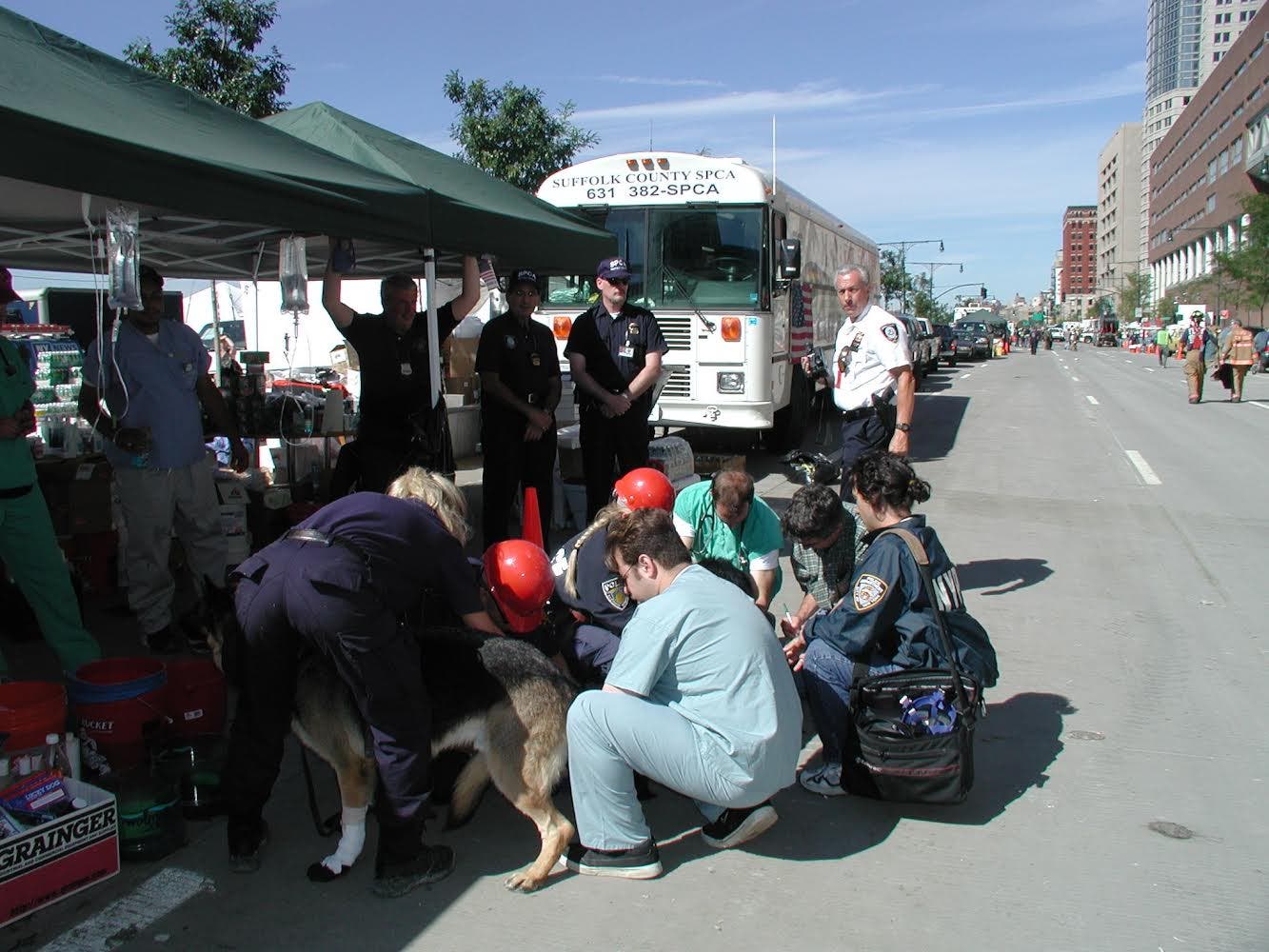
“When we first had the MASH unit set up, it wasn't enough; we had to put tents up,” Gross said. “We had to have different stations because so many dogs were coming in.”
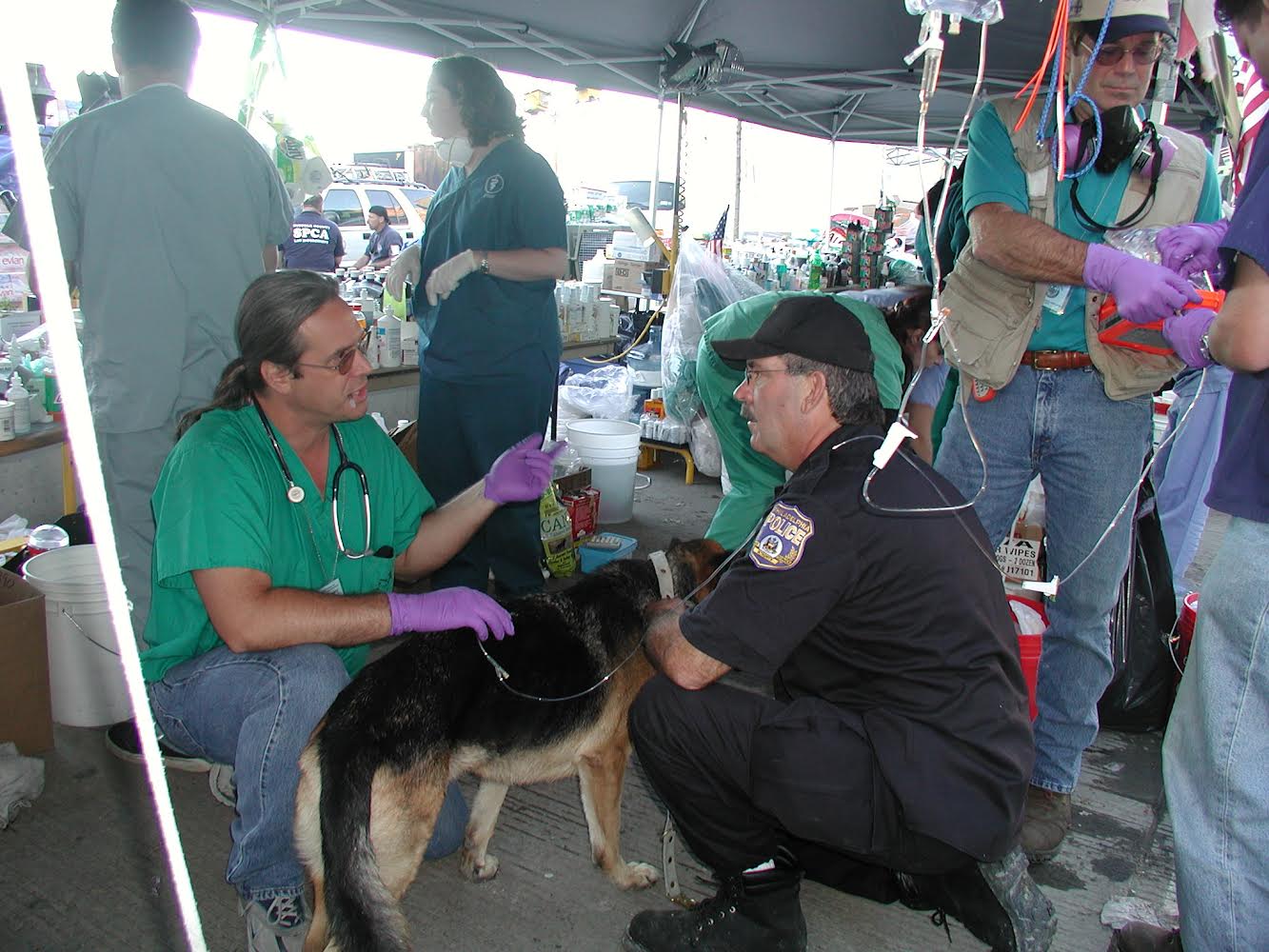
The unit was using saline to irrigate the dogs’ eyes, and volunteers were bathing their paws in plastic basins of water to decontaminate them. Tents were set up with hanging bags of intravenous fluids that were used to rehydrate the dogs, and there was a section with donated booties for the dogs that would wear them, although some didn’t.
“It was incredible how these veterinarians and our peace officers from the SPCA were able to figure out how to put everything together to make it work,” Gross said.
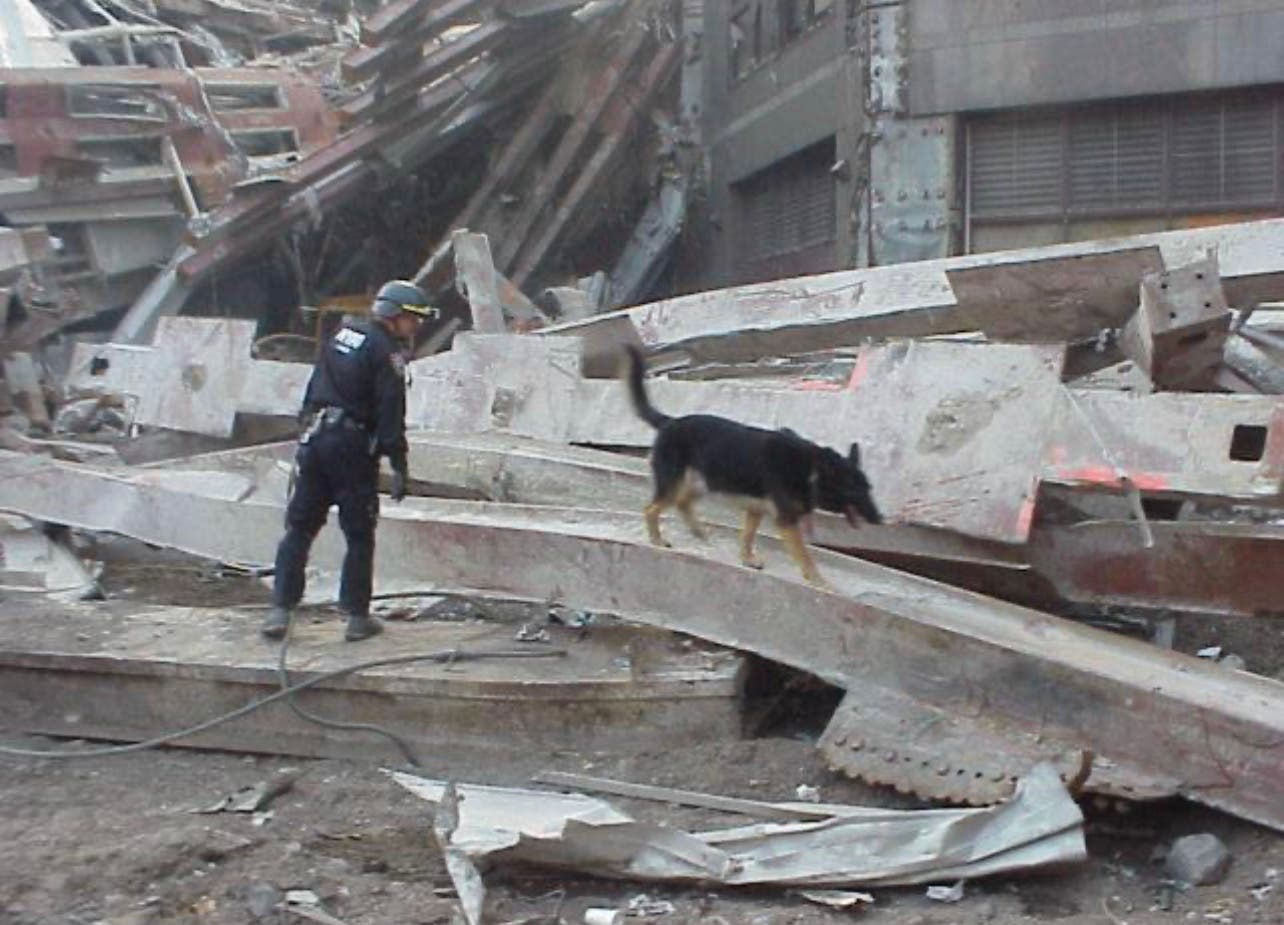
The dogs had been searching what later came to be known as "the pile." They stepped through hot metal and shards of glass without protective gear for their paws, and their coats were covered in soot as they suffered through the stifling heat but continued the work they were trained to perform.
One dog named Loki was buried inside of a police cruiser under debris and, once rescued, went straight to work on "the pile" looking for survivors. Another dog's drive to rescue humans was so strong that he continued to work through his exhaustion until his legs began to buckle underneath him and he nearly collapsed.
“The dog was collapsing; his legs were giving out on him,” said Gross.
The dog was cleaned up, rehydrated and was given “whatever he needed,” including food — but “he started pulling his handler back to ‘the pile.’”
It was a testament to the dog’s loyalty as a working animal charged with helping humans.
Another dog fell snout-first through a gap into a mound of ash, and his handler rushed him to the unit in respiratory distress, but he was able to be revived, recalled Dr. John Charos, a vet from Valley Stream who volunteers for the SPCA.
“We were able to bring him back,” he said. “That was probably the worst that I saw.”
Most dogs were treated with subcutaneous fluids for dehydration, lacerations and burns, but also received a good washing.
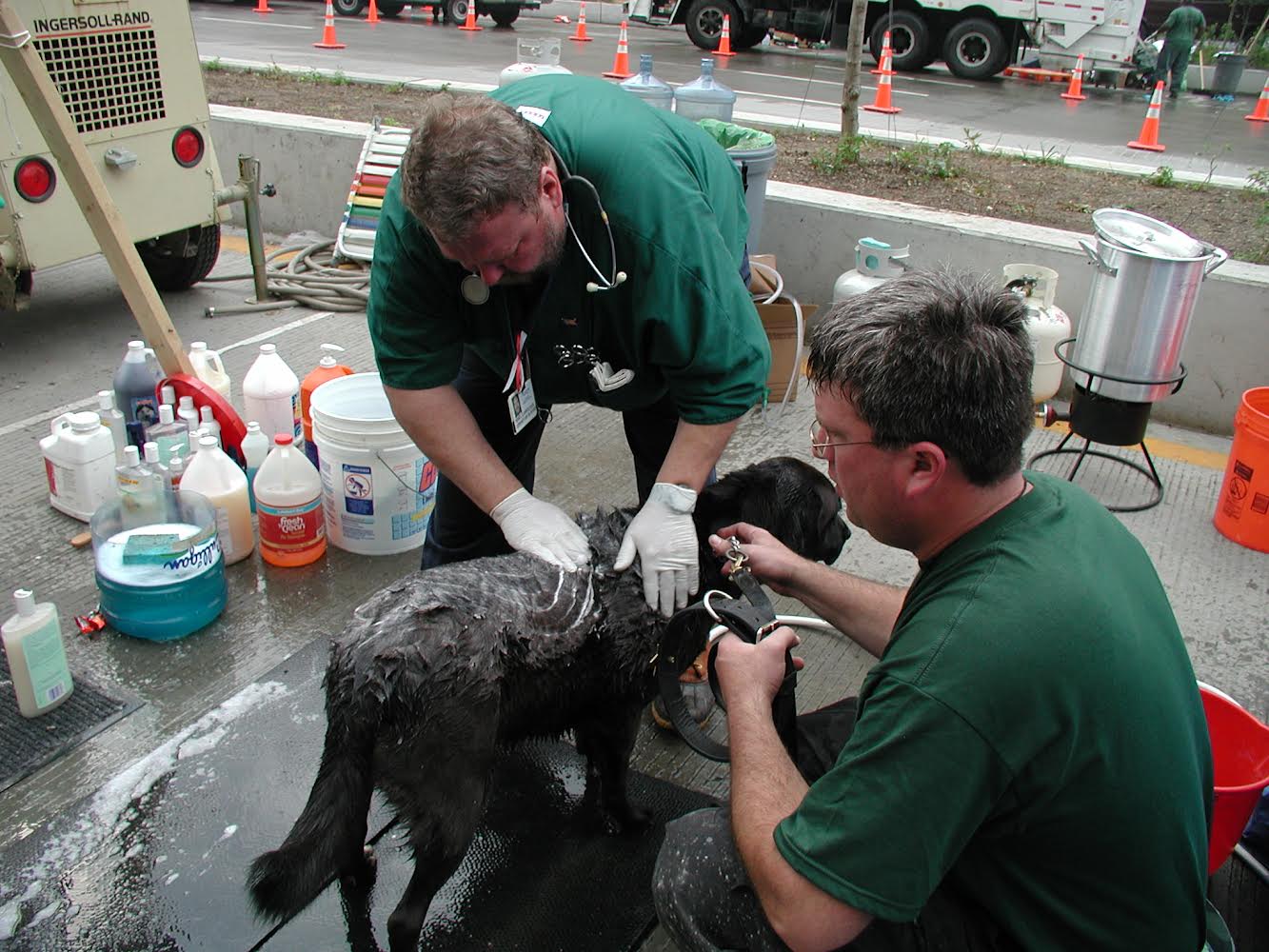
“The biggest thing was the exhaustion factor for them and dehydration because they were so wound up and they weren't achieving what they had been trained for,” Charos said.
The medical operation had been expanded to tents outside to allow for all of the patients coming in and to allow privacy for more serious cases that required stations inside the van.
But with that came another obstacle. The night was very cold, so the unit brought in deep fat fryers to heat water that could be mixed with cold water and then used to wash off the dogs.
Like everyone else, the dogs also suffered on the inside as they sensed the tragedy around them.
“They feed off the emotions of people,” said retired New York Police Department Lt. Dan Donadio, a Staten Island resident who responded to 9/11 as part of the Emergency Services Unit’s K-9 unit.
“I think the dogs sense the carnage around them, and they feed off human emotion, and especially the emotion of their handler.”
As news of the MASH unit spread, working dogs were not the only animals being treated.
The SPCA became a catchall for a menagerie of furry and feathered patients with a litany of medical conditions. There was a house cat named “Precious” who famously survived on a rooftop by drinking rainwater for days, along with some newborn kittens, a squirrel and an injured pigeon that was found by a police officer.
In addition to providing medical care, the SPCA also helped nearby residents who were evacuated from their homes, escorting them back inside to retrieve their animals safely, and then re-evaluated their health after the disaster.
Search and rescue was not the only function of man’s best friend at ground zero.
There were also therapy dogs from all over the world brought in by volunteers to provide some much-needed tender loving care to 'the pile’s' workers, many of whom witnessed the horror of finding people’s bodies and body parts throughout the rubble.
“When they would walk across 'the pile' to go for a break or whatever they needed to do, you could see that same dead stare,” Gross said. “And, you know, I hate to use the word, but they looked like zombies coming off of that pile. Yeah, nobody had a smile on their face. They're covered in debris, and you can see the look of depression.”
One of the most vivid memories Gross has is of standing with his dog, Cody, when a fireman came off the pile and stopped to get down on his knees to pet Cody, “and he just broke down crying.”
Other firemen who stopped for some pet therapy would open up and start talking, and it would make a world of difference in their demeanor.
"It was unbelievable,” Gross said.
Another instance Gross remembers is a father and son who lost their son and brother. One man told him, “This is my father. I just lost my brother; he lost his son. Could he just sit here?”
It was a sad scene with retired firefighters showing up to "the pile" to look for their lost son.
And that atmosphere was only heightened when the occasional alarm would go off warning everyone to clear the street before a nearby building could go down.
While therapy dogs were around at the time, their use was not as prevalent, and Gross and other animal advocates are now calling the 9/11 dogs the first of their kind. The practice of using therapy dogs has grown over the past 20 years, and they are now used not only by those suffering from post-traumatic stress disorder, but also patients suffering from social anxiety as well as special needs children.
It was very depressing for all of the first responders, Donadio said, adding that the NYPD’s dogs are “tough patrol dogs with a lot of cross-training that takes down bad guys.”
“I like to say they were the first-ever therapy dogs because they sense the damage that's around them,” he said, adding that the animals sense the carnage, “all the humans around” and what “they're going through.”
“Quite often, firemen and police would come over to these dogs and actually pet them and comfort them and made them feel better,” he said. “And you can see, by the way the dogs were reacting, that they sense the depth of the carnage and the pain that was around them — dogs are very in tune that way.”
“They are born to work,” he said, adding, “They do everything to hear, ‘Good boy.’”
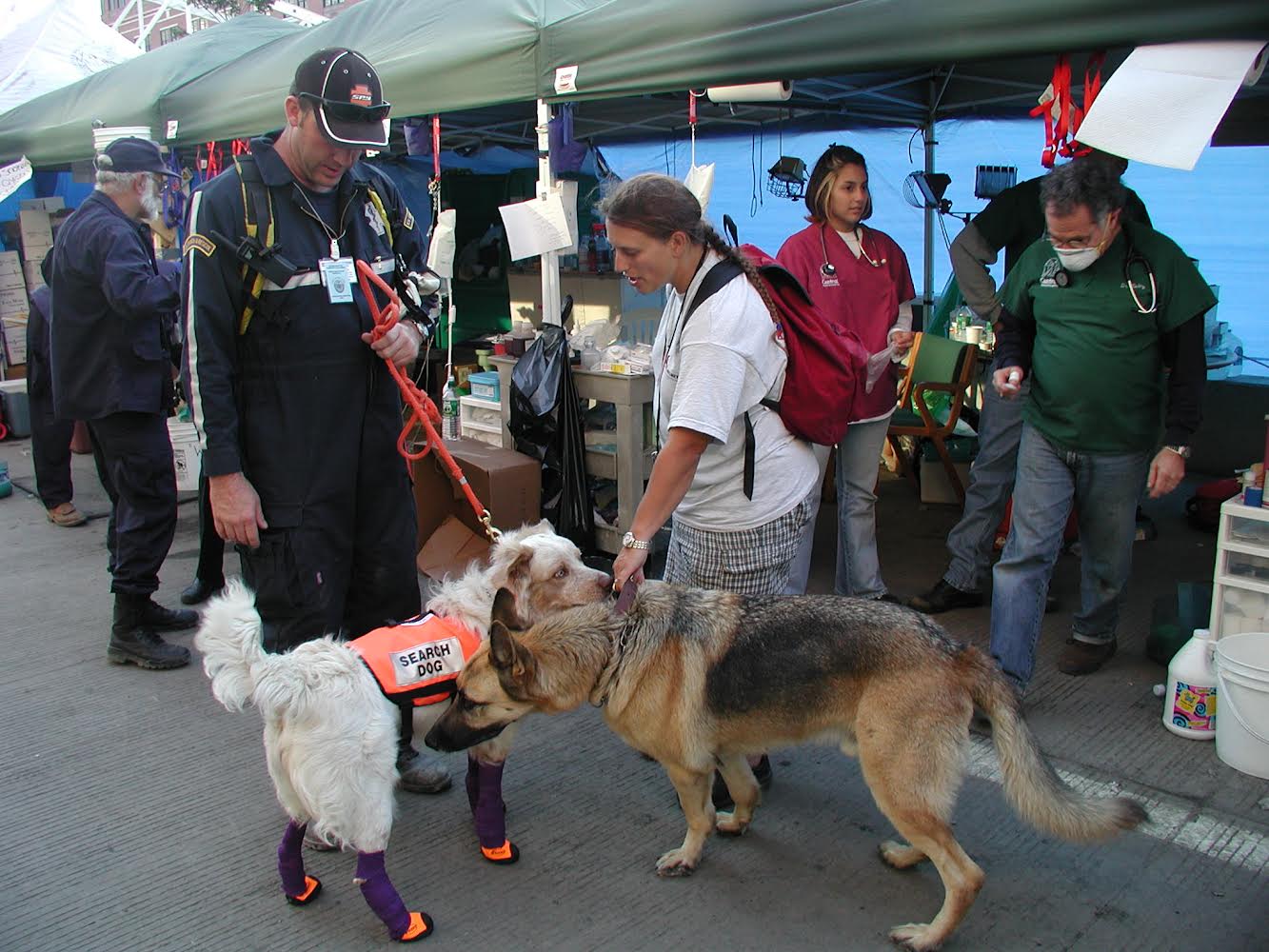
And some of the working dogs needed some therapy also, according to Charos, who noted they would stop eating and drinking, and needed to be given fluids.
“There were some smart guys who knew that dogs were anxious because they weren't being successful finding survivors, and what they would do is to send one of their crew, bury them under some debris and ash at — you know at the end — and let the dog find them,” he said, adding that it would get the dog “excited” again.
And in what might have seemed like the most unlikely place to play at the time, the handlers would just play some fetch with the dogs.
“We started spreading that information to other handlers, and it worked — it was quite effective,” he said, adding, “I can't take the credit for coming up with that, but we definitely had the word out within 24 hours to a couple hundred search and rescue handlers.”
The SPCA ended up staying at ground zero for about two months and provided about 700 to 1,000 medical treatments, which included servicing about 350 dogs.
Gross called the dogs “absolutely incredible” from what he witnessed in the aftermath of 9/11.
And he questions how people can still collect and abuse animals, and that is why he continues his advocacy.
Over the years, people have asked him if he ever gets used to seeing the abuse over and over again, but he still hasn’t.
“It's always on your mind, and it makes you sick to your stomach when you see what people do to these animals,” he said. “And then you look at the other side with how these animals do feel.”
The only payment they seek is “your love,” he said.
“They get paid back in love and affection,” he said. “Animals — that's all they want.”
Get more local news delivered straight to your inbox. Sign up for free Patch newsletters and alerts.