Arts & Entertainment
Verdi’s ‘Il Trovatore:’A War-Horse That Always Wins
This was a Metropolitan Opera in HD film not to be missed.

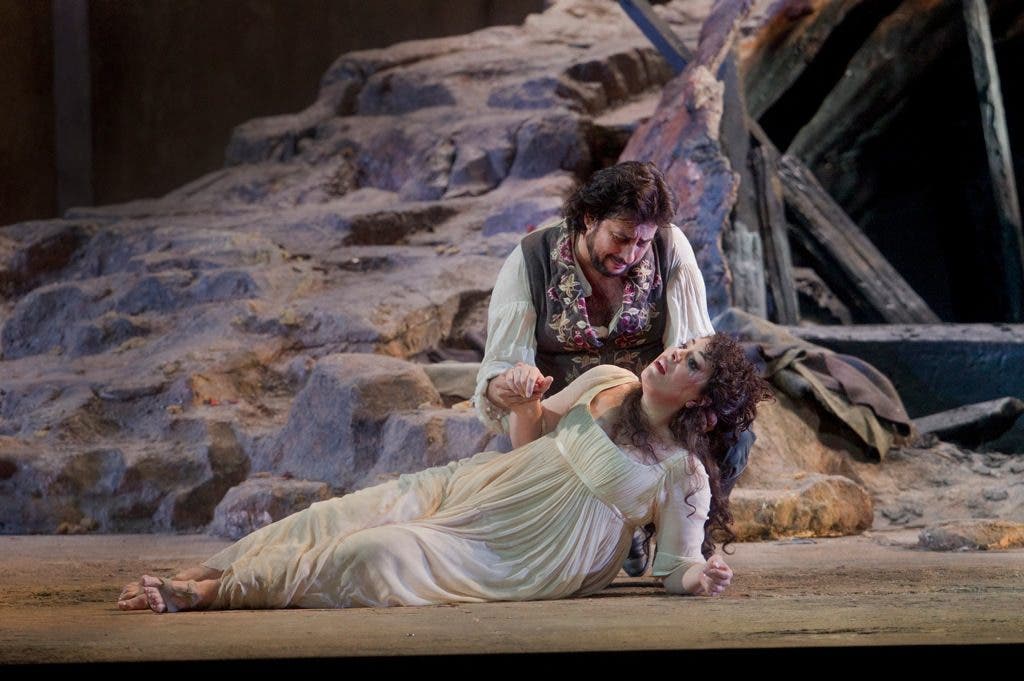


Il Trovatore was a hit when it premiered in 1853, and it has held its position in the repertory of every major—and most minor—opera houses ever since. It withstood being branded “vulgar,” denounced as “over-the-top bathos,” and is accused of having one of the most convoluted story lines in the line-up. But it triumphs because it contains some of Verdi’s most arresting melodies that stick to the ear even on first hearing.
This time around the Metropolitan Opera made sure by giving us a cast that would be hard to top anywhere on the globe—and, of course, in this live HD movie version that is exactly where it went: into over 1,500 venues in 46 different countries.
The production by David McVicar is an almost exact cast-repeat of its run in 2009 and is set during the Peninsular War (1808-1814) when Spain was fighting Napoleon. Alerting its audience to the horrors of war, McVicar makes use of the anti-war artistic “explosions” of the Spanish painter, Francisco Goya. Indeed, the mood is set immediately by the striking show-curtain that is a detail of Goya’s “Pilgrimage to San Isidro” with its terrified, open-mouthed faces.
Find out what's happening in Scarsdalefor free with the latest updates from Patch.
The set by Charles Edwards furthers the Goya theme with deliberately dark scenery that is displayed to great advantage by the Met’s rotating stage. And that is a tremendous blessing. When, in most opera houses, the curtain must be lowered to permit scene changes, here the transition is instantaneous and does not interrupt the mood and music.
Reflecting the cruelty of the time again are the costumes by Brigitte Reiffenstuel. Evidently they are inspired by the most famous of Goya’s war paintings, the bloody executions of “The Third of May 1808.” Even many school-children may be familiar with this firing-squad painting, as they are most certainly with the opera’s famed “Anvil Chorus"—surely one of the most trite clichés of all time. But then a cliché becomes one because it has an initial value that is accepted by the multitude.
Find out what's happening in Scarsdalefor free with the latest updates from Patch.
It turns out that Verdi wanted to achieve exactly that with Il Trovatore. The libretto is based on a turbulent play by Antonio Garcia Gutierrez. That play itself was inspired by some sort of historical event that had the burning of a gypsy/witch and a baby thrown to its death on the same pyre.
When librettist Salvador Commarano—who also gave us Lucia di Lammermooor, for instance—wanted to tone down some of the convoluted bathos, Verdi demanded the opposite. He wanted it to shock with ultimate romanticism. The music holds us with counter rhythms and uneven meters, with most arias for the people we side with, set in minor keys, and some of the Count di Luna’s, surprisingly set in major instead. The rest is box-office history.
But what makes this Met production more than just a spectacle set to music, is the remarkable way each singer, though hardly Italianate, seemed made for his or her role.
The part of the self-sacrificing Leonora was sung by Sondra Radvanovsky, a soprano from Illinois who has sung the part over 150 times. But she has not allowed it to become routine by any stretch of the imagination. She acts well, is very attractive, and is blessed with a slightly sultry, gloriously rich tone.
The Argentine tenor Marcelo Álvarez—as Manrico, the “troubadour” of the title—delivered his part with all the ardor and tenor ping Verdi himself would have wished for.
Dmitri Hvorostovsky with his signature, immediately recognizable white hair, has become a true matinee idol to many opera buffs I talk to. Here, the Russian baritone possesses the part of the evil Count di Luna as though it had been created expressly for him. Vocally always dependable, with his unforced, powerful tone, the baritone offers us the Count’s over-active libido with very effective acting technique.
Dolora Zajick, the gypsy Azucena, was a wonderful surprise for me and some others in our HD audience. The mezzo, who hails from Oregon, and has sung this role innumerably, had disappointed us in what we considered an unfortunately static performance as Amneris in last year’s Aida—a part she also “owns.” Well, she certainly redeemed herself here. Her acting was inspired and her vocal delivery absolutely splendid.
Not to be ignored is the Ferrando, the excellent bass, Stefan Kocan who hails from Slovakia, and of course, the ever-magnificent work of our Met orchestra, this time under the baton of the talented Marco Armiliato.
Here are some comments from the HD audience:
Sylvia Rosenblum of White Plains thought it “a beautiful production with glorious staging.” A relatively recent convert to opera, she said the HD movies “persuaded” her. She is especially impressed by the fact that her friends in Sweden experience what she sees at exactly the same time, and they are then enabled to discuss the shared experience.
Jane Gutman of Scarsdale said: “This Trovatore had four star performers whose acting ability rivaled their incredible singing. Hvorostovsky, with his matinee-idol looks, gave an outstanding performance as the Count whose love crosses over into madness. Zajick completely inhabited the myriad emotions of her Azucena. Alvarez portrayed, believably both romantic love and filial devotion. And Radvanovsky has a pianissimo that stops the heart.”
Dr. Peter Grosewald of White Plains thinks it wonderful that the Met HDs are available live everywhere. A world traveler, he has caught performances elsewhere. He told me that the same thing is being done for La Scala and suggests we contact Columbia University to learn more about that. He considered this Trovatore beautifully done. “The singers now are actors—and they even don’t look too bad!”
Judith and Ted Morse of White Plains considered the performance “extremely exciting, but a bit much.” Judith Morse did not like the staging; felt one could not get the whole feeling of the sets. “We are tipping our pinkies into operatic waters, one pinkie toe at a time,” she explained. But that meant they have seen about nine HDs in the last three years and they are contributing to the Met financially. Good for them!
David Hatch of White Plains still gets to the actual Met at least for one performance a season. He understands fully why the HD tickets here are so hard to get. “The convenience and difference in cost make this a marvelously practical way to attend the opera.” He appreciated the staging and the scenery of this production, but above all, praised the cast: “We were offered a top performance by four magnificent artists,” he said.