Business & Tech
Community Ponders Fate Of Island Cinemas Movie Theater Property In Mastic, Shuttered Since COVID-19 Pandemic
It started as an A&P grocery, before it was turned into a movie theater. Its future is uncertain, but there's some vision.


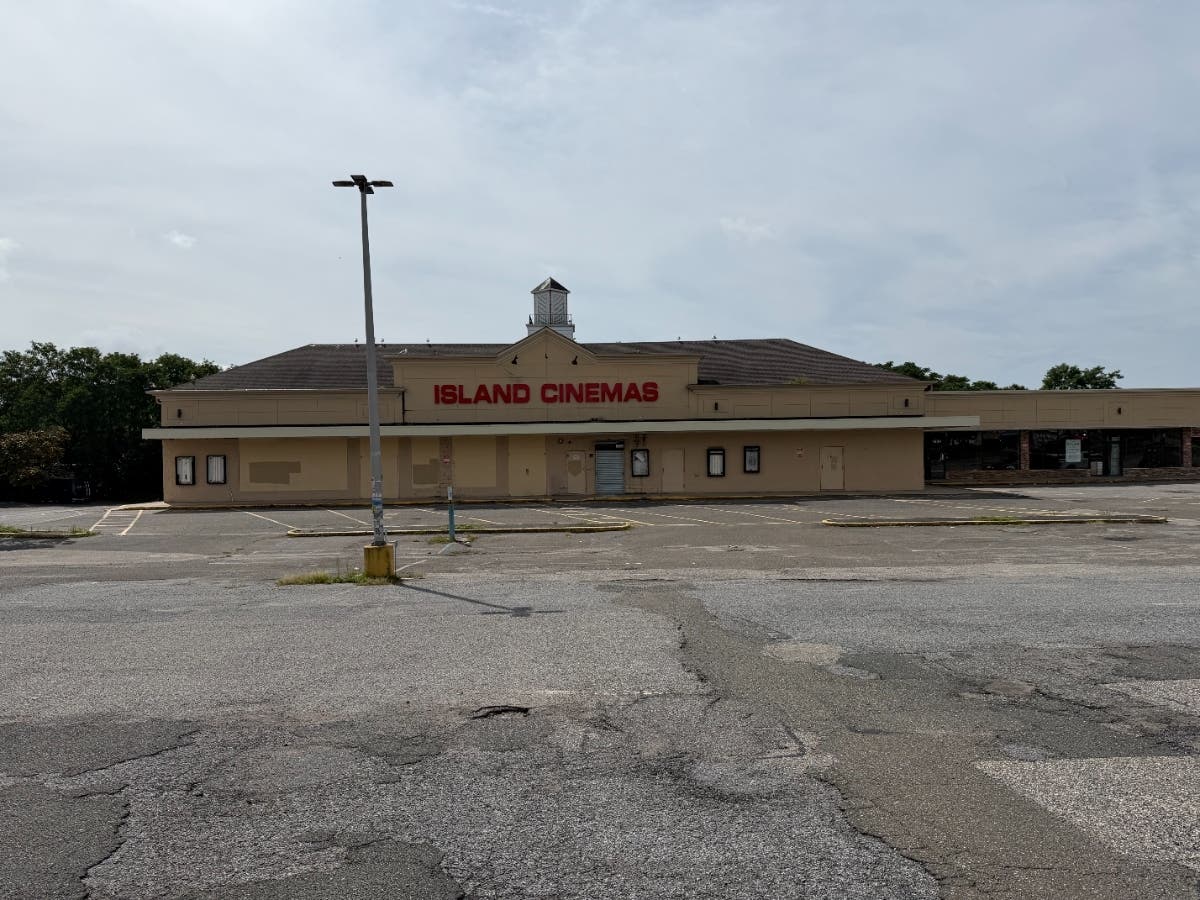
MASTIC, NY — The retro marquee with interchangeable lettering outside the former Island Cinemas in Mastic has seen better days.
No longer illuminated, it features haphazard letters after several disappeared from its last lineup. The only decipherable title is for the DC Comics action movie, "Birds of Prey." It has remained there since the second week of March 2020, when all other public gathering places, including movie theaters, were closed to protect against the spread of COVID-19.
The movie theater property briefly reopened later in the year, but as a makeshift flea market and scrap yard that was shut down by Brookhaven Town officials. It never reopened as a movie theater.
Find out what's happening in Shirley-Masticfor free with the latest updates from Patch.
In the past six years, it has remained shuttered, leaving many, like historic Long Island pop culture social media influencer Steven Pirozzi, who operates The Shirley Drive-in Facebook page, to wonder why the piece of local nostalgia fell by the wayside and what lies ahead for the future.
The king of movie theater lore in the Mastic-Shirley area has pondered another theater there.
Find out what's happening in Shirley-Masticfor free with the latest updates from Patch.
Would he like to see another one?
“Yes, if it's the right person, only because that is where teenagers would go,” said Pirozzi, who lives in Mastic. “I would prefer to see a movie theater back there, but movies aren't as big as they used to be in the 70s and the 80s.”
To Be, Or Not To Be, A Movie Theater Again?
There has been some interest in the property, but no one has mentioned a movie theater as a use, said Councilwoman Karen Dunne-Kesnig, whose constituency includes the location.
“No, definitely not,” she said. “And there's no real … even proposals. It's just people talking about mixed use, you know, to have a restaurant, to have some retail or medical, just different ideas of what they can do with that property.”
“It’s a large piece,” she said.
In its last incarnation, the theater had seven screens and added the nautical-themed Castaway Cafe, which featured items like loaded nachos and flatbread. There was a small portion of it in the lobby dedicated to coin-operated candy machines, and there was also a claw machine, which had a mechanical hand that grabbed prize toys. The theater hosted matinee pricing for the first movie of the day, and themed events with actors, like screenings of "Jurassic Park."
But the beloved movie theater seems to have joined the long list of theaters on the island that have struggled to stay afloat and gone out of business. Most notably, the Regal UA Theater in Hampton Bays closed earlier this year.
At present, the closest theater to the Mastic-Shirley area is the Sunset Theater in Westhampton Beach, which reopened in April 2025 after a revamp that includes Art Deco decor and a concession area with a bar and cafe seating.
Further west, there’s Island 16: Cinema de Luxe in Holtsville, which has Chatters Bar and Grill, as well as an extensive concession stand with Nathan’s hot dogs and Hagen Daz, and theaters with IMAX and reclining seats. There’s also Plaza Cinema and Media Arts Center, a smaller arthouse theater, in Patchogue. Other nearby theaters include Stony Brook AMC, Sayville Theater, and the Southampton Playhouse.
Stony Brook University College of Business Professor Stacey Finkelstein thinks the decline in theaters on Long Island is the result of a “couple things happening,” with Covid-19 as the “real starting point” for the closures.
“Of course, in a pandemic, people were afraid to be in closed, indoor settings, or at least a segment of the population was afraid, I should say, maybe not everybody,” she said, adding that movie theater attendance, particularly among seniors in the population, reduced. “But also anyone who is concerned about being in a closed indoor space with other people for an extended period of time.”
“What I really think is happening is sort of a confluence of, I think, two things. I think one is that online streaming has become such a big thing now, and that's how a lot of consumers are accessing their movies,” she said.
Movies will come out in the theater, but if they are produced by Netflix or Amazon, they are available pretty quickly on those platforms, she noted.
“And so the sort of premium that used to be in place where, if you wanted to see a movie, you had to see it in the theater, or else you had to wait for a year to see it online, I don't think that exists any longer,” she said, adding that consumers are probably already paying a subscription fee for streaming platforms, and "so the additional expense of going to the movie theater is not something they have to consider.”
“It can be really expensive to go to the theater,” she said. “I was with my daughter recently. Between the tickets and the snacks, I think we spent $70.”
It doesn’t surprise Finkelstein that theaters like the Plaza MAC are open, as they are serving a consumer segment where streaming probably “isn't available.”
“I've also heard from people, just anecdotally, and there may be some data on this too, that people like streaming because you can get up, you can go to the bathroom, you can get your own snack, right?” she said. “There's a certain comfort level to being in your own home, but you also may not have them in the theater.”
Finkelstein said she can see how the loss of the theater is a loss for the community “because I think what's happening is that we are seeing this loss of community spaces.”
If movie theaters aren't seen as affordable or as a good value, the question is, "What could you have for members in the community to do?," Finkelstein added.
“And that's probably a bigger question beyond what you're writing about here, but it's one that I'm sensitive to, and I've talked with my students about. When we talk about business closures, it's like, ‘Well, what do you do with that space?’” she said.
But does she think that the island is losing its culture with the closure of movie theaters?
“Well, I think any business struggles to be relevant given how consumer behavior and consumer attitudes are changing, and so I'm willing to bet that theaters that are successful are the ones where there's a special audience or a niche that's not substituted with streaming, or where there is strong community engagement and fostering that sense of community connection,” she said.
When Finkelstein teaches marketing strategy, she tells her students that even if they have something and consumer attitudes are changing, it's all about the value that they’re offering to consumers, and they need to make sure that they’re differentiated from what else can be found in the marketplace.
“So if you're trying to compete by showing movies that people can access via streaming pretty quickly, they’re not going to work,” she said.
If there's “some special niche” for example, like “K-pop Demon Hunters,” which actually moved from online to screening in theaters because “kids were so enamored” by it “that they could come together and have an experience,” she said.
Taking leverage on these cultural phenomena that are trending because of communal connections, and differentiating with arthouse theaters, are the things needed to be successful, according to Finkelstein.
“The key to any successful business is just not having other entities be able to replicate what you can offer,” she said. “And, I think there is something special about sitting in a theater and connecting beyond what you can get at home."
"But I'm not sure that business owners have, perhaps, tapped into that consciously," she said.
Finkelstein says that sometimes what “people under-appreciate is the role of these businesses within the community and how they can serve as a connection point and a hub.”
“And, so it may not seem affordable compared to streaming online, or it may not seem as comfortable, but there are other benefits that they get from supporting a local business, and so maybe making those things top of mind could be helpful,” she added.
Kesnig speculated that no interest in a movie theater at the location could be due to the popularity of streaming and luxury theaters with reclining seats, and the fact that the theater itself was never really popular.
“I was there years and years ago; it wasn't the most popular location,” she said, adding that when she attended screenings, “it was never particularly crowded.”
Her constituents have inquired about the property in phone calls and at events, but no one has inquired about its potential to open as another movie theater.
“No one has asked me, ‘Why isn't it becoming a movie theater?’” she said.
Developer Interest In The Property
Dunne-Kesnig, said now that the Suffolk County sewer project is complete, “it certainly increased a lot of interest in terms of redevelopment.”
Having operational sewers “makes a big difference in terms of what can go in there,” she added.
The long-awaited $224 million Sewage Treatment Plant for the Forge River Watershed Sewer District was completed in March 2025.
The state-of-the-art facility will treat wastewater from nearly 2,000 homes and businesses, about half of the community in the hamlet of Mastic. It was built using funds for flood mitigation from Superstorm Sandy in 2012.
The town has been having meetings “with different interested parties, but no plans that have been submitted for redevelopment,” Kesnig said.
“But I believe it's imminent that something will happen, because there are sewers, and certainly it's a priority of the community and the town to make something happen,” she added.
Kesnig explained that when she came into office two years ago, she drove around her new district and the property, which has been the subject of community complaints about quality-of-life issues.
It “stands out like a sore thumb,” she said.
“That you look at that property, and you say, ‘What the heck?’” she added. “’Do something more there,’ but there's nothing submitted as of now.”
A spokeswoman for Town Supervisor Dan Panico said that the property has been a source of complaints for almost 11 years. The fire marshal’s office has issued many tickets over the years, as well as the Law Department for property maintenance and “other” items, she said.
More recently, a tent fire on the property was investigated by the Arson Squad, Suffolk police said.
The Players Behind The Scenes
Kesnig says she believes the owners of the property were part of the problem.
“For a long time, they were just asking for too much money," she said. "All the developers who were looking to work on it were being quoted way too much money. But, now that there's sewers, I feel optimistic that something will happen.”
Island Cinemas once served as the property's anchor location as the largest building. That has now been shifted between Family Dollar and Luna Laundry. In addition, the strip contains Happy King Kitchen, a Chinese takeout restaurant, and three empty storefronts where various businesses, including a discount store and a furniture retailer, once called home.
The property also contains a separate, empty pad that once housed an HSBC Bank with a drive-thru. Behind the property is a roughly 30-acre wooded lot fronting the ecologically sensitive Forge River that civic leaders have called for officials to preserve for open space purposes, for the better part of 20 years since a massive fish kill in the Forge River in the early 2000s.
Kesnig said she is optimistic that a plan will be submitted soon, and “it'll probably be some sort of mixed-use facility, where there's a restaurant and retail.”
The property, which is zoned J-1 Business, meaning it can only contain businesses, would require a zone change before a mixed-use plan with housing could move forward.
Ultimately, the Town Board would be the governing body that would vote on any zone change for the property.
The town has been working with interested parties, “different developers” who are contacting them to come in and meet and submit proposals, according to Kesnig.
As of September, one potential developer has been speaking with the town’s planning department and is “trying to run by some ideas, potentially it would be mixed-use housing and commercial, but beyond that we know no specifics,” she said.
The corner parcel, 1708 Montauk Highway, is located at the highly-traveled crossroads of Montauk Highway and Mastic Road, one of the peninsula's major arteries allowing access to the South Shore. On the owner's website, it's touted as having a Gross Leaseable Area of 47,000-square-feet, and attracting 5,387 motor vehicles. The former movie theater is around, 20-square-feet, the website states.
In a statement to Patch through a public relations representative, the property's owner, Namdar Realty Group of Great Neck, said the "ownership for Mastic Centre has confirmed they've received some preliminary developer interest in the property, but the discussions are very early stages."
"Any plans or proposals would be preceded by material community engagement for input and feedback, prior to their advancing," the statement said.
Civic Community Leaders Question Property's Fate, As Building Boom Looms On Mastic-Shirley Peninsula
The tri-hamlet community of the Mastics and Shirley is bracing for a building boom to include the largest, a mixed-use plan with housing and retail along Neighborhood Road in Mastic Beach, and a catering hall on Montauk Highway in Mastic. A third large-scale development will include an Islamic center across the street from the present one on William Floyd Parkway in Shirley.
Civic leaders in the area recently aired concerns about what the projects would mean for traffic on the peninsula, which has only two main arteries – William Floyd Parkway and Mastic Road – to get in and out in the event of an emergency.
State officials have been in talks about constructing an underpass for the railroad crossing on William Floyd Parkway, which causes a great deal of the backlog in traffic. Last week, there was also a call to widen Sunrise Highway, and east-to-west artery that feeds William Floyd Parkway, from Route 112 in Patchogue to Wading River Road in Center Moriches, as a possible solution to the gridlock.
But what about Montauk Highway, where traffic is backed up into Brookhaven in the west, and Center Moriches in the east?
What would another development mean for the area?
Mastic Park Civic Association President John Scicignano recalls seeing some renditions of how the Island Cinemas property, then Mastic Movieland, could be revitalized, at least 15 years ago as part of a land-use study along Montauk Highway.
“It looks like they were going to rip the stores down and move them closer to Montauk and have the parking in the back,” he said. “I don't know if that still is; I haven't seen the latest rendition of it.”
The then-owner of the property came to the civic to speak to residents, and he had plans to talk with the town about what he wanted to do, Scicignano says.
At the time, Scicignano had plans to protect the 30 acres in the back of the property.
“There's a stream that runs through there, which is an environmental issue,” he said.
There were plans for a gazebo on the wooded property, if they moved the buildings forward, and a walkway could allow residents to access the Forge River.
“They could put like a little park or something in there,” he said. “There were all sorts of renditions. I don't know what the latest one is. I haven't been keeping up with it. I keep asking [Supervisor Dan Panico] when he's at the meeting. ‘Hey Dan, what's going on with the property there?’ Because we wanted to save the 30 acres back there.”
"He would say, ‘Well, the owner, we're not sure what the owner's going to do. We got some, you know, ideas,'” he said, “So, now it's opening up again. I would assume he wants to make his money.”
Scicignano says that the shopping center has “a lot of history.”
“It would have been nice because it's a really defunct shopping center,” he said. “Half the shopping center is a movie theater, and it hasn't been open for years, and even some of the other stores are closed up. There was a pizzeria in there years ago. I'm not even sure if it's there anymore. And then you have the laundromat, probably the only thing doing any kind of business.”
“It needs something done with it,” he said. “I'd like to see the plans before they approve them. It would be nice.”
Scicignano was asking questions for many years, he says, adding, that “it didn't seem like the owner was doing much with it.”
“He must have a lot of money to keep half the shopping center empty,” he said. “He's not making much money off of it.”
It would be “nice” if the town got “off the gun with it” because “the sewers are going to go in,” he added.
“It's probably more valuable now because you could do more yield on the property, and that's probably what they were waiting for,” Scicignano said. “So, now they could put housing in there. I don't want them overcrowded, though. It's too close to the river, you know? Even with the sewers, you're still going to get the runoff from the cars and parking and all that.”
The town has to be careful that they don’t overdo it, though, he says.
“They think of a sewer as more development instead of to protect,” he said. “The actual reason for a sewer is to protect the environment. Not so you could build more.”
“Because all you're doing, if you build more, is you're negating the fact that we can't save the river really because you're just overbuilding,” he said. “So they really need to look at that. We want to protect that river. It's on the federal impaired waters list.”
The river’s health has long been a concern of the community since a massive fish kill believed to have been caused by a combination of nitrogen overload made worse by the hot weather in 2005.
It became a rallying cry for residents in the area, and some politicians even ran on the platform, demanding the river be dredged and a plan put in place to keep it clean. The clean-up campaign even drew the support of celebrities like former Vogue editor Anna Wintour, who has a property along the river in the Dana Estates of Mastic Beach.
In 2006, the river was included on the state’s list of impaired waters due to impaired aquatic life from excess nitrogen levels.
Beth Wahl, of the William Floyd Community Summit, says she “doesn’t care” about the movie theater coming back to the property, but remembers there was a nice plan when her group undertook the Montauk Highway Project.
Years ago, there was a plan by the former owners of the property, the Parisi family, for a restaurant facing right onto Montauk Highway, and the rest of the shopping center would be knocked down to “create a beautiful thing, whatever it would be, another movie theater, whatever, but nice stores, maybe not dollar stores, and that kind of crap into the place,” according to Wahl.
“But that never happened; it just sat there,” she admonished.
Wahl, who was part of the group of civic leaders who lobbied for sewers for 25 years, says the main reason behind it was to be able to bring in some “nice restaurants for our families, not fast food, but beautiful restaurants.
The plan was for not "ultra-expensive" restaurants but family places to access "without having to leave our community all the time,” she said.
In that time, the community saw the addition of an Applebee’s and an expansion of the pizzeria, Mama Lisa’s, into a luxurious full-scale sit-down restaurant, as well as a revamp of the old Mike's Place, Too, into J.C's Restaurant.
It remains to be seen what will happen to the Island Cinemas property.
“Well, here we are,” Wahl said. “Sewers are there right in front and across the street from that shopping center. It is ideal to put a restaurant there, and whatever the owner would care to do, he would do with the rest of the property.”
She prefers no housing at the site.
“It should be something that people can access in that area that isn't around in that area; maybe another nice grocery store,” she said. “There's housing across the street. There's plenty of houses in that area that people have to drive to get to stores and everything. Gee, wouldn't that be nice if they just drove across the street and they could get to it?
"Very convenient," she added.
Environmentalists’ Concern Over Development Close To The River
Adrienne Esposito of Citizens Campaign for the Environment, an environmental lobbying group that supports water quality, has concerns about the potential for high-density development so close to the river. One of her first questions would be if there is a proposal to hook the potential development up to the property with wastewater treatment.
“Where's the wastewater going, if they're going to put multi-family dwellings there?,” asked Esposito. “Even if it wasn't going to be with multi-family dwellings, but it was going to be like a restaurant or something, I need to know where the sewage is going.”
“People say, ‘Well, the theater doesn't generate that much, right?,” she said. “It's going to generate probably on the weekend, or it's a low generator of wastewater. But, multi-family housing or restaurants would be a high generator, and so we need to know where's the wastewater is going because that would damage the wetlands, the river, and really cause degradation of the ecosystem.”
Esposito explained that the sewer district is divided into four segments, and segment one and two, as well as the new sewage treatment plant, are completed, but there is no funding for three and four.
“I know it's one of the priorities to get funding under the eighth of a penny program that was just passed a year ago,” she said of the county's overall water quality plans. “It takes, what 10 years to build it and connect everything? So it's not exactly around the corner. It could be in the future.”
Esposito says that if anyone were to proceed with multifamily housing at the movie theater’s location, they would “pretty much have to be insane” to do it without sewers.
“I’d really have to strongly object given their location to the wetlands and the river,” she said, adding that she “worked so hard to get the river cleaned up.”
“Now we can't go willy-nilly, and build more housing and dump wastewater into the Forge River,” she said. “That's not the plan.”
Esposito said she could not be sure if a sewage treatment plant attached to any plans for the property would have to be separate from the current one.
“I have no idea what they would do,” she said. "I really don't know if they're going to cut some deal where they hook up to [the current one]. You know, who knows?"
"It would be weird if they wanted to do this and they made their own sewage treatment plant, knowing that a sewage treatment plant will be coming in 10 or 20 years, I don't know," she said. "It's a good question.”
Kevin McAllister, a scientist who grew up in Center Moriches and played in the once-pristine Forge River, which runs between Moriches and Mastic, has concerns about any potential high-density project along the Forge. McAllister, the former Peconic Baykeeper who now heads Defend H20, discovered the fish kill along the river 21 years ago while escorting two members of the press on a tour of the South Shore.
McAllister said the sponsors of the Forge River Watershed Sewer District, principally Brookhaven Town and Suffolk County, represented that the sewer district “was critical for the protection of the Forge River.”
“But in fact it was always about economic growth along the Montauk Highway corridor, which was stymied because of conventional septic systems,” he said. “Multi-family housing, restaurants, and other large wastewater discharges could not happen without sewering.”
“When public opposition was mounting, the name of the district was changed to the Forge River [Sewer District] and fuzzy math, addressing denitrification performance was used to sell it to the public as an environmental/water quality initiative,” he said. “I believe in the not-too-distant future the benefits of sewering will be negated by high-density development that the corridor will come to see.”
“Good for business interests, but false hope for restoring the Forge River,” he said.
Neither the town, nor county responded to a request for responses to Scicignano, Wahl, McAllister, and Esposito's comments.
A Long History In The Mastic-Shirley Community
The property opened as an A&P grocery store before being converted into a theater in the 70s. It still has a steeple that once contained a weather vane, which became an iconic symbol of the now-defunct chain of supermarkets.
Pirozzi, whose page features photos of eastern Suffolk’s days gone by and businesses that have since closed, says he does not know why the first owner of the movie theater failed, but there were a lot of issues involving permission and leaks on the property.
He doesn’t know why the second person failed.
He started the Facebook page to celebrate the legacy of the drive-in, which was a staple of the community until it was converted into the South Port Shopping Center, which has a Kohl’s Department Store, Stop and Shop, an Old Navy, Marshall’s, and other shops and restaurants.
The tri-hamlet peninsula of Mastic-Shirley and Mastic Beach was once the home of three theaters, including the drive-in, and Mastic Movieland where the former Island Cinemas is. There was also the Shirley Squire Theater at the strip mall at the intersection of Montauk Highway and William Floyd Parkway where there is now a Gala Fresh, and Zwanger Pesiri, a shuttered Boston Market where a bank is proposed, and a pop-up Spirit Halloween in place of a pharmacy that closed.
“Back in the 60s, 70s, and 80s, that was a walk-in movie theater,” Pirozzi said.
The theater was “made for teenagers because that's where everybody went on a Friday and Saturday night,” he explained.
Mastic-Shirley was this really small town,” he said. “It really was small, and we would … everybody I knew would meet up, and just that's where you'd wind up. So you saw every movie, and they made a fortune because that's where everyone was.”
“And I remember in the 70s when it first went up, I was always told, ‘Oh, that's where you go on a Friday night,’” he said. “So when I became a teenager in the '80s, they all flocked to the movie theater.”
“The drive-in. How do I explain the drive-in?” he asked.
His time with it was so small.
When the graduation picture of William Floyd High School was taken in '86, all the seniors fit in.
“We all fit on one section of the bleachers,” he said. “So when the drive-in was open, that's where everybody would try to go on a Friday night. You would wait. You had to get in.”
Teens could walk, or they could get someone to drive in, but the theater operators didn't really care, Pirozzi says.
“We would all wind up just going to the drive-in movie theater,” he said. “You couldn't walk into one movie theater. You went to the drive-in. You begged your parents to take you or your friends because the town was so small. That was the entertainment of the evening. It was … that's what our entertainment was. There was nothing in this neighborhood.”
Pirozzi, who, like others in the area, now goes to Island 16, says another shopping center is not needed at the location. There is already a King Kullen on William Floyd Parkway, and Stop and Shop, Lidl, and Aldi on Montauk Highway.
“You don't need another Stop and Shop," he said. "Although, that side of Mastic is different when you go past a certain point heading west. Mastic still has that small town feel; that look. But as you go past towards the west, towards that, it all changes. I would like to see something in there where you help the community, if it is a shopping center. But I don't know who would buy it.”
And housing?
“Mastic has always been a smaller-income neighborhood, a lower-income neighborhood,” he said. “You don't need to put condos up or nothing like that.”
Community leaders have said over the years, if not feared, condos overlooking the river could be a high-end draw.
He noted that Family Dollar is still on site, and the Chinese restaurant has been owned by so many different people since the '60s.
“The laundromat is a big thing for people, locally, right there,” he said, adding that the bank has been shuttered for a long time.
“I think a bank should enter over there or a real estate company,” he said. “But something's got to go in there that's going to help the community.”
He doesn’t think condos at the location would help the community.
“There's condos across the street, and they've never done anything with those condos,” he said. “They've never expanded. It's a lower-income neighborhood. Putting condos in there isn't going to help. People can't afford the condos you're going to charge the prices of.”
“Like Mastic Beach is trying to reinvent itself, and it won't,” he added, making reference to the large-scale mixed-use housing development planned along Neighborhood Road in Mastic Beach.
He likes the idea of retail, but he wants to see it more affordable.
“You have a lower-income neighborhood,” he said. “Let people go in there and get things they can afford. If one person goes in and can afford it, they tell the next person, and the next person, and the next person, and then they put it on social media, and people go there.”
As for another movie theater, people would go there and bring business to restaurants nearby, he says.
"You open a movie theater — the Chinese restaurant is right next door — they make a fortune," he said. "You open something small like a deli, right next to that ... all those people would make money for every person going to a movie theater, especially in the afternoon showings, because they want to go out and get some food."
The restaurants would be handy.
"You wouldn't have to travel," he said.
Pirozzi has fond memories of Island Cinemas, including seeing "Face/Off" with John Travolta and Nicholas Cage on its opening night in 1997.
He does not know of any groups seeking a return of the movie theater to the location.
"There's only me for a while," he said. "I don't know anybody trying. I tried the second time it shut down because I wanted to know what was going on there, and I went to town hall. It was like nobody had the answer."
Get more local news delivered straight to your inbox. Sign up for free Patch newsletters and alerts.