Community Corner
Agawam Real Estate Has Long Been Irresistible
For more than a century, Agawam's been Southampton's choice neighborhood.
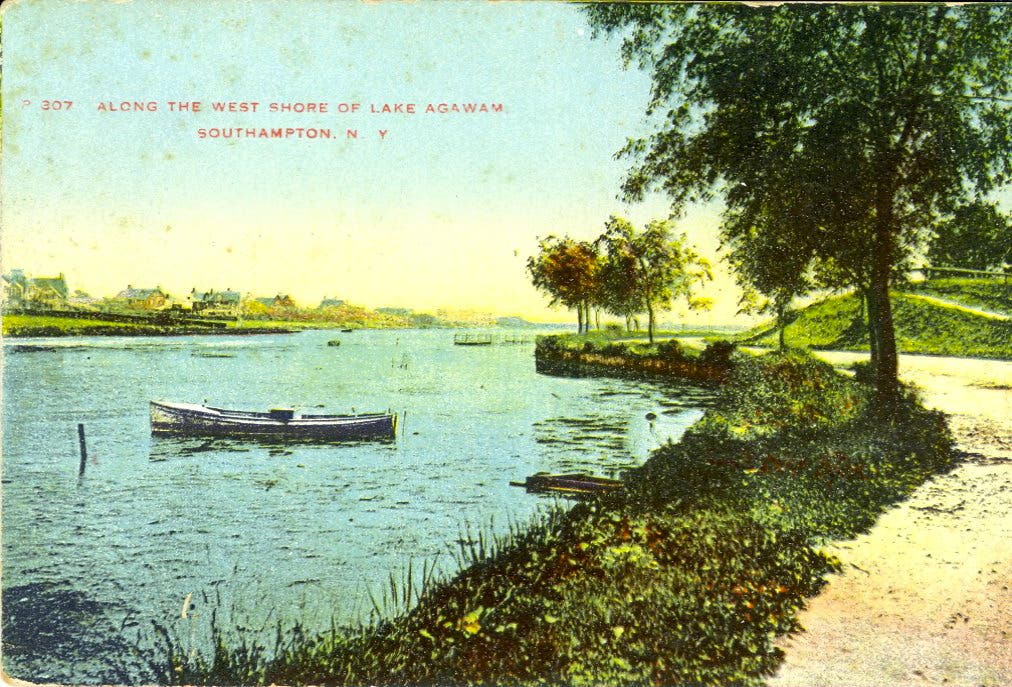


Once the railroad came through in 1870 connecting Southampton to the city, gentrification, with all its tensions, was not far behind. Here, in four lines of poetry, is its reflection:
Away with your Silver Lake
Be off with your Agawam
Three times three and a tiger take
For glorious old Town Pond
Published in The Sea-Side Times, the little ditty took aim at the pretensions of newcomers from the city who found the name "Town Pond" too banal for what Dr. T. Gaillard Thomas described in 1884 as "this beautiful sheet of water whose waves are constantly cloven by a swan-like fleet of pleasure boats."
Find out what's happening in Southamptonfor free with the latest updates from Patch.
Silver Lake did not stick, for what seem obvious reasons, but did, Indian names having a certain exotic appeal for the urbanites.
By 1884 gentrification was in full gear and Dr. Thomas, who had built the first house on the beach just east of the lake in 1877, went on to cite Lewis Bowden, "our enterprising real estate authority," in noting that the most accurate measure of "the facility of renting cottages" was the distance separating them from the lake.
Find out what's happening in Southamptonfor free with the latest updates from Patch.
As everyone knows, there is no gentrification without real estate speculation and Bowden knew whereof he spoke. What more charming setting for a summer cottage than the shores of Lake Agawam, so close to the surf yet safe from its rages, so close to the village, yet serene and secluded? It's no wonder prices were skyrocketing.
In 1880, Salem H. Wales, a prominent publisher and former New York City parks commissioner, had purchased 10 acres of land on the lake at $400 (up from $50 a decade earlier). In 1884, four acres on the lake fetched $4,000 and two years later Charles T. Barney paid $20,000 for five acres that included a house.
Quick to appreciate their position on the inside track, the resort pioneers not only snapped up properties for themselves but purchased additional acreage to build cottages to rent out to their friends. Perhaps the most agile and acquisitive of all were the brothers Frederic and C. Wyllis Betts, wealthy corporate lawyers in the new mold who cornered much of the market around the south end of the lake and were able to bequeath a dozen or so cottages to their heirs.
As picturesque as the lake remains, its charms pale a bit when compared to a time around the turn of the last century when the cottages' seasonal occupants were a tight circle, when everyone knew everyone else and everyone lived well, enjoying one golden summer after another.
And about that "swan-like fleet of pleasure boats" Dr. Thomas mentioned? In a 1965 reminiscence, Marion McKeever Thompson, who was born in 1876 and spent all of her summers on Agawam, described the lake as a hub of summer activity.
"During the morning," she wrote, "Agawam Lake was a busy and gay sight as people rowed or sailed down to the beach for a swim." At night, the color of lanterns displayed on the docks identified their owners, an aid to guests arriving by boat. Invited for dinner, "one just hopped into his boat and rowed across, carrying a lantern to light the way over the lawns up to the houses."
The lake may have lost a bit of its vitality, but it has lost none of its value. When billionaire hedge fund manager John Paulson fell under its spell in 2008, he parted with $41.3 million for the handsome summer retreat built in 1912 on 10 lakeside acres by architect Goodhue Livingston.
Sources from the : The Sea-Side Times, July 10, 1884; "Old and New Southampton: The Transformation of a Long Island Community, 1875-1900" (manuscript slated for publication by State University of New York Press; Southampton, Long Island 1640-1965, 325th Anniversary (commemorative booklet).