Neighbor News
The Unabridged Record: What Municipal Files Reveal About Southampton's Sewer Project
An analysis of internal Village records, FOIL defaults, and parkland alienation ahead of the Oct. 8 hearing.


To the Editor:
The residents of Southampton Village and the broader community deserve to know what municipal records reveal about the planning of the proposed downtown sewer project and centralized wastewater treatment facility.
I recently compiled a comprehensive report entitled "Documented Municipal Record - Village of Southampton Sewer Project," organizing disclosed Village records, Sewer District Task Force minutes, engineering deliverables, planning materials, state funding applications, public-relations proposals, and FOIL correspondence into an auditable chronological record.
Find out what's happening in Southamptonfor free with the latest updates from Patch.
I am not asking residents to take my word for what occurred. I am asking the public, elected officials, and the press to examine the Village's own paper trail and ask a straightforward question: How can these official documents be reconciled with what the public has been told?
Key Findings at a Glance:
Find out what's happening in Southamptonfor free with the latest updates from Patch.
- Admitted Parkland Alienation: The Village's September 10, 2026, Draft GEIS Scoping Document formally concedes that 185 Windmill Lane is dedicated parkland requiring New York State legislative alienation to construct an industrial wastewater treatment plant.
- Prejudged Environmental Review: Early municipal engineering RFPs contractually commanded a SEQRA Negative Declaration under an "uncoordinated review" and barred bidding firms from budgeting for an Environmental Impact Statement before baseline scientific reviews even began.
- Contradicted FOIL Certification: On September 3, 2026, the Village certified under penalty of NYS FOIL law that "no records exist" regarding engineering or environmental studies of Lola Prentice Park, seven days before officially publishing an engineering scope and groundwater mounding analysis for that exact parcel.
1. The Documented Decision to Suppress Public Participation
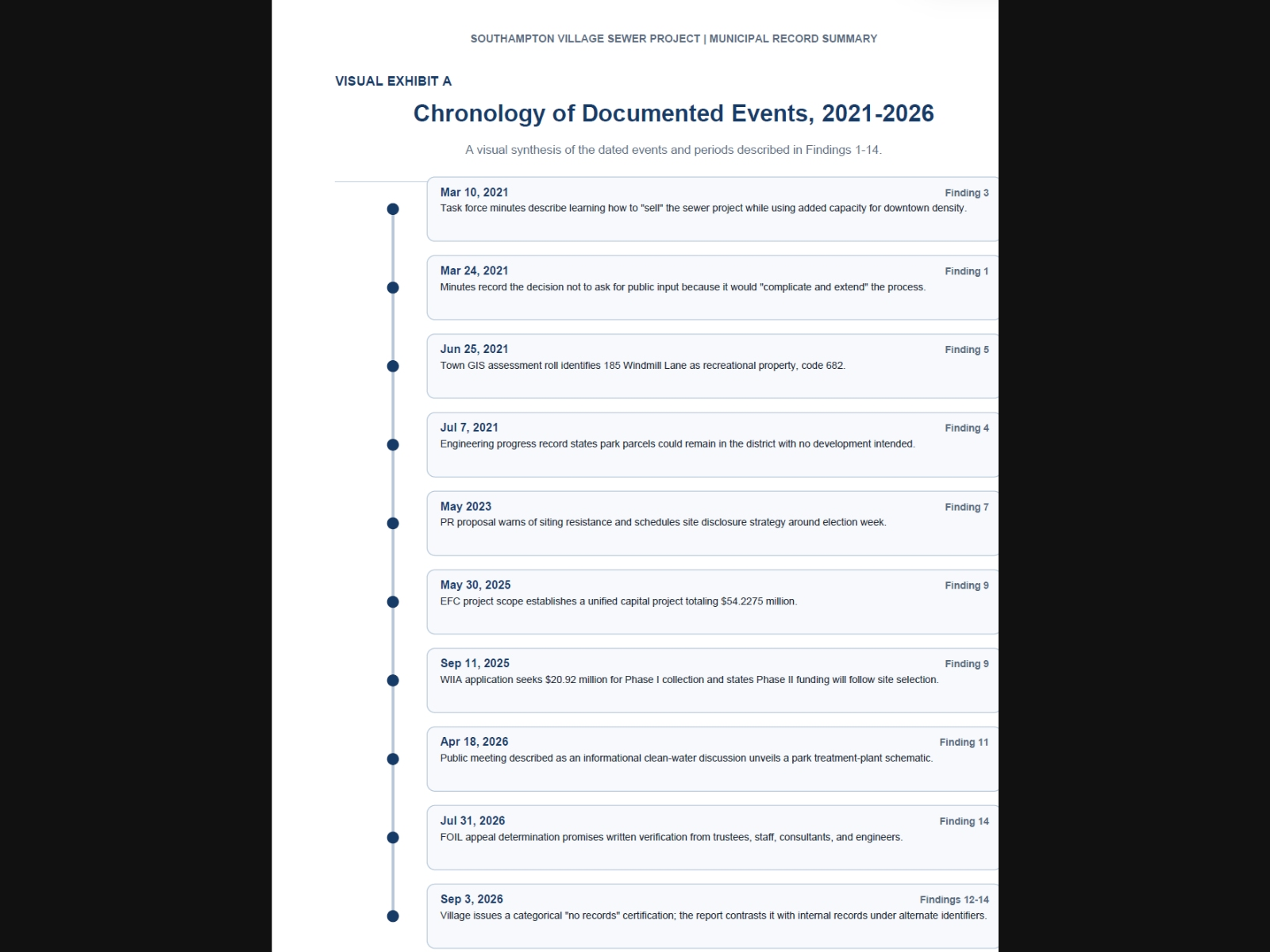
On March 24, 2021, Sewer Task Force minutes recorded the following policy decision regarding public consultation:
"The committee decided not to ask for public input as it will only complicate and extend our process."
Why would a public committee planning an infrastructure project of this magnitude affirmatively decide from its inception to avoid public scrutiny?
2. The Westhampton Beach "Playbook," Commercial Upzoning, and the Formal GEIS Build-Out Scope
Two weeks earlier, on March 10, 2021, Task Force minutes documented a presentation by Westhampton Beach officials on how to "sell" a municipal sewer district. The records outline a strategy where sewers are promoted publicly as an environmental clean-water necessity to secure state grants, while the added wastewater capacity is utilized internally to upzone downtown for commercial expansion, increased restaurant seating, and second-story apartments, all while updating master plan language to soothe residential fears about overdevelopment.
Internal engineering notes from 2021 to 2023 confirmed that future wastewater flows were calculated from development assumptions across 39 parcels, upzoning corridors along Nugent Street, Windmill Lane, and Hill Street for two- and three-story mixed-use redevelopment. The system's design capacity of 198,330 gallons per day exceeded baseline flows by 40,316 gallons per day specifically to accommodate 60 new residential apartments and expanded commercial "wet uses".
When Village Planning Commission Co-Chair Marc Chiffert warned in July 2023 that development should be treated as purely collateral to water quality, the Board bypassed those warnings. The Village's September 10, 2026, Draft GEIS Scoping Document formally codifies this agenda in Chapter 2 ("Redevelopment Build Out Scenario"), openly conceding that downtown development is maxed out under existing septic limits and that the sewer system is engineered to enable second-story commercial expansions, apartments, and high-flow restaurants. Was this project conceived purely as an ecological rescue of Lake Agawam, or was downtown commercial densification a primary objective from day one?
3. Contractually Rigging the Environmental Review
The Village's January and March 2021 engineering RFPs prejudged the environmental review before engineering work even began. The solicitations classified the sewer project as an "Unlisted Action" under an "uncoordinated review," told bidding firms that the Board anticipated adopting a SEQRA Negative Declaration, barred firms from budgeting for an Environmental Impact Statement (EIS), and made Task 6 an explicit contractual command to "Prepare a Negative Declaration for the Village".
This predetermination persisted as the project progressed. In April 2023, project engineers advised Village officials that a Negative Declaration was expected even though archaeological survey results remained outstanding, explicitly noting that avoiding a positive declaration would save six months of EIS review. Why was the environmental outcome repeatedly anticipated before objective scientific reviews were complete?
4. Official Notice of Dedicated Parkland Status Since 2021
The Town GIS assessment roll dated June 25, 2021, officially cataloged 185 Windmill Lane (SCTM Parcel 904-6-1-1) under NYS Property Code 682: "Recreational Facilities Nature trails, bike paths, etc.," surrounded by 4.6 contiguous acres of municipal parkland and drainage reservations. The Task Force was on official notice of this dedicated recreational classification for five years.
Furthermore, on July 7, 2021, the project engineer placed a formal representation on the record that park parcels within the district boundaries "will remain as such, and that no development is intended in the future (no flow)". When was that commitment abandoned, who authorized converting public parkland into an industrial treatment site, and why was the public kept in the dark?
5. Shielding Siting Disclosures Around Election Week and Reverse-Engineered PR
In May 2023, communications consultant Nancy Kane submitted a $15,000 public-relations proposal, subsequently authorized by the Village, explicitly identifying the political sensitivity of the plant location: "Residents don't want to live near plant, put it in the village".
The proposed communications calendar noted: "Week of June 12: ELECTION WEEK," and recommended deferring public disclosure of the treatment plant site until after that election had passed. It also proposed distributing promotional materials to patrons at the local dog park, the exact parkland slated for appropriation. Municipal records even contain draft Clean Water Project press releases with editorial notes seeking figures to back up environmental claims after the text had already been drafted. Why were public relations and election timing consistently allowed to lead science and public disclosure?
6. The Cost-Driven Siting Pivot from 1 Bowers Lane to "Site 4"
Engineering files show that the Village spent public funds fully engineering an off-site treatment plant at 1 Bowers Lane / David Whites Lane, complete with architectural barn renderings, 300 CAD-modeled leaching pools, and State Historic Preservation Office (SHPO) archaeological clearances.
However, internal records reveal that this site was abandoned after the Southampton Town Attorney formally notified the Village in May 2023 that the Town would not fund the acquisition, opposed the plant location, and cited zoning prohibitions. Faced with an $8 million purchase price at National Grid and $2.7 million in directional drilling, the Task Force abandoned off-site options and pivoted to Village-owned property at Windmill Lane, internally designated as "Site 4".
While using parkland avoided acquisition costs, the Village's internal comparison memo noted severe site deficiencies: a shallow water table with an alarming 10-to-25-year groundwater travel time, a mandatory groundwater mounding study, and the explicit acknowledgment that "The parcel will need the alienation of the current Dog Park site".
7. The Pre-Workshop Parkland Plan, the "Green Space" Double Standard, and Physical Setbacks
Internal Task Force chronologies confirm that by November 2025, five months before the public was presented with the plan, the committee had already internally resolved to pursue the Southampton Press parcel, relocate the dog park there, and alienate the existing park for wastewater treatment and leaching fields. Yet on April 9, 2026, the project engineer issued a "Final List of Sites" eliminating alternative candidate parcels specifically because they were "designated green space or parkland". Why was parkland status treated as an insurmountable barrier for outside parcels, but ignored when targeting Lola Prentice Memorial Park?
Furthermore, Suffolk County Department of Health Services requires a 150-foot setback for enclosed treatment buildings from property lines, plus an additional 100-foot buffer to areas of substantial human use. Applying a 250-foot buffer across a 2.4-acre parcel containing an active dog park, basketball courts, and adjoining homes collapses the buildable envelope to near zero, requiring the complete elimination of public recreation to force an industrial facility onto the parcel.
8. The Formal Written Admission of Parkland Alienation at 185 Windmill Lane
What was once privately acknowledged in internal drafts has now become official policy. In the September 10, 2026, Board of Trustees agenda packet, the Village published its formal Draft Scoping Document for the Generic Environmental Impact Statement (GEIS), prepared by H2M architects + engineers. Section 4.0 explicitly concedes:
"The proposed WWTP will involve the potential use of Village parkland that is to be alienated if approved by the New York State Legislature. As part of the Proposed Action, new parkland will be dedicated, replacing the alienated parcel... Alienation of parkland - 185 Windmill Lane, Southampton, NY (SCTM: 904-6-1-1) and designation of new replacement parkland at recently acquired property at 135 Windmill Lane."
Under New York Court of Appeals precedent (Friends of Van Cortlandt Park), diverting dedicated parkland to non-park municipal utilities without state legislative approval is unlawful. The Village has now formally conceded that 185 Windmill Lane is parkland and that its conversion to a sewer facility requires special act legislation from Albany. Why did Village leadership conceal this reality from the community for years?
9. Slicing the $54M–$56M Project into Phased Grant Requests
In 2024 and May 2025, Village officials executed Environmental Facilities Corporation (EFC) Project Scopes identifying an integrated capital project costing $54.2 million to $56.0 million, encompassing both Phase I collection ($13.4 million) and the Phase II treatment plant ($22.0 million). Yet on September 11, 2025, the Village submitted a separate application for $20.92 million covering Phase 1 collection only, stating in writing that funding for the treatment facility would be sought later once siting was finalized.
That same day, the Board of Trustees adopted agenda Item 11, committing municipal funding to Phase 1 while acknowledging on the record that the annexed environmental review concerned the abandoned Bowers Lane concept and would need updating. Slicing collection pipes from the treatment plant conceals the true $54M+ taxpayer burden and insulates the controversial treatment plant from required environmental review.
10. Broken Sworn FOIL Commitments and the Impeached "No Records" Certification
Recent letters in this paper have questioned the abrupt departure of the Village Clerk, raising sharp concerns over administrative turnover and records delays surrounding the sewage facility. The municipal record confirms that transparency had to be compelled at every step.
The public only has access to these planning files because disclosure was forced through a formal Notice of Constructive Denial and an administrative appeal. On July 31, 2026, Village Administrator and FOIL Appeals Officer Scott Russell approved my appeal in writing, promising:
"I am approving your appeal and will direct all parties, including all task force members, Village Trustees who served as liaisons, Commissioner of the Department of Public Works, Village Clerk, Consultants, Engineers, and me to conduct a diligent search of all records in their possession that are responsive to your request. Further, I am requesting verification, in writing, from each member that such a search was undertaken and all records in their possession have been submitted or, if none exist, to verify as such. All documentation will be provided to you by this date, August 28, 2026, as required by NYS FOIL §89(3)(a)."
That letter was copied directly to the New York State Committee on Open Government. One week later, on August 6, 2026, Russell admitted in an internal memorandum to Task Force members that the Village's initial response "was not adequate to comply with FOIL" and explicitly recognized that the search covered Lola Prentice and alternative sites including Pond Lane, Bowers Lane, and Aldrich Lane.
Yet despite Russell's written mandate, not a single signed verification from any Trustee, Task Force member, DPW Commissioner, consultant, or engineer was ever provided to me.
Instead, on September 3, 2026, that same Appeals Officer attempted to close the matter by certifying under Public Officers Law § 89(3)(a) that:
"No records exist regarding any environmental, engineering, economic study/analysis, or like, of Lola Prentice Park."
That sworn certification was obliterated seven days later. On September 10, 2026, the Board published an official agenda revealing that on August 13, 2026, it had adopted a SEQRA Positive Declaration (Resolution 2026-682) requiring an EIS for a project centered directly on 185 Windmill Lane and released H2M's Draft GEIS Scoping Document evaluating parkland alienation and mandating a "Groundwater Mounding Analysis for 185 Windmill Lane".
How could the Village Administrator certify under penalty of law on September 3 that "no records exist" when the Village was actively circulating and publishing engineering scopes, mounding analyses, and parkland alienation plans for that exact parcel?
When formally called out on this default and the missing custodian verifications, the Appeals Officer attempted to retreat from his own July 31 mandate, claiming in a subsequent email that he lacks the legal authority to compel Village personnel, trustees, or consultants to verify their searches. An agency head cannot issue a binding administrative order only to disavow it when compliance becomes inconvenient. With the Village in default of its statutory duties and refusing to enforce its own determination, administrative remedies have been exhausted, leaving judicial enforcement under CPLR Article 78 as the community's only avenue for the truth.
These are not clerical technicalities. They concern public participation, environmental review, commercial density, public trust parkland, election transparency, fiscal integrity, and the public's statutory right to government records.
Protecting Lake Agawam and improving water quality are vital public priorities. But supporting clean water does not require residents to surrender transparency, accept unlawful environmental shortcuts, or forfeit dedicated parkland. This is no longer merely a debate over whether Southampton needs sewers; it is an examination of how our local government conducted itself while planning them.
The Village has scheduled a public hearing on the Draft GEIS Scope for October 8, 2026, at 6:00 PM, and will accept written comments through October 22, 2026. Residents should demand complete transparency: the Village must release all unredacted engineering memos, Task Force correspondence, search certifications, and site analyses for every alias of the Windmill Lane site.
Southampton residents should not have to guess about decisions involving tens of millions of public dollars and the permanent conversion of dedicated parkland. The Village's own records must speak for themselves.
The complete, unabridged report and documentary paper trail are available here:
acrobat.adobe.com/id/urn:aaid:sc:US:9787bb39-fed5-4222-b3ae-66c18c32e905
Blaise F. Labriola
Southampton, New York