Politics & Government
District 35 State Senate Candidates on the Economy, Jobs and Albany Politics
Liam McLaughlin and Andrea Stewart-Cousins discuss the issues in the first part of a two-part series in the run up to the Nov. 2 election.

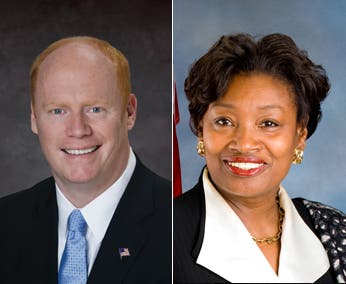
The race to represent the 35th state Senate district features two familiar faces in local politics—and well-known political issues such as taxes and a dysfunctional state government.
The district, which includes Hastings, Dobbs Ferry, Irvington, Tarrytown and Sleepy Hollow, is up for grabs on Nov. 2.
Under the Democrat and Working Family party lines, incumbent Andrea Stewart-Cousins is looking to keep her position. Stewart-Cousins, a resident of Yonkers, was first elected to the state Senate in 2006 after serving for a decade as a Westchester County legislator. Before her political career was launched, she was the director of community affairs for the city of Yonkers.
Find out what's happening in Tarrytown-Sleepy Hollowfor free with the latest updates from Patch.
On the Republican and Conservative ticket is Liam McLaughlin. McLaughlin, also from Yonkers, is a certified public accountant and practices law as a senior associate with the firm Bashian & Farber, LLP in White Plains. In November 1999, he was elected to the Yonkers City Council representing the Fourth District. He was re-elected in 2001, 2003 and 2005 and served a total of 10 years on the Yonkers City Council.
On the Economy
Find out what's happening in Tarrytown-Sleepy Hollowfor free with the latest updates from Patch.
The economy is on everyone's mind. What are some solutions for righting the economy and tackling taxes?
"Especially in Westchester, people are fed-up with taxes, government spending and the corresponding tax increases that are getting shoved down our throats," McLaughlin said. "The economic times are difficult. The people and jobs are fleeing our state."
Regarding taxes, McLaughlin pointed out numerous new taxes that have been instated in the past two years, mainly the MTA payroll tax–which charges $0.34 cents for every $100 in payroll spending by private and public companies. Also on his list are ever-increasing property taxes; the elimination of some elements of property tax relief provided under the New York State's School Tax Relief (STAR) program; and new taxes such as the elimination of a sales tax exemption on clothing sales under $110.
"Then there are all the fees and back-door taxes," he said. "It's death by a thousand cuts."
As examples of jobs fleeing Westchester, McLaughlin singled out businesses such as Precision Valve, which closed down its Yonkers operation to consolidate in South Carolina; and Stewart Stamping, which also closed down its Yonkers operation.
McLaughlin said that he also had family moving out of New York, specifically Westchester, to places like North Carolina, in part due to the tax burden in New York.
"Because of the economy, they are being forced to move," he said. "I hate to think about all the people that have moved away. Even those staying in New York are moving to Rockland, Dutchess or Orange County."
Stewart-Cousins"We've made a lot of positive groundwork to make sure state government is operating in the way it is supposed to be," Stewart-Cousins said.
Regarding taxes, Stewart-Cousins said that the senate had voted to cap increases in local property taxes at 4 percent or the rate of inflation—a final agreement on the bill has not been reached in the state legislature.
Stewart-Cousins believes the one of the best ways to combat taxes is to audit government departments, and consolidate taxing agencies in the state.
"This type of auditing has never been done," she said of her work on the Task Force for Government Efficiency. "We're stepping up the Medicaid fraud investigation, having stronger oversight internally, and trying to curtail the spending we have. That is some of the ways we are approaching the tax issues."
She also noted that the Task Force has cut over $350 million from the budgets of SUNY, the Department of Transportation and the Office for People with Developmental Disabilities.
"We've been able to question spending and overtime, and identify what we feel constitutes waste," she said.
She also said that there are over 10,000 taxing districts in the state. Her view is that the tax burden can be simplified, in part, through consolidating these agencies. The idea is central to SB5698 – a bill she sponsored and got through the legislature.
"So far we've dissolved 118 authorities and agencies that were on the books and generating some kind of expense, but weren't doing anything," she said. "This is the work we need to do help the taxpayers save."
On Job Creation
How do we stimulate job growth locally and across the state?
"Taxes have an affect on all of that, it also has a huge effect on business," McLaughlin said.
McLaughlin noted that he had helped the city of Yonkers combat some of the "onerous taxes" that were keeping jobs and people out of the city. Specifically he cited a tax on property transactions. If a property were sold in the city for $500,000, the government would get $15,000 in the transfer. It has since been reduced to 1 percent of a sale, though he said he would prefer to do away with the practice entirely.
"That started to get people to move back to Yonkers," he said, which in turn helps create a demand for more services.
He noted that Yonkers is in a particularly disadvantaged position because it imposes an income tax that continues to make business investors wary. He said the tax was unfair because it charged wage earners who may not even live in the city limits, but happen to work in Yonkers. He cited this as one of the many anti-business taxes in the state.
"New York State has one of the most hostile environments from a business perspective," McLaughlin said. "And what do they do? They make it worse with new taxes such as the MTA tax."
McLaughlin said it would be his consistent stance to reduce taxes on businesses and do what he can to foster a more "business friendly" environment in the state.
Stewart-CousinsStewart-Cousins also expressed her concern about the job market.
"Small businesses are the prime engines that grow stagnant economies," she said.
In her experience, she said much can be done in Albany to stimulate job growth. She specifically cited the work of the senate to make state contracts more transparent and equal in their distribution—she noted that only 1 percent of state contracts go to minority-owned businesses.
The senate is also working on revamping the Empire Zones program, which gives incentives to businesses in the form of tax credits and exemptions. The program has been extended to 2014, but, she said, still lacks transparency. The goal of a revitalized Empire Zone program would be to increase retention and find new ways to attract businesses, specifically in research fields.
"It will help to sustain jobs," she said. "One of our targets will be to attract the research and development fields in pharmaceutical and nanotechnology industries."
She said that micro-loans, tax relief and government contracts were imperative to keeping jobs in the region and attracting more businesses. She also said there needed to be a commitment to investment in educational programs, such as those provided through Westchester Community Colleges, to get people interested in new industries and to create a more qualified workforce.
On the Political Climate
A lot has been said about the "culture in Albany" this year. What is wrong with the culture in the legislature and how do you feel about the current political climate?
McLaughlin"For me, it's a very big deal. Our state is in dire financial times," McLaughlin said. "It's not a time to raise taxes, and the politicians in Albany seem to be oblivious to the suffering that is going on."
He said that the Nov. 2 election will show just how dissatisfied residents in New York, and the 35th Senate District, are.
"I think the good thing that is going to happen, is there is so much anger, there is going to be a lot of incumbents removed," he said. "We'll get a legislature that is more in tune with the public."
"We need people who are serious about governing and the need the cleanup Albany," Stewart-Cousins said. "We've already begun making progress to make it more transparent and accountable to the public.
Stewart-Cousins feels that with the aid of an effectual governor–her choice being Attorney General Andrew Cuomo–the legislature can continue to crack down on government spending and corruption. However, she feels that the current political climate is full of misinformation and fear.
"There is a lot of insecurity and anxiety," she said. "I think it's important that that not carry the day. People have every right to be concerned. That is why it is important that people working on these issues communicate... I've always trusted the voters."
We'll run our second piece with Liam McLaughlin and Andrea Stewart-Cousins in two weeks.
Get more local news delivered straight to your inbox. Sign up for free Patch newsletters and alerts.