Politics & Government
Media Racism History 101: Part 4
Did U.S. Establishment's New York Times newspaper operate in an institutionally racist way in late 20th-century?
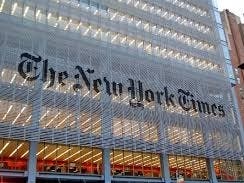
In 2020 U.S. Establishment newspapers like the New York Times now claim to be against institutional racism in the United States and elsewhere in the 21st-century. Yet in the late 20th-century the U.S. Establishment's New York Times apparently operated in an institutionally racist way in its Midtown Manhattan newsroom offices.
During the 1970's, for example, the New York Times was sued by its African-American employees who charged the newspaper with "racial discrimination in hiring, job classification, salaries and other issues," according to Fit To Print: A.M. Rosenthal And His Times by Joseph Goulden. New York Times managers were accused by then-New York Times columnist Roger Wilkins, in a deposition, of running a "racist paper" and the case was eventually settled out-of-court by the Times. As a result, the African-American employees of the Times covered by the settlement received substantionally more than $250,000 in legal settlement money.
And during the 1980's, a New York Times employee between 1969 and 1985, Ruby Howard, continued to accuse the New York Times of operating in an institutionally racist way in the 1980's. In a March 27, 1987 legal opinion, then Federal Judge Goettel, for example, summarized the former New York Times employee's work experience at the New York Times's Midtown Manhattan offices in the late 20th-century in the following way:
Find out what's happening in Upper West Sidefor free with the latest updates from Patch.
"Plaintiff Ruby Howard was employed by the New York Times from 1969 until she was discharged in 1985...In 1969, the plaintiff began working for The Times as a secretary in the Editorial Department...In 1975, the plaintiff and two other employees were given an opportunity to try out for the high paying position of assistant indexer. The plaintiff was unsuccessful...Shortly thereafter, the plaintiff filed charges with the NYC Commission on Human Rights [CCHR] and the federal Equal Employment Opportunity Commission [EEOC] alleging that The Times had refused to promote her to the assistant indexer position because of her race and color...
"...On December 19, 1984, the plaintiff again filed charges with the EEOC and CCHR. This time she alleged she was being disciplined in retaliation for the racial discrimination charges she filed against The Times in 1975. She specified the following actions as the basis for her retaliatory discrimination claim: (1) The Times's continuing refusal since 1975 to promote her to the position of assistant indexer; (2) her `demotion' to index clerk in 1977; (3) a bad reference allegedly given by The Times on an unspecified date; (4) a disciplinary memorandum from plaintiff's supervisor dated 10/13/84, warning her about work performance; and (5) a two-week disciplinary suspension of plaintiff, which began on October 16, 1984.
Find out what's happening in Upper West Sidefor free with the latest updates from Patch.
"On August 6, 1985, the plaintiff's employment at The Times was terminated for `gross insubordination'..."
Coincidentally, in their Unreliable Sources: A Guide To Detecting Bias In News Media book, Martin Lee and Norman Solomon observed that "a profile of the Times, published in the Columbia Journalism Review at the end of 1988, said that `despite more than 20 years of pledging to vary the color of the newsroom and despite settlement of a rancorous lawsuit eight years ago that set specific hiring and promotion goals, the paper has only six Blacks who have reached positions as assistant or deputy editors or editors of special sections."